
DIY Living Trust: How to Set One Up Without a Lawyer
Learn how to set up a DIY living trust the right way, from drafting and funding it to avoiding the costly mistakes that send most estates back to probate.
Most DIY living trust advice gets the order wrong. It spends pages on the form, the signatures, and the boilerplate, then treats funding like a clerical chore. That's backwards. A trust document without retitled assets is just paperwork, and I've seen more families lose the benefit of a trust because of missed funding than because of a bad clause.
The central question isn't whether you can sign a DIY living trust. You probably can. The question is whether you can finish the job, keep it funded, and keep it current without dropping assets back into probate.
Table of Contents
- What a DIY Living Trust Actually Does
- Drafting and Signing the Trust Document
- Funding the Trust the Right Way
- Maintaining the Trust After It Is Signed
- Common DIY Mistakes and How to Catch Them Early
- When DIY Stops Making Sense
- Your DIY Living Trust Checklist
What a DIY Living Trust Actually Does
A revocable living trust is not magic, and it's not a tax shelter. It's a legal arrangement you create during your lifetime, you can amend or revoke it, and it mainly keeps properly titled assets out of probate at death, which is the old reason people started using it in the first place. Probate matters because it's a court process, so trust assets stay private while probate records do not, and that privacy is one of the quiet reasons people choose the trust route Wisconsin State Bar guidance.
What it does well
A living trust does three jobs well when it's set up right. First, it helps your assets pass outside probate if they've been transferred into the trust. Second, it gives a successor trustee a path to step in if you become incapacitated. Third, it keeps the trust terms out of the public probate file.
Practical rule: A trust only works on assets that are inside it. If an account or deed never got retitled, the trust doesn't control that asset.
A will still matters because it handles property left outside the trust. A pour-over will acts like a backup instruction, pushing stray assets toward the trust at death, but it does that through the probate system. That's why I don't treat a living trust as a will replacement. I treat it as the center of a broader estate plan.
| Feature | Revocable Living Trust | Last Will and Testament | Pour-Over Will |
|---|---|---|---|
| Main job | Holds titled assets for probate avoidance and incapacity planning | Directs property at death | Sends leftover assets to the trust |
| Probate effect | Properly funded assets usually avoid probate | Usually goes through probate | Usually goes through probate |
| Privacy | Trust terms stay more private | Public probate record | Public probate record |
| Lifetime control | Creator usually keeps control as trustee | No lifetime management function | No lifetime management function |
For a straightforward estate centered on a primary residence, a couple of financial accounts, and clear beneficiaries, DIY can be reasonable. The trust itself is not the hard part. The hard part is making sure the assets land in it.
Drafting and Signing the Trust Document
Start with a state-specific template, software built for your state, or an attorney-reviewed online service. Don't waste time looking for a universal form, because there isn't one. State law drives trust language, and generic templates tend to miss the parts that make a trust workable after signing.
The document needs the basics: the trust declaration, the settlor's identity, the trustee and successor trustee, the beneficiary schedule, and the amendment and revocation language. Get those parts wrong, and the trust may still exist on paper but become awkward or expensive to administer. A badly chosen trustee is a problem too, because the person you name has to keep records, follow fiduciary duties, and deal with beneficiaries when emotions run hot.
The choices that actually matter
Pick a successor trustee who can do the job, not just someone you like. If the person is disorganized, lives far away, or can't handle money calmly, you're building a future problem. If your family situation is simple, outright distribution may be enough. If you have a spouse, children, or hard-to-value assets, the document may need more structure, like continuing trusts or clearer instructions for what happens next.
One legal planning habit worth copying is the self-proving approach. A properly executed trust, with notarization and the right formalities, is easier to rely on later, and it reduces the chance that someone ends up arguing over whether the document itself is valid. That matters less on day one than it does when a bank officer or title company starts asking questions years later.
Before you sign, get at least one external set of eyes on the draft if anything feels off. A smart checklist of questions to ask before hiring counsel is still useful even if you're doing most of the work yourself, and you can find one at what to ask before hiring a lawyer.
The trust document is only the shell. The real estate deed, account registrations, and beneficiary forms do the heavy lifting.
Funding the Trust the Right Way
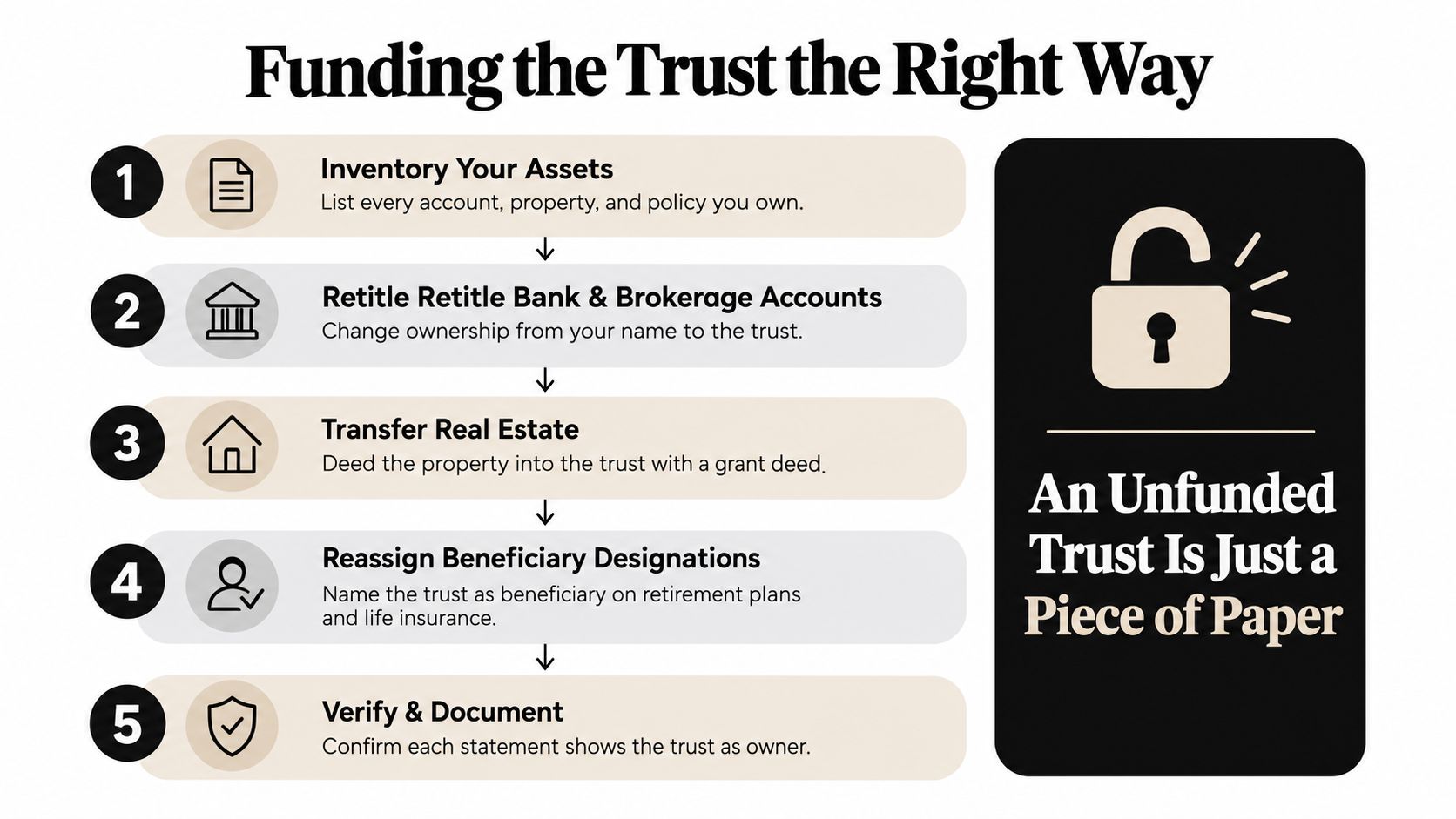
An unfunded trust is an empty container. That's not a slogan, it's the whole case. Signing the document doesn't transfer a single house, bank account, or brokerage account into the trust, because title only changes when you complete the ownership paperwork.
Real estate comes first
For a primary residence or other real estate, you usually need a new deed that names the trustee of the living trust, then you record that deed under your state's rules. DIY mistakes get expensive fast here. A lot of people assume they can just “mention” the house in the trust document and call it done. They can't.
Check for conflicts with transfer-on-death deeds, and don't ignore homestead rules or mortgage paperwork. Real estate is the asset most likely to expose an unfunded trust, especially when the property sits in a different state from the rest of the estate.
Financial accounts need institution paperwork, not guesswork
For bank and brokerage accounts, use the institution's own forms to retitle the account. Don't move the money around just to make the paperwork look cleaner. You want the account registration to show the trust, or the trustee of the trust, as owner. Then confirm the statements reflect the new title, because that's what proves the transfer happened.
Some assets go in by beneficiary form instead of retitling
Retirement accounts and life insurance usually belong in a different bucket. Some assets are better handled by beneficiary designation rather than by changing title. That's why people get into trouble when they name a trust as the retirement account beneficiary without understanding the tax and administration issues. The same caution applies to closely held business interests, which may require coordination with operating agreements, partnership documents, or shareholder restrictions.
Use the following working standard: fully funded means every asset that should be inside the trust has been legally retitled or assigned into it, every asset that should stay outside has a deliberate reason for doing so, and every beneficiary designation matches the plan. New accounts and new purchases need the same treatment, or the trust starts leaking assets back into probate.
Maintaining the Trust After It Is Signed
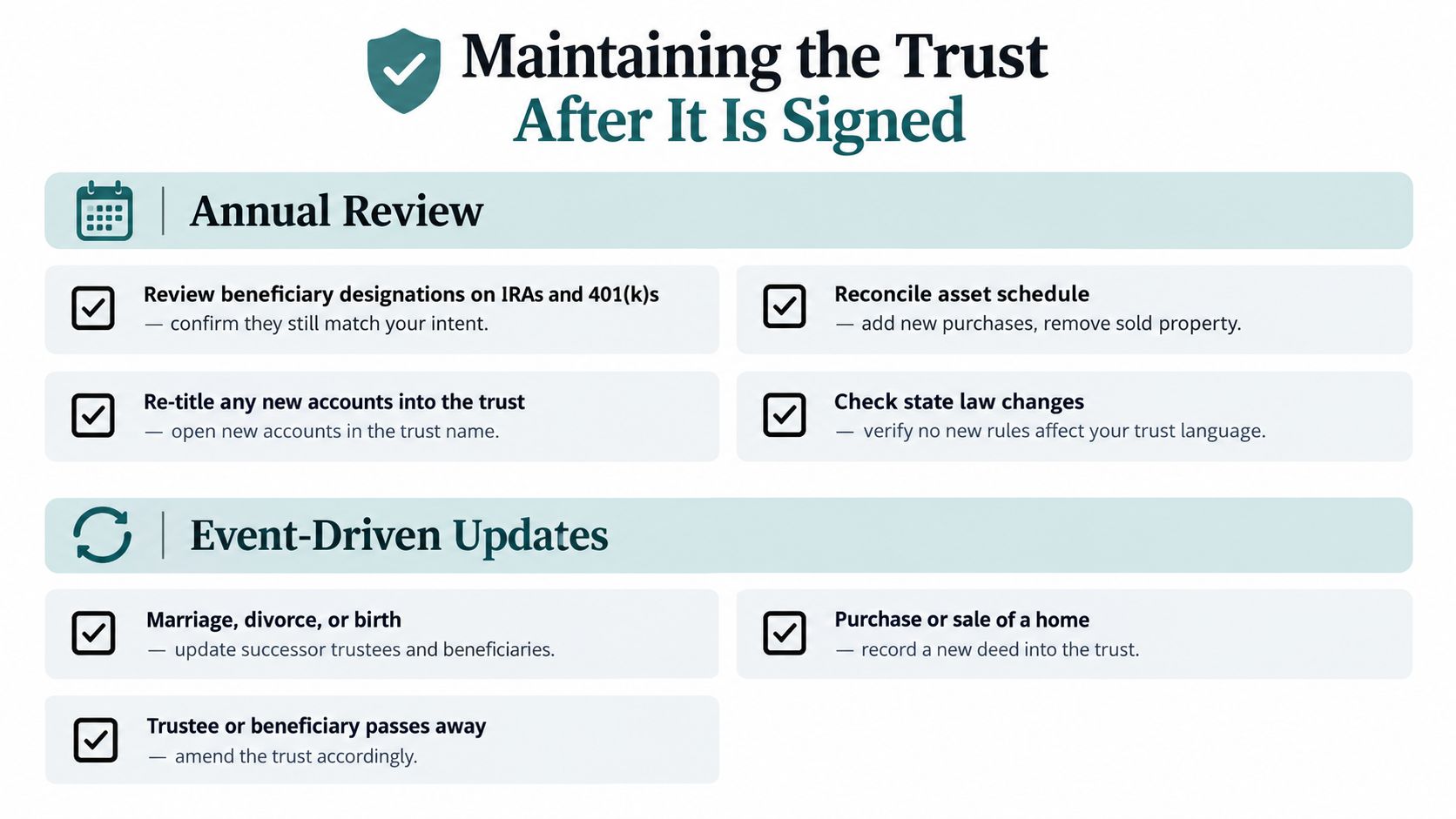
A trust that worked last year can fail this year if nobody touches the paperwork. I've seen that happen after a home sale, after a new account gets opened in one spouse's name, and after a trustee dies. The trust still exists, but the assets have drifted away from it.
Run the same review every year
Set one annual reminder and keep it boring. Review beneficiary designations, reconcile the asset list against actual statements, confirm trustee information, and check whether any new accounts or policies got left out. That simple habit catches most drift before it turns into a probate problem.
For a practical budgeting mindset, it also helps to compare the trust upkeep question with the cost of a legal consultation. If the issue starts getting complicated, the fee question is usually the wrong place to save money, and a quick overview of legal consultation fee basics can help frame the decision.
Treat life events as update triggers
Marriage, divorce, a birth, a death, the sale of a house, or the addition of a business interest should all trigger a review. Don't wait for a major estate-planning crisis. Update the trust when the family or the assets change, because a trust that no longer matches reality is worse than no plan at all.
If the asset list on paper doesn't match the statements in your drawer, the trust is already drifting.
When changes are small, a simple amendment may be enough. When the structure gets stale or the family situation has changed a lot, a full restatement is cleaner. The point is not to admire the old document. The point is to keep the trust aligned with the actual estate.
Common DIY Mistakes and How to Catch Them Early
The most expensive mistake is the simplest one. Someone downloads a form, signs it, and never retitles anything. At that point, they have a signed trust and a probate estate, which is exactly the outcome they were trying to avoid.
Here's the pattern I see over and over:
- The house is still in the individual's name. The deed never got recorded into the trust, so the residence can still land in probate.
- The successor trustee can't really serve. The person named is unavailable, ineffective, or trapped by family tension, so administration slows down immediately.
- The out-of-state vacation property was forgotten. A separate state can still require its own probate process if the deed never changed.
- The trust and the pour-over will disagree. The documents point in different directions, and the estate plan loses clarity when it's needed most.
- The bank account opened after signing. New assets often stay outside the trust unless someone deliberately funds them.
The administrative errors are just as annoying. Missing notarization, missing witnesses where they're required, or sloppy trustee conduct can all turn a supposedly clean plan into a fight. A trustee who benefits personally also needs to respect fiduciary limits, because self-dealing invites problems fast.
A tax mistake can sneak in too. If you open accounts and never set up the trust properly on the institution side, the paperwork gets messy and the plan becomes harder to administer. That's one reason I tell people to pull the latest statements and look at the owner line. If it doesn't read as the trustee of the trust, the asset probably isn't where you think it is.
| Mistake | Warning Sign | Fix |
|---|---|---|
| Trust never funded | Statements still show your personal name | Retitle the asset into the trust |
| Wrong successor trustee | Person can't act or isn't a good fit | Amend the trust and name a workable trustee |
| Out-of-state property left out | Separate deed never changed | Record a new deed in the trust's name |
| Conflicting documents | Pour-over will doesn't match trust terms | Reconcile the documents together |
| Outdated account titles | New accounts were opened after signing | Update titles and beneficiary forms |
When DIY Stops Making Sense
DIY works best when the estate is simple, the family line is straightforward, and the assets are easy to title. Once the facts get messier, the savings shrink fast. That's when professional review stops being a luxury and starts being the cheaper path.
The situations that usually need help
Blended families are a classic problem, because one bad distribution clause can create a permanent fight between a surviving spouse and children from a prior relationship. Real estate in more than one state is another bad fit for pure DIY, because each jurisdiction can bring its own transfer headaches. Business interests also deserve caution, especially when the trust has to mesh with an LLC agreement or partnership restrictions.
Special-needs planning, creditor concerns, and Medicaid-related issues are not places to improvise. Those situations can collide with eligibility rules, transfer restrictions, and family expectations all at once. If the trust has tax sensitivity or the estate could become large enough to raise tax questions, I'd stop treating software as the main answer.
The consumer preference data points in the same direction. A 2026 LegalShield survey found 70% of Americans want an attorney involved in wills and estate planning, while only 16% prefer a DIY online solution LegalShield newsroom. That doesn't mean everyone needs a full-service attorney, but it does mean people already understand that some estates are too important to wing.
If you want a middle path, use attorney review instead of full representation. That's usually where the value sits, a completed draft gets checked by someone who knows the traps, and you keep the cost lower than building the whole plan from scratch. If you need help deciding what kind of lawyer fits the problem, start with what kind of lawyer you need.
A small fee for review is cheap. A trust that gets kicked back into court is not.
Your DIY Living Trust Checklist
If you want to do this yourself, do it in order. Don't start with software and hope the rest sorts itself out.
This week's checklist
- Inventory first. List every asset, decide who the successor trustee is, and write down who benefits.
- Draft and sign second. Use a reputable state-specific template, sign it properly, and store the original in a secure place.
- Fund immediately. Retitle the house, update bank and brokerage registrations, and handle any business interest that belongs in the trust.
- Review within 30 days. Check every account statement and confirm the owner line matches the trust plan.
- Set a yearly reminder. Reconcile the trust asset list against actual holdings, not the other way around.
Some situations should trigger a lawyer referral instead of more DIY time. Out-of-state property, blended-family distributions, business coordination, or any taxable estate concern are all reasons to slow down and get review. Those are the cases where the documents are easy to get wrong and expensive to unwind.
The funding step is the one people skip, and it's the one I would never skip. If you do the paperwork but leave the assets behind, you didn't finish the job.
If you want a faster way to find the right legal help for a trust issue that's more complex than a basic template, HeyAtty can help you compare vetted attorneys, see pricing and availability, and narrow the field without wasting time. For a DIY living trust that needs a careful second look, visit HeyAtty and start with a lawyer who's handled the kind of estate you're trying to protect.