
7 Employment Visa Lawyer Resources to Compare
Compare 7 employment visa lawyer resources by H-1B, L-1, and PERM needs, pricing cues, availability, case experience, and practical fit.

You just changed jobs, got pulled into a transfer conversation, or learned your employer needs to sponsor you, and the question is suddenly urgent. The strongest employment visa lawyer search starts with the exact scenario, the visa category, the deadline pressure, the consultation price, availability, and whether the attorney has handled a case like yours before. Some resources help you understand the rulebook, some help you estimate the issue, and others help you compare counsel by real fit instead of a generic immigration label. The seven resources below serve different jobs, and the wrong one can waste time when the filing clock is already moving.
Table of Contents
- 1. Online Legal Marketplace
- 2. Specialized Visa Consultation Service
- 3. Government Immigration Office
- 4. Pro Bono and Legal Aid Clinic
- 5. Online Legal Marketplace
- 6. Fee and Eligibility Estimator Tool
- 7. Immigration Law Firm
- Employment Visa Lawyer: 7-Resource Comparison
- Choose Counsel by Scenario and Fit
1. Online Legal Marketplace
A good attorney directory saves time when you already know the rough problem but don't yet know who's equipped to handle it. The best versions don't just list names, they let you compare case experience, pricing, and availability side by side, which matters when you're trying to find someone who has worked on an H-1B transfer after a layoff or an employer-sponsored filing with tight timing.
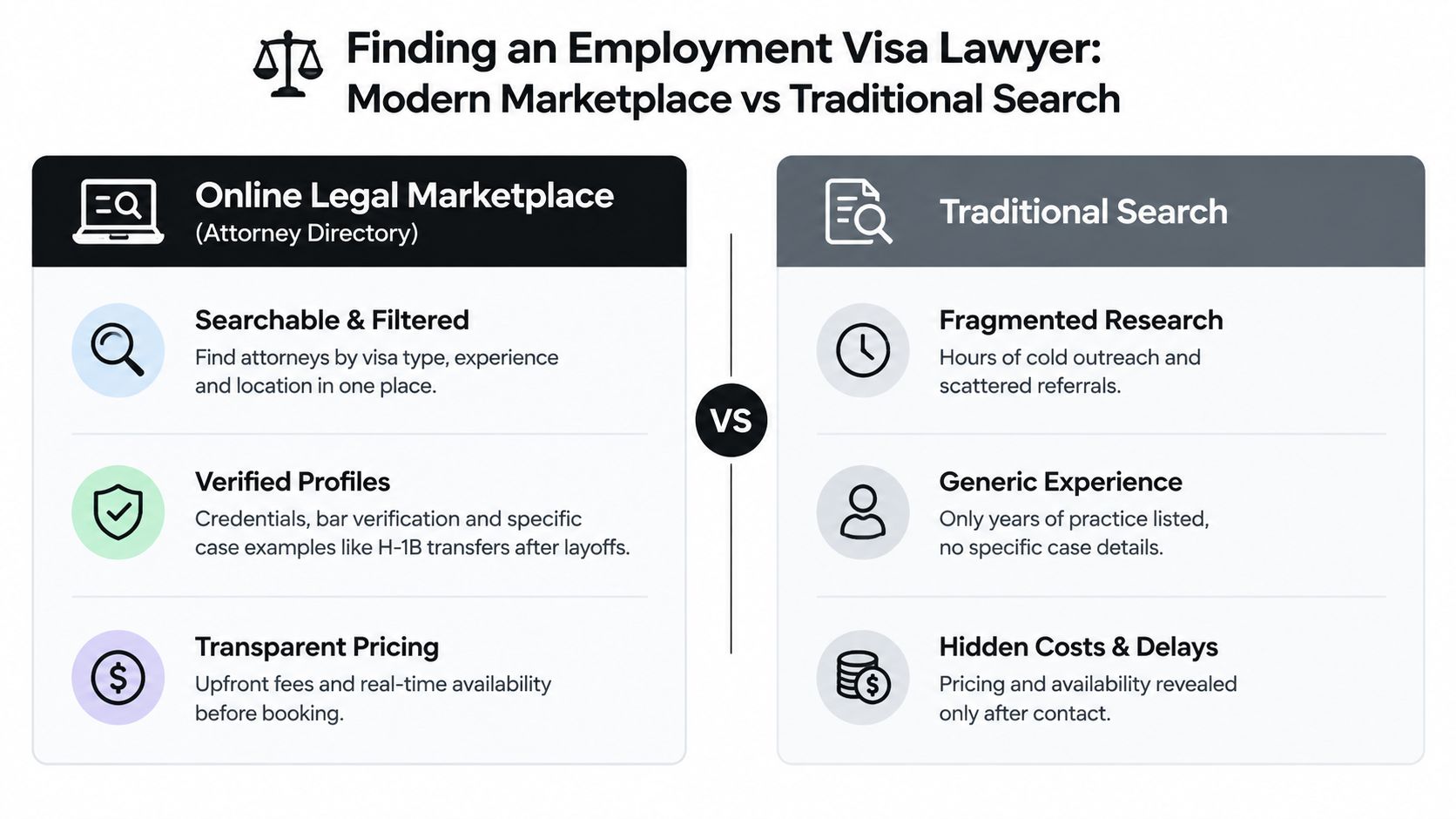
A structured marketplace is especially useful when attorney bios are too broad. One attorney may say “immigration,” but that doesn't tell you whether they've handled H-1B transfer timing, employer documentation issues, or cap strategy. A more useful profile shows specific past scenarios, which is exactly why a structured case-experience dataset can be so valuable for matching a user to the right person instead of the nearest available lawyer.
Practical rule: look for profiles that show recent, specific employment visa work, not just years in practice. General immigration credentials don't tell you whether the lawyer has seen the same transfer, renewal, or employer-side document problem you're dealing with.
If you're comparing directories, ask whether the platform makes it easy to book quickly, whether the lawyer's license is verified, and whether the attorney's case examples are recent enough to reflect current adjudication reality. A marketplace like HeyAtty's guide on questions to ask before hiring a lawyer is useful because it pushes the search away from vague credentials and toward the questions that affect fit.
What works here
- Specific case examples: five or more concrete scenarios tell you far more than “10 years of immigration experience.”
- Upfront consultation details: availability and pricing reduce back-and-forth when time is tight.
- Scenario-based intake: “H-1B transfer after layoff” is far more useful than “Need visa help.”
What doesn't
- Generic immigration categories: they blur together lawyers who do very different work.
- Old bios: stale profiles can hide whether someone is still actively handling your visa type.
- Hidden pricing: if you can't see the cost until late in the process, comparison gets harder.
2. Specialized Visa Consultation Service
A specialist is the right place to go when the case already has friction. That might be a transfer after termination, a degree issue, a change of employer, or a situation where the employer needs a clear filing plan before HR moves forward. The value here isn't just legal knowledge, it's the ability to decide quickly what the strongest route is and what evidence will matter most.
Specialized firms and consultants tend to be best when the question is not “Do I qualify for immigration help?” but “What's the safest move right now?” That's the difference between a broad adviser and someone who lives inside H-1B, L-1, O-1, or employment-based green card work every day. In practice, that specialization matters because employment visa cases are document-heavy, deadline-driven, and often tied to labor-market rules and employer filings, as reflected in the broader legal market data for immigration lawyers and attorneys (U.S. immigration lawyers and attorneys market overview).
You can often see the difference in how they speak. A strong specialist doesn't just say “we can help,” they ask about transfer timing, payroll start dates, cap status, previous filings, and whether the employer can support the paperwork without delay.
A specialist should be able to explain the trade-offs in plain English. If the explanation stays vague, the firm may know immigration law broadly but not your exact visa lane.
For a founder exploring a self-petition path, or an H-1B worker trying to move after a layoff, the right question is whether the firm has handled the same pattern before. Ask for recent examples in the same category, how they handle RFEs, and whether they'll coordinate with HR or recruiting teams when the case depends on employer-side documentation.
3. Government Immigration Office
Official government sources are the starting point when you want the actual rule, not someone's summary of it. USCIS and the State Department are where you verify forms, filing instructions, and category basics before you pay for advice. That matters because employment visa law changes through policy milestones and agency guidance, not just through blog posts, and the modern H-1B framework itself was built through the Immigration Act of 1990, the American Competitiveness and Workforce Improvement Act of 1998, and the American Competitiveness in the Twenty-First Century Act of 2000 (USCIS historical immigration and citizenship data).
For H-1B and employment-based green card planning, official sources are where you check the baseline before strategy gets layered on top. The practical use is simple, you read the instructions, confirm whether you're dealing with a cap-subject or cap-exempt case, and then bring informed questions to counsel. If you're tracking priority dates or visa timing, the State Department's visa materials help you confirm what is moving and what isn't, while USCIS forms tell you what the government wants in the packet.
A lawyer still matters because official sites don't tell you which filing route is smartest when more than one path is possible. They also won't translate a messy fact pattern into a risk-managed strategy. Still, they are the cleanest place to confirm the legal floor before you start comparing law firms.
Use government pages for requirements, not for strategy. If the question is “what is the rule,” official sources help. If the question is “what should my employer file first,” you usually need counsel.
A practical workflow is to read the forms first, mark the missing documents, and then ask an attorney how those documents should be framed. That saves time and makes the consultation more productive.
4. Pro Bono and Legal Aid Clinic
A pro bono clinic is worth pursuing when cost is the main barrier and your situation fits the clinic's scope. These services exist to widen access, but they usually have limited capacity and narrower intake rules than a paid attorney. If you qualify, they can still be a real path to help, especially for people who need basic filing support or a low-cost review before they can afford private representation.
The best use case is not a high-urgency employer transfer with a hard deadline, unless the clinic explicitly handles employment visas and can take the file quickly. Many clinics focus on family, asylum, or general immigration support, so specialization matters even more here. If you need help with an H-1B employment issue, confirm that the clinic accepts employment-based cases before you spend time applying.
Several legal aid organizations and law school clinics operate in this space, including programs associated with RAICES, the AILA Pro Bono Directory, and university clinics such as Georgetown, UC Davis, and UCLA. Those names matter because they show the range of legal aid models, from nonprofit field work to academic clinics and referral directories.
If the clinic can't tell you whether it handles employment visas, it probably isn't the right fit for a sponsorship problem.
Use pro bono options when:
- You meet income and intake rules: many programs screen for eligibility before they ever review the case.
- Your issue is clearly within scope: some clinics only take certain visa categories.
- Your timeline is flexible: waiting lists can be long, so this is rarely the fastest route.
- You need partial help: document preparation or a consultation can still be useful if full representation isn't available.
The downside is obvious, capacity. If your employer needs immediate direction, pro bono help may be too slow. Still, for people who qualify and can wait, it's one of the few ways to get real immigration support without standard private-firm pricing.
5. Online Legal Marketplace
Generalist legal marketplaces are a mixed bag for employment visa work. They're useful when you want a broad first pass, but they're usually weaker than specialized platforms at showing whether a lawyer knows H-1B, L-1, PERM, or transition cases. That's the central trade-off, breadth is convenient, but depth is thinner.
These sites can still help if you know how to search them. Filter by immigration, then narrow further to employment visa or the specific category you need. If the platform doesn't let you do that cleanly, you'll spend too much time reading bios that sound similar but hide real differences in case experience.
A broad marketplace is best used as a screening tool, not as the final decision engine. Read reviews with care, especially when they mention the exact visa category, response time, and whether the lawyer explained employer-side steps clearly. That last part matters, because recent coverage shows tighter adjudications, more RFEs, and stronger I-9 and worksite scrutiny, and many public resources still stop at basic eligibility instead of answering who owns the case day to day (employment visa trends under stricter review).
Use generalist platforms for
- Initial comparison: they can quickly surface multiple attorneys.
- Basic price checking: some let you see consultation pricing before you commit.
- Early fit testing: messages and brief discovery calls help you judge responsiveness.
Be cautious when
- The profile is vague: “immigration attorney” is not enough for a transfer or cap case.
- Reviews are generic: praise without category detail doesn't tell you much.
- The attorney's site and marketplace bio conflict: inconsistency is a warning sign.
If your case is routine, a broad marketplace may be enough to find someone competent. If your case is complicated or time-sensitive, it's often better to use the marketplace to identify a specialist, then move to a direct consult.
6. Fee and Eligibility Estimator Tool
An estimator is the fastest way to stop guessing. Before you talk to counsel, a good tool can help you understand whether you're even in the right category, what the main questions will be, and what documents you should gather. That makes the eventual consultation more useful, because you're not spending paid time on basics.
These tools are especially helpful when you're comparing options and don't yet know whether the issue is a simple filing or something that needs a lawyer's attention right away. A lightweight guided intake flow can route you to the right practice area, which is the whole point of using an estimator before booking. It's also a good way to prepare better questions for your first call, since a clear intake often exposes missing facts early.
Use the estimate as a starting point, not a final decision. Hidden complications show up all the time in employment visa work, especially when the employer, job title, worksite, wage, or timing doesn't fit a clean template. If the estimator is built into a legal platform, make sure it's current and doesn't rely on stale rules or oversimplified category logic.
A practical example is a worker who thinks they need one filing but learns through the intake flow that a transfer, renewal, or alternate path may fit better. Another is a small business owner who wants to understand likely legal spend before scheduling a consultation. In both cases, the estimator doesn't replace an attorney, but it can prevent a bad first call.
You can see this logic reflected in HeyAtty's consultation fee guidance, where the value is not just the price itself, but whether the fee matches the complexity of the first conversation.

7. Immigration Law Firm
A full-service immigration law firm makes sense when your situation has more than one moving part. That could mean an employment visa plus a green card path, a pending appeal, a transfer paired with family questions, or a case that needs ongoing coordination with the employer and other counsel. These firms are built for continuity, which helps when a file won't be solved in one call.
The trade-off is cost and complexity. A large or full-service firm may offer broader coverage, but not every case needs that layer. A straightforward H-1B transfer may be better served by a specialist first, especially if you mainly need focused strategy and fast execution. A more complex package, on the other hand, may justify a firm that can move from work visa counseling into broader immigration planning without starting over.
The lawyer's actual scenario experience matters more than the firm brand. A candidate attorney might be excellent on paper, but if they haven't handled PERM timing, L-1 transitions, or employment-based filings tied to broader immigration strategy, you still may not have the right fit. The difference is practical, not theoretical.
Ask who will actually touch the file. In a larger firm, the partner you meet may not be the one drafting the documents, and continuity can matter more than the name on the door.
If you're comparing firms, ask about billing structure, who handles the day-to-day work, and whether the firm has specific experience in the exact path you're pursuing. For broader legal help, HeyAtty's guide on what kind of lawyer you need is a useful way to sort the fit question before you book.

Employment Visa Lawyer: 7-Resource Comparison
| Service | Key features (✨) | Trust & quality (★) | Cost & value (💰) | Target audience (👥) | Best for / USP (🏆) |
|---|---|---|---|---|---|
| Online Legal Marketplace (Attorney Directory) | ✨ Searchable directory, vetted profiles, availability & booking, guided intake, community Q&A | ★★★★☆ Verified credentials & reviews; profile depth varies | 💰 Mid, transparent consult fees; platform booking/commission | 👥 Consumers & SMBs seeking fast comparisons | 🏆 Structured case-experience matching; fast "right-lawyer" matches |
| Specialized Visa Consultation Service | ✨ Deep visa-category expertise, strategy sessions, USCIS policy tracking | ★★★★★ High specialization & up‑to‑date practice | 💰 High, premium hourly/retainer rates | 👥 Applicants with complex employment-visa needs (founders, layoffs) | 🏆 Niche expertise for high-risk/complex visa scenarios |
| Government Immigration Office (USCIS / DOS) | ✨ Official forms, policy updates, visa bulletin, case tracking | ★★★★☆ Authoritative source; not legal advice | 💰 Free, official guidance and forms | 👥 Self-researchers and anyone needing official info | 🏆 Definitive, up‑to‑date rules, forms, and status tracking |
| Pro Bono / Legal Aid Clinic | ✨ Free/sliding-scale representation, community outreach, hearings support | ★★★★ Dedicated advocates; capacity-limited | 💰 Free/low, income-restricted services | 👥 Low-income & high-need individuals | 🏆 Full representation for eligible clients; strong community/cultural competency |
| Online Legal Marketplace (Generalist Directory) | ✨ Broad attorney network, reviews, messaging, flat/ hourly options | ★★☆☆ Variable; many generalist profiles | 💰 Low–Mid, often lower average fees; mixed value | 👥 Users with broad/ multiple legal needs | 🏆 Wide selection & volume; useful for initial searches |
| Fee & Eligibility Estimator Tool | ✨ Interactive questionnaire, fee/timeline estimates, rule‑based routing | ★★☆☆ Estimates only; not legal advice | 💰 Free/low, quick ballpark numbers | 👥 Users wanting quick self-assessment before consulting | 🏆 Fast cost & eligibility snapshot to prepare consultations |
| Immigration Law Firm (Full-Service) | ✨ End‑to‑end services, appeals/litigation, employer coordination, case management | ★★★★★ Established track record & resources | 💰 High, $5k–$20k+ per case; retainer common | 👥 Complex cases, corporations, high‑stakes matters | 🏆 Comprehensive resources for complex/multi‑issue immigration work |
Choose Counsel by Scenario and Fit
The most efficient path starts with the official source, not the lawyer search. Confirm the baseline requirements with USCIS or the State Department, use an estimator to clarify the issue, then decide whether legal aid, a specialist, or a full-service firm fits the level of complexity. That sequence keeps you from paying for strategy before you understand the category.
For most employment visa problems, the question is not “Do they do immigration?” It's whether they've handled H-1B, L-1, PERM, or transition work that looks like yours. You should compare consultation pricing, availability, communication expectations, and how clearly the attorney explains employer-side documentation. A lawyer who can't tell you who owns the case day to day, or who can't walk through the likely evidence, is not the right pick for a time-sensitive filing.
The market itself supports that specialization. Lawyers are a large profession, with a median annual wage of $159,670 in May 2025, projected 5% growth from 2025 to 2035, and about 28,700 openings each year on average over that decade (U.S. Bureau of Labor Statistics lawyer outlook). Immigration law is a distinct slice of that market, and the numbers show a mature, specialized field where experience with a specific scenario matters more than a generic title.
You can also see why fit matters from client satisfaction data. In New Zealand, 86% of visa applicants who used a licensed immigration adviser were satisfied overall, 54% were very satisfied, and 91% would recommend the adviser, with work-visa applicants reporting 90% satisfaction (visa applicant survey results). Communication quality clearly shapes the experience, and that's just as true in U.S. employment visa cases where deadlines, employer coordination, and status risk all collide.
HeyAtty is a practical place to start if you want to compare immigration attorneys by verified profiles, case experience, pricing, and availability before you book. It's not a substitute for legal advice, but it can help you get to the right first conversation faster and with better questions.
If you're sorting out an employment visa issue right now, use HeyAtty to compare vetted immigration professionals by experience, pricing, and availability in one place. You can narrow the search to the scenario you're facing, then book a consultation with someone who's handled similar employment visa work before.