
Green Card Process for EB2: A Practical 2026 Roadmap
A practical 2026 roadmap to the green card process for EB2, covering PERM, I-140, NIW, priority dates, and adjustment of status or consular processing.

You've got a strong job offer, a degree that took years to earn, and a green card goal that still feels maddeningly abstract. One attorney says PERM first, another says NIW might fit, and the Visa Bulletin makes the whole thing look like a moving target. The green card process for EB2 is easier to understand once you stop treating it like one line on a checklist and start treating it like two different paths that meet at the same finish line.
Table of Contents
- The Two Tracks Behind Every EB-2 Green Card
- Who Qualifies for EB-2 Classification
- The National Interest Waiver Option Explained
- How the PERM Labor Certification Stage Works
- Reading the Visa Bulletin and Priority Date
- Adjustment of Status Versus Consular Processing
- Common Pitfalls and How to Avoid Them
The Two Tracks Behind Every EB-2 Green Card
Rina is a senior data engineer in the United States. Her employer wants to keep her, so her path usually starts with a labor certification and an immigrant petition. Arjun is a cancer researcher building a case around his own work, so his route may be a National Interest Waiver, where he can self-petition if he proves the work itself serves the national interest.
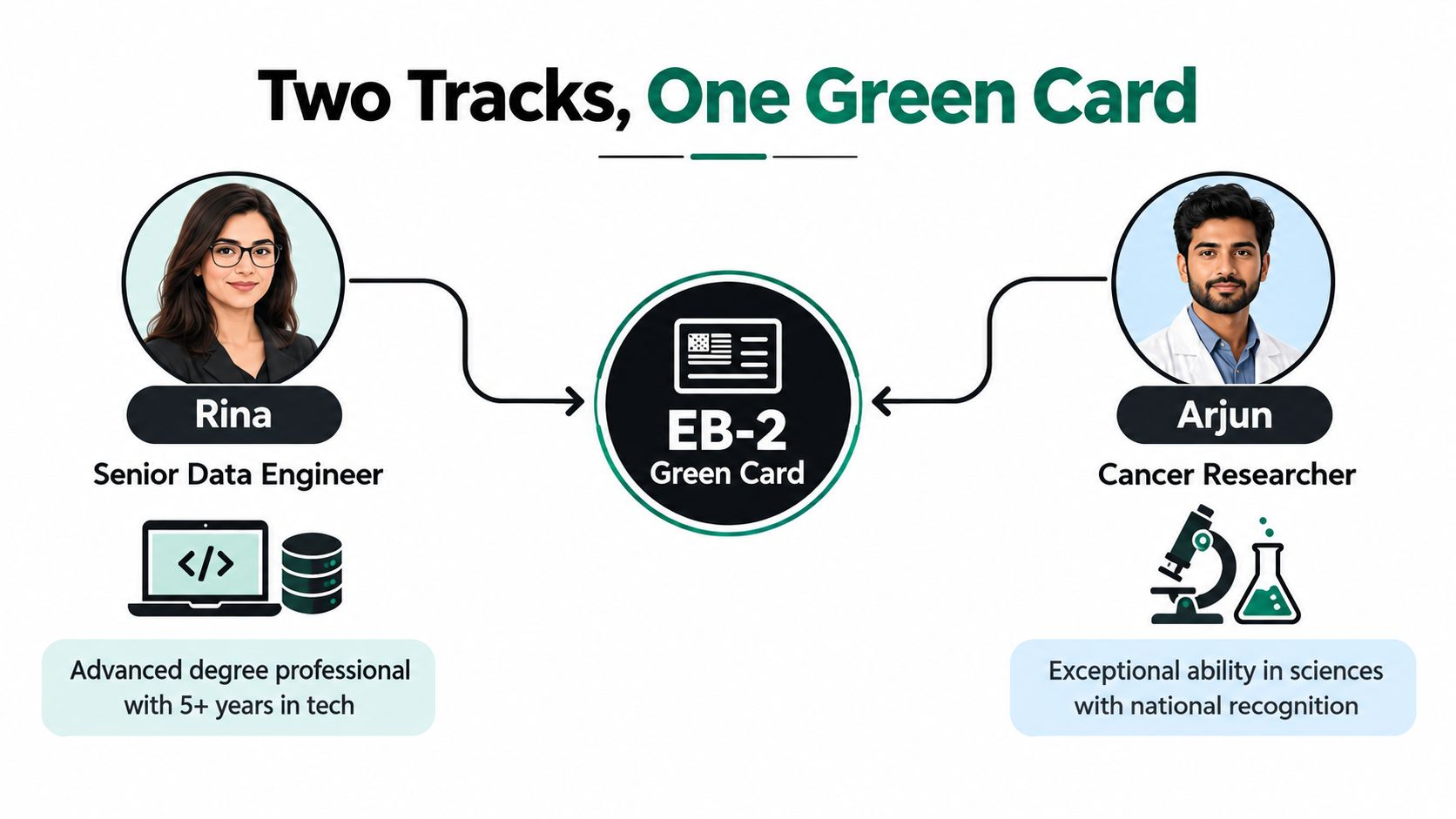
Two routes, same category
EB-2 is a preference category for professionals with advanced degrees and people with exceptional ability, but that label hides the fork in the road. In a standard employer-sponsored case, the employer drives the process. In an NIW case, the person seeking the green card may drive it themselves if they can clear the waiver standard.
The agencies are split too. The Department of Labor handles the labor certification stage for most employer-sponsored cases, USCIS handles the immigrant petition and, later, adjustment of status, and the Department of State controls visa availability through the monthly Visa Bulletin. That means no single filing tells the whole story.
Practical rule: If your case depends on a job offer, think employer-sponsored EB-2. If your case depends on the value of your own proposed work, think NIW.
That fork matters early. People often ask whether they “qualify for EB-2” as if the answer is yes or no. A better first question is whether they qualify for EB-2 through an employer or through a waiver-based self-petition. Those are different evidentiary stories, different filing sequences, and different pressure points.
Who Qualifies for EB-2 Classification
EB-2 has two membership lanes. One covers members of the professions holding advanced degrees. The other covers people with exceptional ability in the sciences, arts, or business. That distinction sounds technical, but it changes how you build the file and what kind of evidence matters most.
Advanced degree cases
For an advanced degree case, the usual question is whether the role and the person match the standard. A U.S. master's degree works, and so can a foreign equivalent. In some cases, a bachelor's degree plus progressive experience can be treated as the equivalent of an advanced degree if the job and the evidence line up.
That is why job description precision matters. If the employer files one version of the role for recruitment and a different version for the immigrant petition, the inconsistency can become a problem later. USCIS expects the petition to reflect the actual job, not an aspirational title.
Exceptional ability cases
Exceptional ability is different. The person is not just educated, they stand out in a meaningful way in their field. The evidence often includes a mix of credentials, recognition, experience, and professional documentation that shows the applicant is well above the ordinary level of competence.
People often get stuck. A strong résumé does not automatically prove category fit. The file needs to show the applicant belongs in EB-2, not just that they are smart or successful.
Common mistake: Treating EB-2 like a reward for career prestige. It's a classification test first, and a green card process second.
If you are doing a first-pass self-check, ask three questions. Do I have an advanced degree or its equivalent? Do I have an employer ready to sponsor me, or do I need to explore a waiver path? Does my evidence tell a consistent story from qualifications to the final immigration category? Those answers usually tell you more than a title ever will.
The National Interest Waiver Option Explained
The National Interest Waiver is not a shortcut around EB-2, it's a different route through the same category. The traditional path asks whether the employer and the job satisfy the labor market process. The NIW path asks whether the applicant's proposed endeavor itself is important enough that the United States should waive the job offer and labor certification requirements.
What the waiver standard really asks
USCIS's guidance centers on a three-part framework. The proposed endeavor must have substantial merit and national importance. The person must be well positioned to advance the endeavor. And, on balance, the United States must benefit from waiving the job offer requirement.
That last point is where many cases stumble. The evidence has to connect the person's future work to a concrete benefit, not just describe a strong résumé. A publication record, prior implementation success, funding, customers, patents, or independent validation can all matter, but only if they support the specific future endeavor.
Why the résumé alone is not enough
A scientist with an excellent CV can still have a weak NIW case if the proposed work is vague. A founder with limited traditional credentials can still have a persuasive NIW case if the business plan, market traction, and evidence of execution make the endeavor real. The file has to answer, in plain English, why this work matters nationally and why this person is the one positioned to do it.
The 2025 USCIS guidance puts more emphasis on the proposed endeavor, business plans, recommendation letters, and evidence of being well positioned, which makes the narrative structure of the petition matter even more. The strongest NIW files do not read like a biography. They read like a proof file for a future project.
The question isn't whether the applicant has done impressive things already. The question is whether those accomplishments make the next endeavor credible, specific, and nationally relevant.
How the PERM Labor Certification Stage Works
For most employer-sponsored EB-2 cases, PERM is the gate before the immigration petition. It is not the green card application itself. It is the labor-market test that shows the employer tried to recruit U.S. workers for the position and followed the Department of Labor's rules.
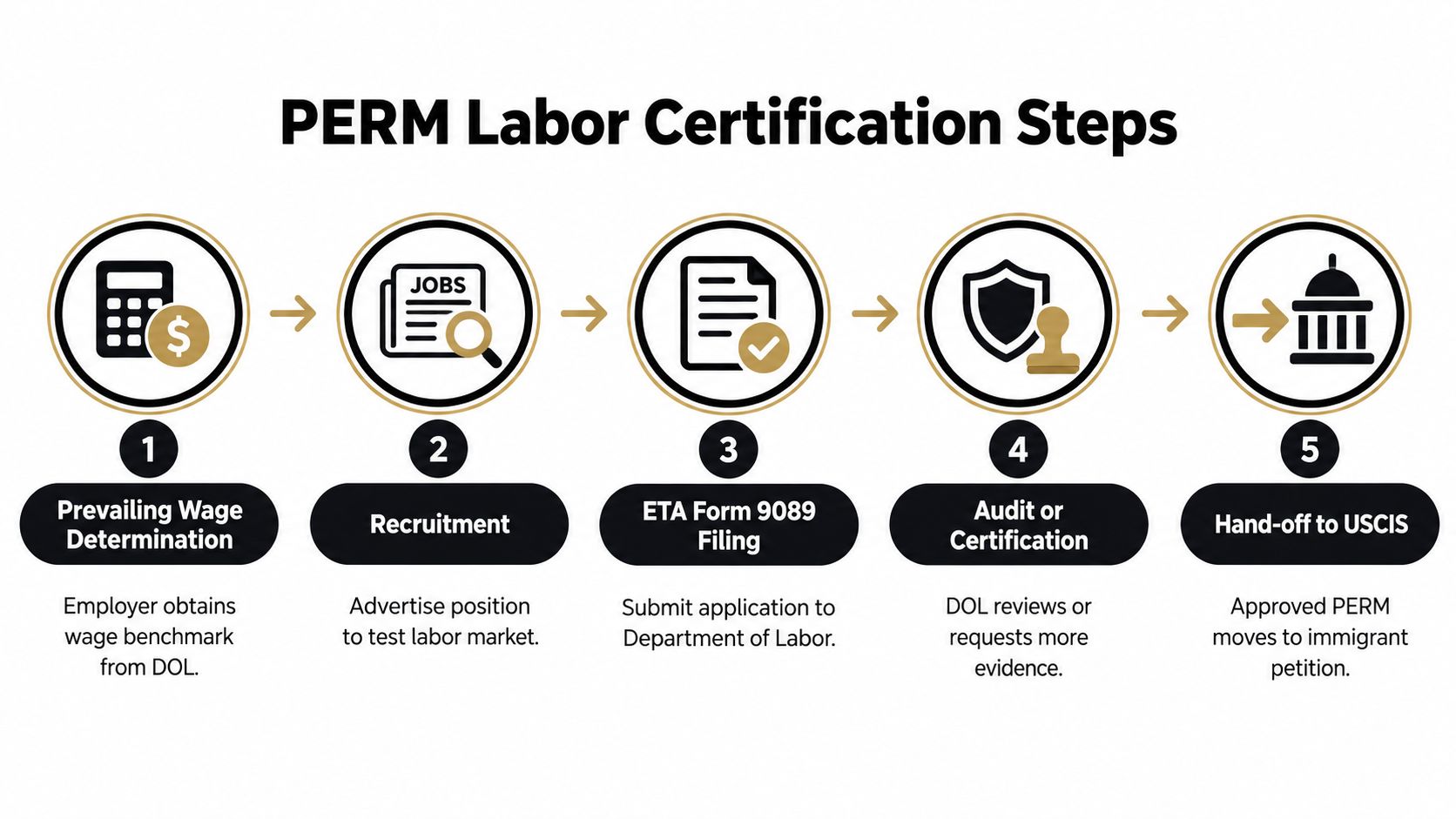
The chain of events
The employer usually starts with a prevailing wage request. Then it runs recruitment. After that, it files ETA Form 9089 with the Department of Labor. If the case is certified, the employer can use that certification to support the later Form I-140 filing with USCIS.
The labor certification filing date is the worker's priority date. That date becomes the place-holder in line for visa-number purposes. It is one of the most important dates in the entire case because it can control when the person is allowed to move to the next stage.
The deadline that quietly breaks cases
A certified labor certification has to be filed with USCIS within 180 days, or it expires and cannot support the immigrant petition, according to the Department of Labor's permanent labor program rules (DOL permanent labor certification overview). That deadline catches people off guard because the case can feel “done” once PERM is approved. It isn't done. It still has to stay alive long enough to support the I-140.
Practical rule: Keep the recruitment file, prevailing-wage record, and final job description aligned from start to finish. If the documents drift, the case can drift with them.
This is also where employer coordination matters. HR, the company's lawyers, and the beneficiary all need the same facts. A changed title, a rewritten description, or a missed deadline can force rework and lose time that's hard to recover later.
If you need a deeper look at how employer-side immigration filings get coordinated, an employment-based immigration attorney can help you map the sequence without guessing, and this employment visa lawyer resource is a useful starting point for understanding how those cases are usually organized.
Reading the Visa Bulletin and Priority Date
A priority date is more than a file number. It is the place marker that tells you where an EB-2 case stands in line, and the Visa Bulletin shows whether that line has moved far enough for the next step.
Why the bulletin matters
The Department of State publishes the Visa Bulletin each month with two different charts: Dates for Filing and Final Action Dates. They do not do the same job. The filing chart shows when some applicants may submit paperwork. The final-action chart shows when a visa can be issued or a green card can be approved.
That is why an approved I-140 does not end the case. The petition can be approved while the priority date still sits behind the cutoff on the relevant chart.
October 2026 as a snapshot
The October 2026 Visa Bulletin shows how strongly country of chargeability can change the wait. For EB-2, the cutoff date was March 15, 2026 for the general category, including Mexico and the Philippines, January 1, 2023 for mainland China, and January 15, 2015 for India (October 2026 Visa Bulletin). Two applicants can be equally qualified and still face very different timelines because their countries fall into different queues.
The labor-certification stage can add its own delay before the priority date even starts to matter. Department of Labor PERM disclosure data showed 60,096 applications processed in the first two quarters of fiscal year 2026, including 55,218 certified, 1,925 denied, and 2,953 withdrawn, with 147,884 applications still pending as of March 31, 2026. The same data reported an average of 336 calendar days for analyst review in August 2026 (Department of Labor PERM disclosure data). That is why the green card process for EB2 does not move on one clock.
| EB-2 Visa Bulletin Cutoffs (October 2026) | EB-2 Priority Date Cutoff |
|---|---|
| General, Mexico, Philippines | March 15, 2026 |
| China | January 1, 2023 |
| India | January 15, 2015 |
For planning, the key question is whether the priority date is current under the right chart, not just whether the I-140 has been approved. Filing eligibility and final approval follow different gates, and EB-2 timing depends on both.
Adjustment of Status Versus Consular Processing
Once a visa number is available, the case still needs a final filing path. For an EB-2 applicant, the two tracks are adjustment of status inside the United States and consular processing abroad. Both can end in the same green card, but they work through different offices and different rules.
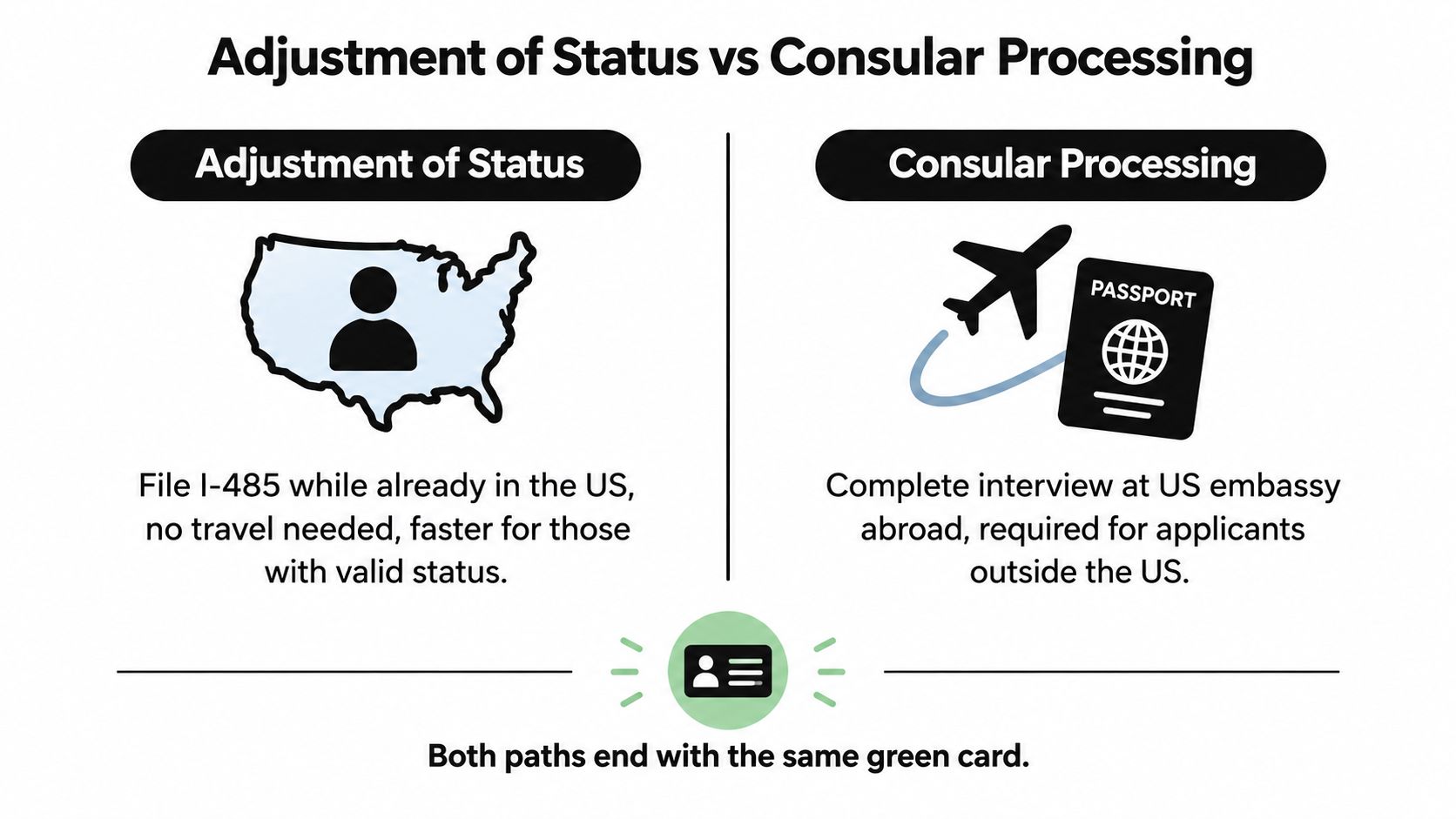
Adjustment of status inside the United States
Adjustment of status is the inside-the-U.S. route. USCIS says the applicant must have been inspected and admitted or inspected and paroled, must be physically present in the United States when filing, and must be eligible to receive an immigrant visa (USCIS employment-based green card eligibility).
For someone already working in the United States, that often makes the case easier to manage day to day. The person can stay in the country while USCIS processes the file, which helps when school schedules, job continuity, or travel would make an overseas interview harder to handle. It also affects work authorization planning, so people often coordinate green card timing with a renewal strategy for their current status. If you are checking that piece, this work authorization renewal guide shows how employment continuity fits into the waiting period.
Consular processing abroad
Consular processing is the outside-the-U.S. route. The applicant completes the immigrant visa process through a U.S. consulate or embassy abroad, then enters the United States as a permanent resident after the visa is issued. That path often fits people who are already abroad, or who prefer to finish the case outside the United States.
The choice is not about which route sounds simpler. It is about where the applicant is now, whether travel is realistic, and whether family members can wait in the same place. Those facts can change the best filing path.
Decision point: Choose the route that matches current status, travel needs, and where the family can actually wait. A mismatch can add avoidable delay.
USCIS also identifies the I-140 approval or receipt notice as a typical supporting document, unless the I-485 and I-140 are filed together (USCIS Form I-485 instructions). That shows the petition and the final step are connected, but they are not the same filing.
Common Pitfalls and How to Avoid Them
The biggest mistake is assuming that an approved I-140 means the green card is already won. It doesn't. The case still depends on visa availability, the correct filing path, and the applicant's ability to keep the file consistent from one stage to the next.
The errors that quietly slow cases down
The first problem is priority-date drift. People hear that their petition is approved and assume the rest is automatic. Then they learn the chart for their country hasn't moved enough, or they were looking at the wrong chart.
The second problem is PERM inconsistency. If the recruitment file, job description, and I-140 don't match closely enough, the case can stall or require rework. The third problem is missing the 180-day window after PERM certification, which can make the certification unusable for the petition.
A simple safeguard list
- Track the bulletin monthly: Watch both charts, not just one, because filing eligibility and final approval are different.
- Keep one version of the job: Align duties, title, and wage details across recruitment, PERM, and I-140.
- Preserve the paper trail: Save recruitment records and supporting documents so the case can survive review or audit.
- Plan for family timing: Coordinate dependent filings and travel before the visa number becomes current, not after.
The Department of State can change the movement of EB-2 dates from month to month, so any universal promise about “how long EB-2 takes” is usually too neat to be useful. A better question is which track you're on, which country chargeability applies to you, and whether your case needs PERM strategy, NIW analysis, adjustment planning, or consular processing.
For a more focused conversation with a lawyer who handles immigration cases, this green card lawyer guide can help you think through the kinds of issues that deserve legal review before you file.
If you're trying to decide whether your EB-2 case belongs on the employer-sponsored track or the NIW track, HeyAtty can help you compare lawyers who work on these cases and see who fits your situation. Visit HeyAtty to find immigration professionals, review their experience, and book a consultation with someone who can map your green card path with you.