
H1b Transfer
Navigate your h1b transfer with confidence. Learn eligibility, portability rules, documentation, premium processing, and when to book an immigration attorney.

An H-1B transfer had a 98.0% approval rate in FY2025, with 68,167 approvals out of 69,552 decisions. That favorable baseline doesn't protect someone who starts work before USCIS receives a properly filed petition or submits incomplete status, fee, LCA, or role documentation.
The phrase “H-1B transfer” makes the process sound like a routine paperwork swap. In practice, the petition is often straightforward, but the timing is not. A job offer alone doesn't authorize employment, and a grace period that lets you remain in the United States doesn't itself give you permission to work. The cases that cause the most trouble usually fail at that boundary.
Table of Contents
- Why H-1B Transfers Are Easier Than You Think
- Eligibility Requirements and Required Documentation
- Premium Processing vs Regular Processing Timelines
- The Timing Trap Between Grace Period and Portability
- Common Denial Risks and Retroactive Status Loss
- When to Consult an Immigration Attorney Before Transferring
Why H-1B Transfers Are Easier Than You Think
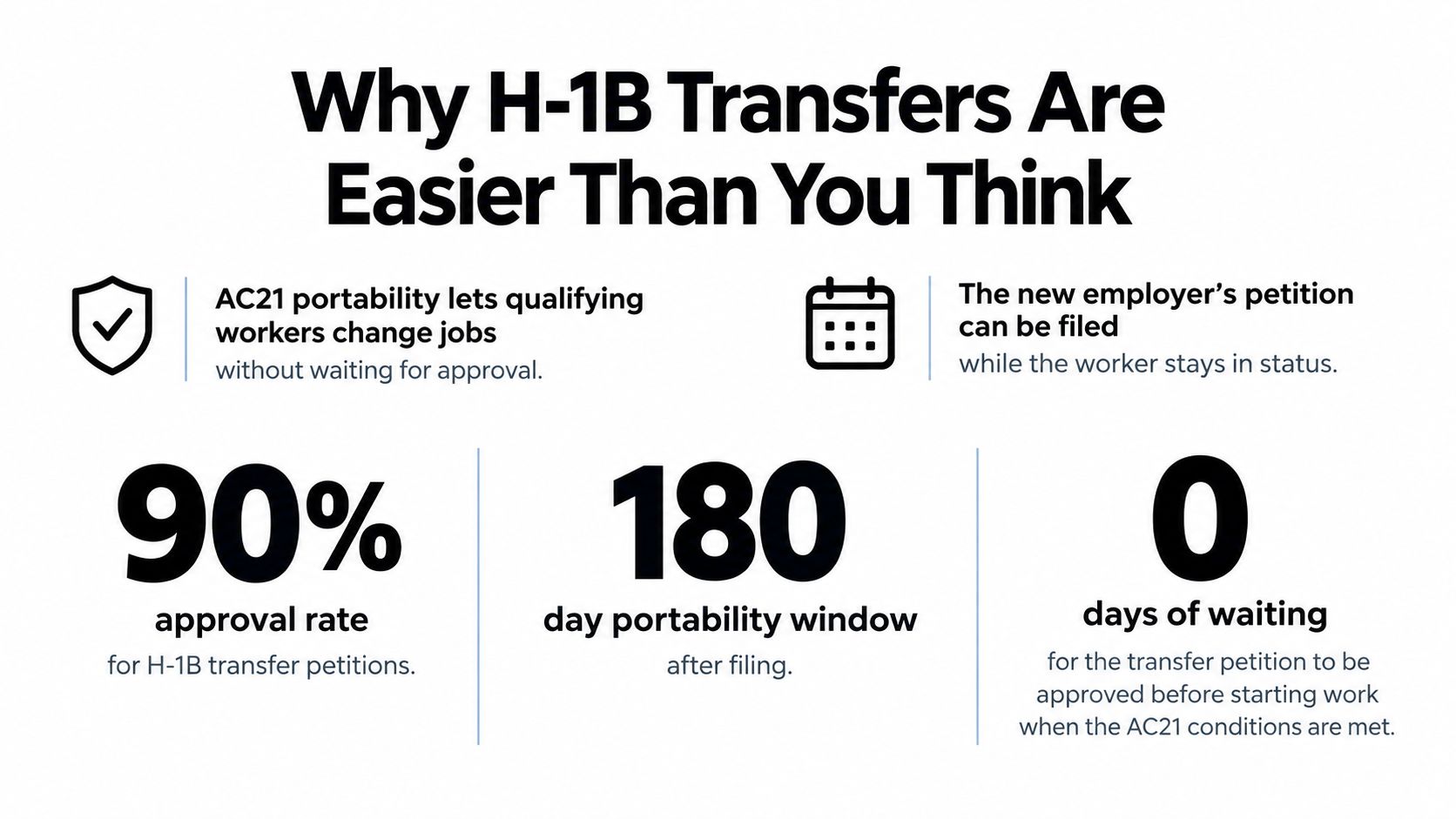
The approval data changes how most workers should approach an H-1B transfer. A 2026 industry analysis recorded 69,552 transfer decisions in FY2025, including 68,167 approvals, for a 98.0% approval rate. Through June 30, 2026, the same analysis reported 47,178 decisions and 46,059 approvals, producing a 97.6% approval rate. Those figures come from the published H-1B transfer approval analysis, and they point to a practical conclusion: a properly prepared transfer is usually more predictable than an initial cap case.
The legal reason is equally important. The modern mechanism comes from the American Competitiveness in the Twenty-First Century Act of 2000, commonly called AC21. Its portability rules allow a qualifying H-1B worker to change employers without waiting for USCIS to approve the new petition, provided the new employer files the required Form I-129 and the worker satisfies the portability conditions. The move isn't a new lottery entry. It's a statutory change-of-employer process built around the filing.
Why portability feels faster
An initial cap petition asks an employer to participate in a selection process before the worker can proceed through adjudication. A transfer generally starts from a different position. The worker has already been counted against the cap, and the new employer must show that the proposed employment qualifies and that the worker remains eligible.
USCIS guidance, summarized in this explanation of H-1B portability under AC21, permits the worker to begin with the new employer after USCIS receives a properly filed petition, assuming the worker has maintained status and meets the other conditions. That distinction is why an H-1B transfer can support a faster job change than many applicants expect.
Practical rule: Portability begins with a qualifying filing received by USCIS, not with an accepted offer letter and not with an approval notice.
The high approval rate should create confidence, not complacency. USCIS still examines the I-94 record, the employment history, the offered position, the labor condition application, fees, and supporting evidence. A transfer becomes risky when the employer files late, uses the wrong worksite, omits required evidence, or assumes the worker's prior approval automatically solves every new eligibility question.
Eligibility Requirements and Required Documentation
A successful H-1B transfer starts with eligibility, not with the new employer's preferred start date. The worker and employer should verify each condition in sequence because one missing piece can undermine the entire filing.
Start with the worker's status
The first check is the worker's current immigration record. Review the most recent approval notice, passport, visa history, and especially the I-94 admission record. The worker generally must have been lawfully admitted in H-1B status and must have maintained that status, subject to the rules that allow portability.
An expired I-94, an unexplained gap in employment, or a prior status problem changes the analysis. A new offer doesn't cure an old defect. Counsel or the employer's immigration team should reconcile the I-94 with payroll records, prior approval notices, and the actual employment history before anyone sets a start date.
Confirm the position and worksite
The new role must qualify as a specialty occupation, and the worker must have the education, license, or experience required for that role. The job description should match the actual duties, not merely repeat a generic occupational label.
The employer also needs a new Labor Condition Application, or LCA, for the specific employment conditions and job location. A transfer filing that uses an old LCA or overlooks a changed worksite can create a serious compliance problem. The wage, location, duties, and supporting explanation should tell one consistent story.
Assemble the petition package
The core filing is Form I-129, supported by the employer's corporate documents, the signed offer or employment agreement, the specialty-occupation analysis, the LCA, evidence of the worker's qualifications, prior H-1B approval notices, passport and I-94 materials, and the required fees. The petition must be complete and properly signed.
A useful preparation sequence looks like this:
- Verify status dates: Confirm the I-94 expiration and the worker's current H-1B approval period.
- Test the role: Compare actual duties and minimum requirements with the specialty-occupation basis.
- Validate the LCA: Match the wage and exact worksite to the proposed employment.
- Review the filing: Check signatures, forms, fees, delivery details, and supporting exhibits.
- Set the start date: Treat employment authorization as beginning only after USCIS receives a qualifying portability filing.
The phrase “properly filed” matters. A package that arrives at USCIS but has a fee error, missing signature, incomplete form, or absent LCA may not provide the protection the employer expects. Workers who want an individualized document review can arrange an immigration lawyer consultation before the employer submits the petition.
Premium Processing vs Regular Processing Timelines
The choice between premium and regular processing is a strategy decision, not a test of confidence in the case. Portability depends on the qualifying filing being received, so paying for faster adjudication doesn't replace the need to file correctly or establish the right start date.
Premium processing can make sense when the worker has a fixed onboarding date, needs a faster answer for travel planning, or faces a business decision that depends on an approval. It provides a defined USCIS response framework, but it doesn't guarantee approval. USCIS can still issue a request for evidence or deny a petition that doesn't establish eligibility.
Regular processing may suit a worker whose current employment continues and whose new employer can tolerate uncertainty. It avoids the premium charge, but the pending period can complicate travel, onboarding, internal staffing, and contingency planning. A worker should not assume that a faster adjudication track makes an otherwise defective filing safe.
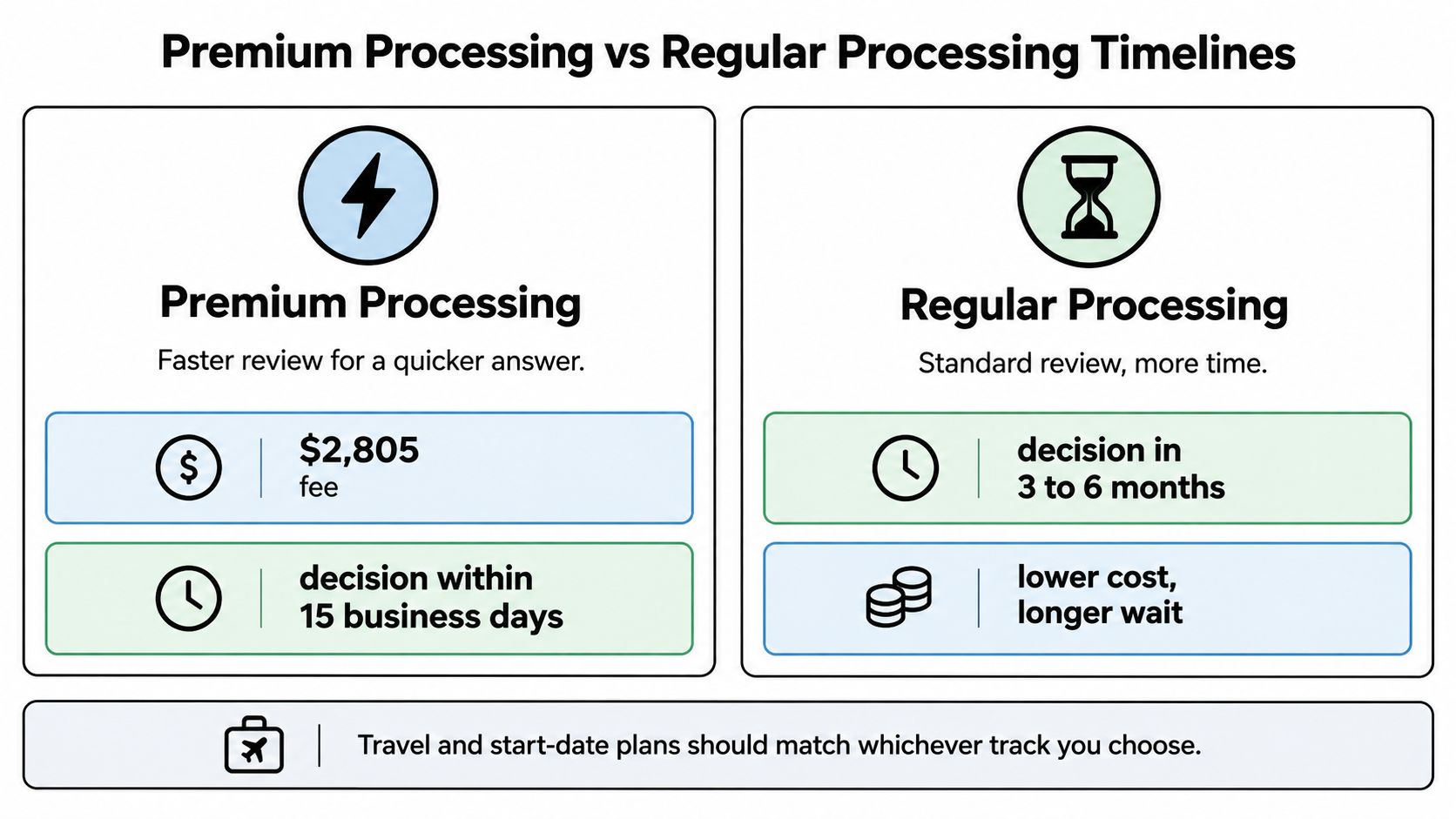
| Decision factor | Premium processing | Regular processing |
|---|---|---|
| Main benefit | Faster case action and earlier certainty | Lower cost and less urgency around adjudication |
| Best fit | Fixed start dates, travel decisions, or tight business planning | Flexible employment timelines |
| What it doesn't change | Eligibility, filing quality, or portability requirements | The need to wait for USCIS receipt before relying on portability |
Before choosing a track, align the filing date, start date, travel plans, and current employment status. This guide to how long an H-1B transfer takes can help frame the timing discussion, but the employer and counsel still need to assess the specific petition.
The Timing Trap Between Grace Period and Portability
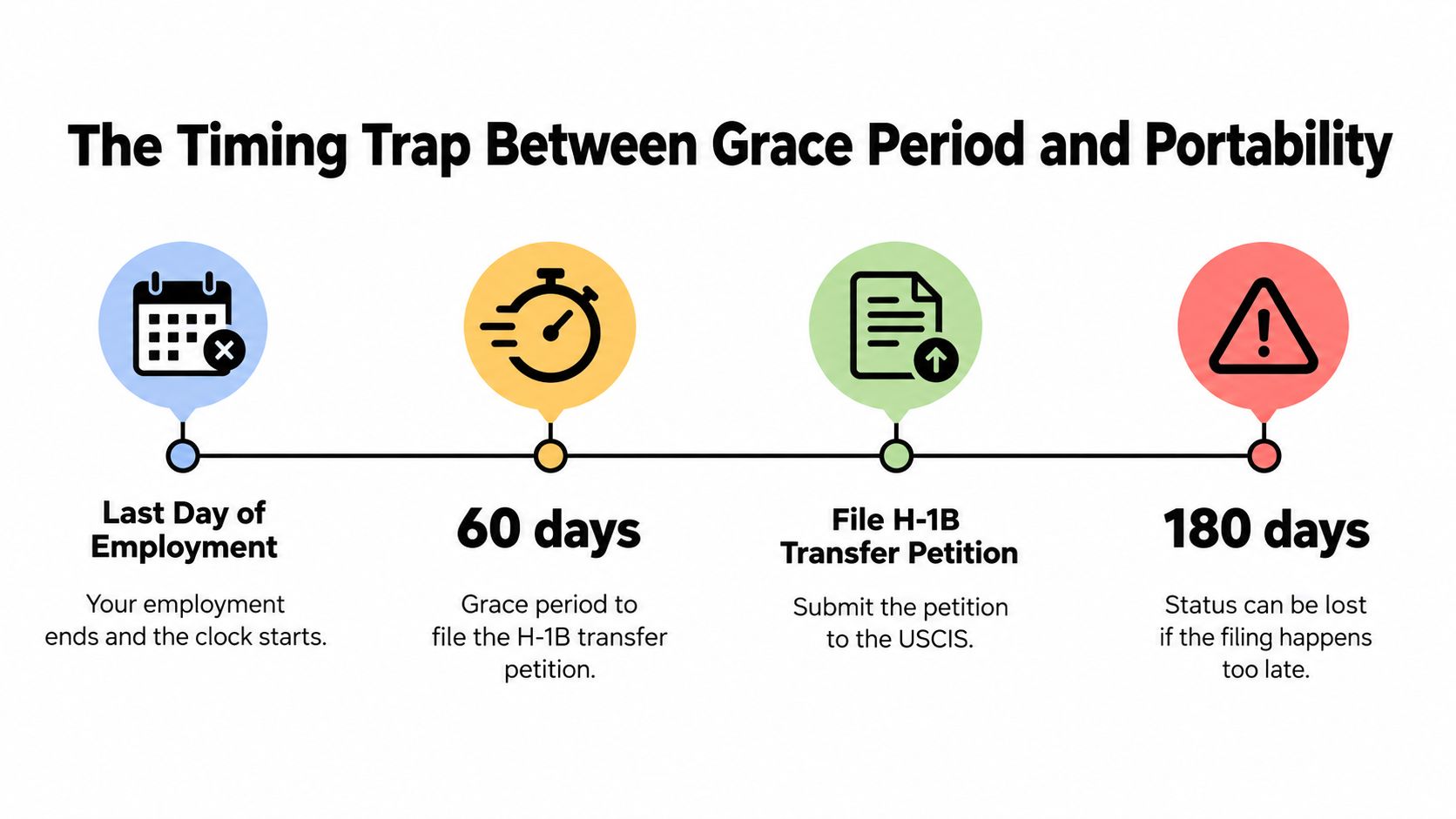
The most dangerous misunderstanding is simple: the grace period is not work authorization. Certain H-1B workers may have a 60-day grace period to find a new employer and file a portability petition, but remaining lawfully in the United States during that period doesn't permit work for the new company.
The employment clock begins with the last day of employment, not necessarily the date severance payments stop. A worker may receive severance after the employment relationship ends, but that payment doesn't automatically extend the period in which the worker was employed in H-1B status. The facts matter, and the employer's termination records should be reviewed carefully.
Three dates that must stay separate
A worker facing a job change should write down three separate dates:
- Last day of employment: This anchors the grace-period calculation after a layoff or qualifying employment exit.
- USCIS receipt date: This is when the new employer's properly filed, non-frivolous petition can trigger portability.
- Actual start date: This should follow the receipt event, not merely the offer, signing of paperwork, or shipment of the petition.
Confusing these dates creates avoidable exposure. Someone who accepts an offer during the grace period can stay in the country while the employer prepares the filing, but cannot begin the new job until portability becomes available. Someone who starts before USCIS receives the petition may have worked without authorization, even if the petition arrives shortly afterward.
The 60-day grace period buys time to pursue a solution. It doesn't authorize the new job while the solution is still being prepared.
A late filing also creates a second problem. If USCIS denies a petition after the worker has started under portability, the worker may face retroactive loss of work authorization for the period worked with the new employer. That risk is why a start date should follow confirmation of receipt and why a high-risk petition deserves a contingency plan before the worker resigns or begins work.
The visa stamp is not the whole status story
Workers often focus on the employer name printed on the visa foil. A valid H-1B visa stamp from the prior employer may not need to be replaced after a successful transfer, because the worker's status is reflected through the petition and approval record rather than solely through the employer name on the stamp. The visa permits travel and a request for admission, while the petition and I-94 establish the employment-related status inside the United States.
That doesn't eliminate travel planning. A pending filing, a change in requested action, or a status problem can affect the travel analysis. The safe approach is to treat travel, employment authorization, and petition adjudication as separate questions rather than assuming one document answers all three.
Common Denial Risks and Retroactive Status Loss
A strong approval rate doesn't mean every transfer is routine. The denials that practitioners see usually arise from identifiable defects in the worker's status, the employer's filing, or the relationship between the proposed role and the evidence.
The first review should focus on the current immigration record. An expired I-94 or an out-of-status period can defeat portability even when the new employer is legitimate and the job clearly matches the worker's background. The employer should also confirm that every form is complete, every fee is correct, and the filing contains a new LCA for the proposed worksite.

Where petitions commonly break
- Status defects: An expired I-94, unauthorized employment, or an unexplained gap can undermine the worker's eligibility.
- Filing defects: Missing signatures, incomplete forms, incorrect fees, or weak delivery control can prevent a filing from functioning as intended.
- LCA defects: The employer must obtain an LCA that corresponds to the actual job location and employment terms.
- Role mismatches: The petition should connect the position's duties, minimum requirements, and the worker's qualifications. A generic title won't repair a weak explanation.
- Timing defects: Starting before USCIS receives the qualifying petition can create unauthorized employment, even if the petition is later accepted.
The consequences can extend beyond the immediate job. If USCIS denies the transfer after the worker has begun under portability, the denial may create a retroactive work-authorization problem. That can affect payroll records, future immigration filings, and the credibility of the worker's status history.
Protect the longer immigration strategy
A transfer can also intersect with permanent-residence planning. Changing employers before I-140 approval may disrupt the intended green-card timeline and require the worker and counsel to reassess the strategy. The new job may be excellent, but the timing of the move can matter as much as the job itself.
Before resigning, the worker should complete a status review, ask the new employer to validate wage and LCA details, confirm the filing plan, and decide what happens if USCIS issues a request for evidence or denies the petition. Practitioner guidance on the H-1B transfer process identifies these status, documentation, and sequencing issues as central risks.
When to Consult an Immigration Attorney Before Transferring
A worker with a clean status record, a conventional specialty-occupation role, and an experienced employer may have a relatively orderly transfer. The risk rises sharply when the facts don't fit that pattern.
Legal advice is especially important after a layoff, because the last day of employment controls the timing analysis and the grace period doesn't authorize work. It's also warranted when the worker has an expired or confusing I-94, a prior status violation, unauthorized employment, a pending application, or travel plans that overlap with the transfer filing.
Situations that deserve individualized review
A lawyer should examine the case before resignation when:
- The job is unusual: The employer may need a detailed explanation of why the role qualifies as a specialty occupation.
- The worksite is changing: Remote, hybrid, client-site, and multi-location arrangements can affect the LCA and supporting evidence.
- A layoff has already occurred: The filing must be timed against the actual last day of employment.
- A green-card case is pending: The transfer may affect I-140 planning or the broader permanent-residence strategy.
- The employer lacks immigration experience: A good business can still submit an incomplete petition if it doesn't understand the required forms, fees, LCA, or evidence.
- The worker has started or may have started early: Counsel should assess possible unauthorized employment and the consequences of a later denial.
DIY filing often fails because people treat the transfer as a form rather than as a coordinated employment, status, and documentation event. An attorney can test the factual assumptions before filing, identify missing records, and establish a response plan if USCIS asks for more evidence.
Workers who need to locate counsel can review an employment visa lawyer through a legal-professional marketplace, then compare relevant experience, availability, and consultation details before booking. The important selection question is not just whether someone handles immigration. It's whether that lawyer has handled the specific combination of transfer timing, status history, worksite, and long-term strategy involved in the case.
A favorable approval environment helps, but it doesn't remove the need for careful sequencing. The safest transfer is the one where the worker verifies status early, the employer prepares the LCA and I-129 accurately, and nobody treats an offer letter or grace period as a substitute for portability authorization.
HeyAtty helps people describe an immigration issue, compare vetted legal professionals, and review profile details, availability, and pricing before booking a consultation. If your H-1B transfer involves a layoff, a tight filing window, a status concern, or a pending green-card strategy, visit HeyAtty to find an appropriate starting point.