
How to Apply for H-1B Visa: A Complete Guide for 2026
Learn how to apply for h-1b visa with this step-by-step guide covering eligibility, registration, the lottery, required documents, and when to hire an attorney.

You've received an offer from a U.S. employer, your degree appears to fit the role, and someone has told you to “apply for the H-1B.” That wording creates the first problem. You don't normally file the H-1B petition yourself, and registration doesn't give you work authorization or immigration status. The employer must decide whether it will sponsor you, prepare the case, pay the required costs, and file the petition.
That employer dependency shapes the entire process. Your most important decisions often happen before anyone completes Form I-129, when you confirm the job classification, employer type, registration plan, documents, and fallback options. The process is competitive for cap-subject employment, but cap-exempt filings and transfers can change the analysis completely.
Table of Contents
- Understanding the Employer-Driven Reality
- Eligibility Requirements and Specialty Occupation Criteria
- The Electronic Registration and Lottery
- Preparing and Filing the H-1B Petition
- Alternative Pathways and H-1B Transfers
- Common Pitfalls and When to Consult an Immigration Attorney
- Your H-1B Action Checklist and Next Steps
Understanding the Employer-Driven Reality
A software engineer named Maya accepts a position with a growing company and starts searching for an H-1B form. She downloads documents, gathers her passport and degree records, and assumes she can submit the application once the employer gives her a job offer. When she asks the company for its immigration filing address, the recruiter says the company hasn't decided whether to sponsor her.
Maya has encountered the central reality too late. The employer is the petitioner, and the worker is the beneficiary. The employer normally submits the petition, not the prospective worker. The USCIS explanation of the H-1B electronic registration process makes that employer-driven structure clear.
What the employer controls
The employer controls whether it will sponsor the role, whether the position is cap-subject or cap-exempt, how the job is described, and whether the company will proceed after a registration is selected. It must also provide evidence about the business, the offered position, the worksite, the employment terms, and the worker's qualifications.
That doesn't mean the worker is powerless. A prospective employee should ask questions early, before accepting vague assurances:
- Sponsorship commitment: Will the employer register the position and, if selected, file the full petition?
- Role definition: What duties, requirements, salary terms, and worksite will appear in the case?
- Timing: Which immigration status does the employer expect the worker to hold when the petition is filed?
- Responsibility: Who will coordinate the immigration lawyer, documents, fees, and responses to USCIS?
- Contingency planning: What happens if the registration isn't selected or the petition can't be filed?
Practical rule: Treat “we sponsor H-1Bs” as a company policy statement, not as a commitment to sponsor your particular role.
Why the distinction changes your leverage
A registration is only an employer's entry into the selection process. It isn't a visa application in the ordinary sense, and it isn't approval of H-1B status. The employer must first submit the registration, and only a selected registration generally permits the employer to submit the cap-subject Form I-129 petition for that beneficiary and fiscal year.
Your strongest opportunity to influence the case comes before registration and petition drafting. Review the proposed duties, identify gaps in your academic or professional records, and make sure the employer understands any status or travel issue that could affect the filing. Once a case is filed, changing the job description or employer strategy can create avoidable complications.
Eligibility Requirements and Specialty Occupation Criteria
H-1B eligibility has two connected parts. The position must qualify as a specialty occupation, and the beneficiary must be qualified to perform that position. A strong degree alone won't fix a weak job description, and an impressive job title won't establish that the role requires specialized knowledge.
A specialty occupation analysis focuses on the actual duties and requirements of the offered position. The employer needs to show that the role calls for highly specialized knowledge and that the beneficiary meets the stated educational or equivalent qualifications. The job description should explain what the worker will do, not merely repeat a generic occupational label.
Test the role before the petition is drafted
Ask whether the employer can explain why the position requires a specific field of knowledge. A data analyst role involving statistical modeling, database design, and specialized forecasting may present a clearer argument than a broadly described “business operations” role. A marketing position may require careful analysis if the employer relies on a specialized degree requirement that the actual duties don't support.
The employer should align four pieces of evidence:
- Actual duties: The daily work should be detailed enough to show specialized responsibilities.
- Position requirements: The required degree field or equivalent experience should match those duties.
- Business context: The company should explain why it needs this role and how the work fits its operations.
- Beneficiary records: Your degree, transcripts, credential evaluation, and employment history should support the qualifications listed.
A candidate can perform an early self-check by comparing the offer letter with the detailed job description. If the documents describe routine work while the employer claims the role requires advanced specialization, the petition may face a credibility problem. The answer isn't to make the title sound more technical. It's to document the actual work accurately.
The degree and advanced-degree questions
The worker generally needs a bachelor's degree or qualifying equivalent connected to the position's requirements. If the worker holds a master's degree or higher from a U.S. institution, the employer may consider the separate advanced-degree exemption, commonly called the master's cap. That exemption can provide an additional route into the selection structure, but it doesn't eliminate the need to prove that the job is a specialty occupation or that the beneficiary qualifies.
The employer type matters just as much as the worker's credentials. A private company may face the regular cap-subject process, while a qualifying university or research organization may pursue a cap-exempt filing. Before investing in a lottery strategy, determine whether the employer and job are subject to the annual cap.
The Electronic Registration and Lottery
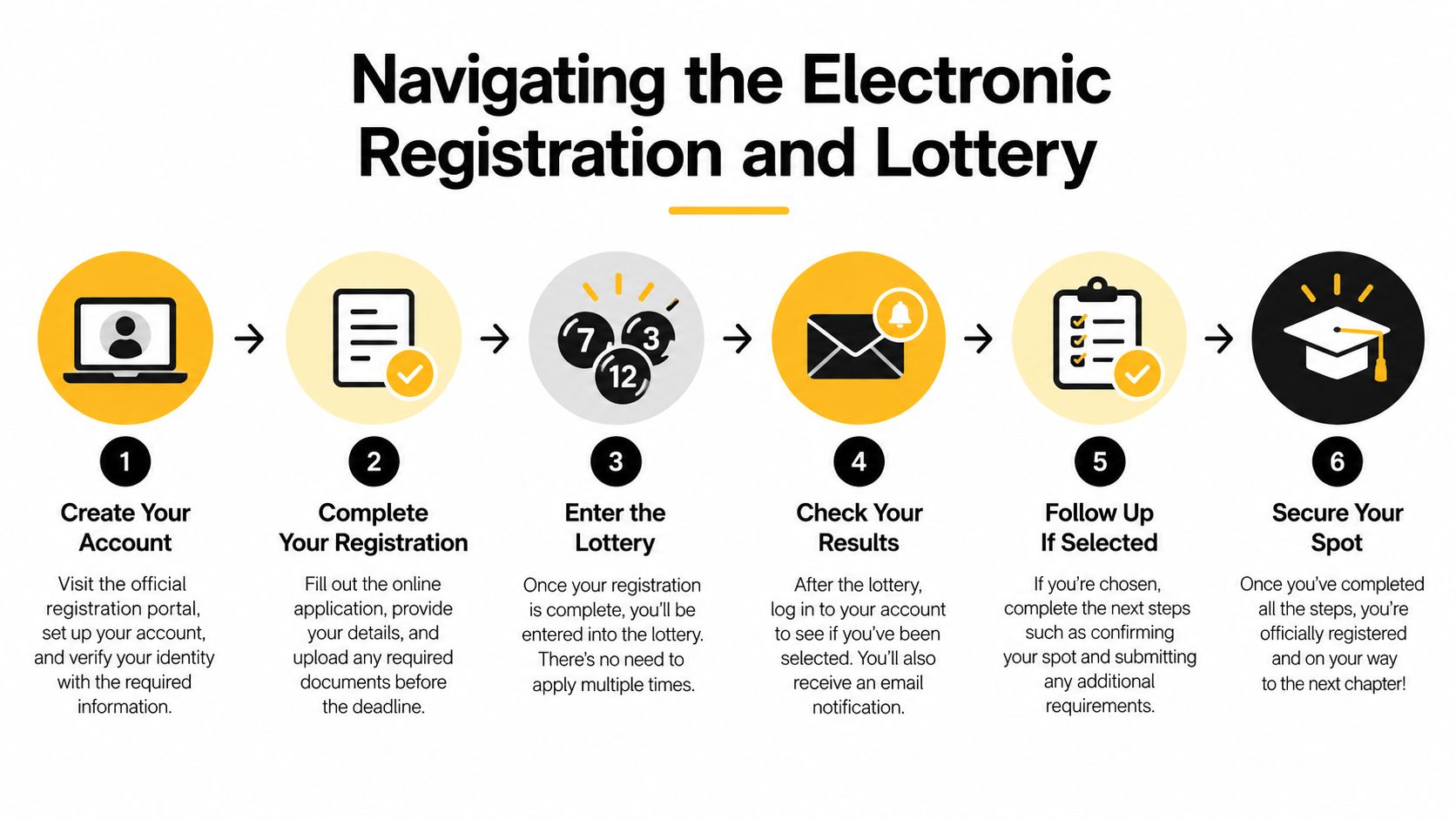
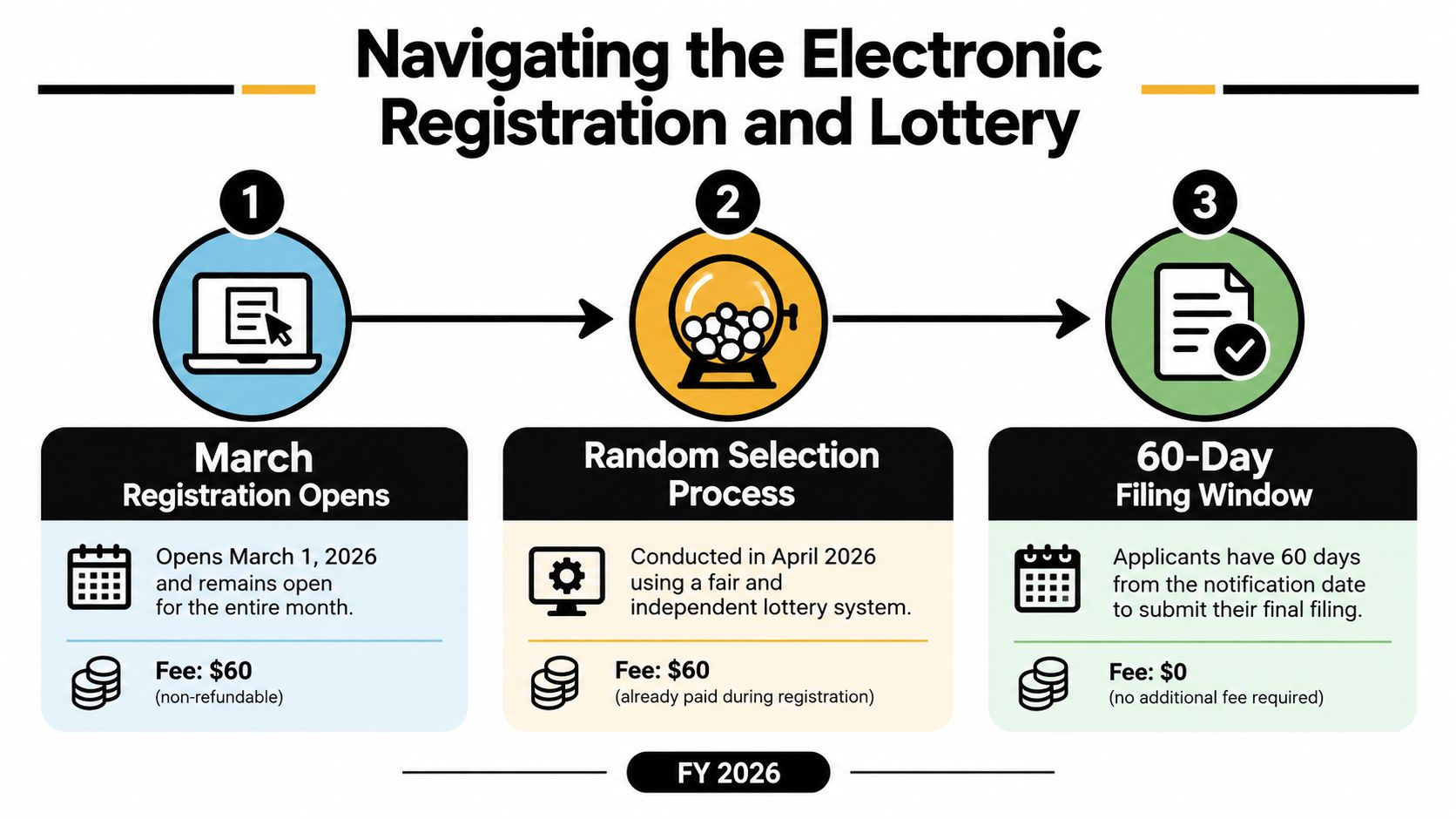
Registration is the point where many workers assume the case is already in motion. In practice, employer dependence becomes impossible to ignore at this stage. The employer, or its counsel, controls the online account, enters the worker's information, pays the fee, and decides whether the company will follow through if the registration is selected. A worker who waits passively can miss errors that are easy to prevent and hard to clean up later.
For the FY 2026 cap season, USCIS listed the electronic registration fee as $215 per prospective beneficiary. The employer submits a separate online registration for each worker and pays the applicable fee. Before anything is submitted, the worker should confirm the spelling of names, passport details if used, the correct fiscal year, and whether the company is prepared to file a full petition if selected. Registration without a real filing plan is one of the most common early problems I see.
USCIS states that the initial registration period must stay open for at least 14 calendar days under its H-1B registration guidance. That minimum window does not mean every employer will be ready to act. Some companies line up counsel and documents early. Others wait until the portal opens and then rush through position details that should have been reviewed weeks before.
Before registration opens
A serious conversation with the employer should happen before the portal opens, not after. Ask who is handling the case, whether outside counsel is involved, what information the company needs from the worker, and whether anyone has tested the job description against the specialty occupation standard instead of relying on a job title. If the answers are vague, treat that as a warning sign.
The cap question also needs to be settled early. Some cases do not belong in the regular lottery at all. Extensions, many changes of employer for workers already in H-1B status, and jobs with qualifying universities or nonprofit or government research organizations are generally outside the annual cap. Workers often focus so heavily on lottery timing that they miss a cap-exempt or transfer path that may fit their situation better.
What selection means
After the registration period closes, USCIS runs the selection process. Selection gives the employer the chance to file the full H-1B petition. It does not grant H-1B classification, work authorization, or lawful status by itself.
That distinction matters. A selected case still has to prove the position qualifies, the worker qualifies, and the employment terms are supported. If the registration is not selected, a regular cap-subject filing usually cannot go forward for that fiscal year on that basis. The worker may still have options, including a transfer if already counted against the cap, cap-exempt employment, another immigration strategy, or trying again in a later season.
After approval, the final step depends on where the worker is. Someone outside the United States usually applies for an H-1B visa at a U.S. consulate before seeking admission. Someone in the country may request a change or extension of status through the petition. These are separate stages, and each has its own risks and timing.
Preparing and Filing the H-1B Petition
Selection changes the case from a preliminary registration into a document-heavy petition. The employer generally files Form I-129 with evidence showing that the company offers a qualifying specialty occupation and that the beneficiary meets the position's requirements. The legal team should build the filing around the actual employment arrangement, not a recycled description from an unrelated case.
Typical evidence may include the offer or employment agreement, a detailed statement of duties, organizational information, worksite documentation, degree records, transcripts, credential evaluations when needed, and evidence of relevant experience. The exact document set depends on the role, employer, worksite, and worker's current location and status.
Build the petition around consistency
USCIS looks at the relationship between the forms and supporting evidence. The title, duties, degree requirement, worksite, salary terms, and employer information should tell the same story throughout the filing. A polished letter can't compensate for contradictions between the petition, the offer, and the company's supporting records.
The employer should also use the correct form editions and secure valid signatures. USCIS identifies required information, a valid signature, and the correct fee as basic filing requirements. An administrative rejection can delay a case before an officer evaluates the substantive eligibility issues.
Reconcile every fee before mailing or submitting
USCIS materials identify several possible charges. The employer must determine which apply based on its circumstances:
- Base Form I-129 fee: Confirm the current amount on the USCIS Fee Schedule before filing.
- ACWIA training fee: The listed amount is $750 for employers with 25 or fewer U.S. employees or $1,500 for larger employers in the referenced USCIS materials. See the USCIS H-1B overview and fee guidance.
- Fraud Prevention and Detection fee: The listed fee is $500 for an initial H-1B or change-of-employer filing, according to the same USCIS overview.
- Public Law 114-113 fee: When applicable, the listed fee is $4,000 for certain employers with at least 50 U.S. employees whose U.S. workforce is over 50% H-1B or L-1.
- Premium processing: The referenced USCIS schedule lists $2,500 for Form I-907, but the current USCIS Fee Schedule controls because fees can change.
Premium processing can request faster adjudication, but it doesn't repair a weak specialty-occupation argument, missing evidence, or an incorrect filing. Before submission, reconcile the fee calculation against headcount and immigration-worker percentages, verify the filing address or online pathway, check the form editions, confirm signatures, and test the payment method.
Alternative Pathways and H-1B Transfers
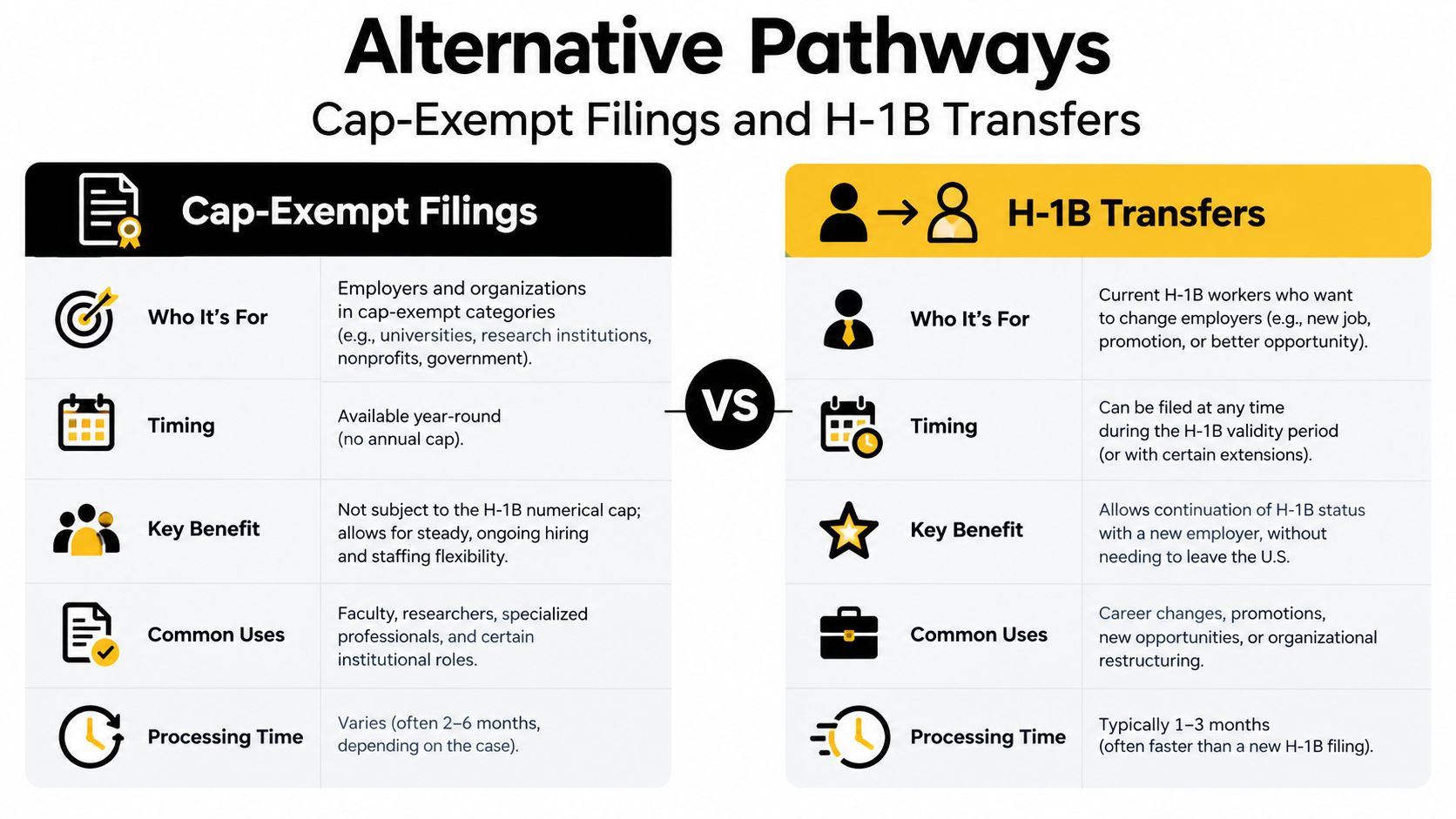
The regular cap-subject route isn't the only realistic H-1B strategy. The correct pathway depends on the employer, the worker's current or prior H-1B history, and whether the case requires selection before the petition can be filed.
A qualifying university, nonprofit research organization, or government research organization may be able to file a cap-exempt petition. An existing H-1B worker changing employers may generally pursue a new employer petition without entering the regular lottery. The employer must still prove eligibility, and a transfer isn't a shortcut around specialty-occupation or status requirements.
Compare the routes
| Pathway | Selection pressure | Timing profile | Main evidence focus |
|---|---|---|---|
| Regular cap-subject filing | Requires the employer to use the annual registration and selection process | Depends on the registration period, selection, and subsequent petition window | Specialty occupation, beneficiary qualifications, employer details, and registration validity |
| Cap-exempt filing | Generally avoids the regular lottery when the employer and employment qualify | Can proceed through petition preparation without waiting for regular-cap selection | Qualifying institution or organization, qualifying role, duties, and worker qualifications |
| H-1B transfer | Existing H-1B workers generally don't re-enter the regular lottery for a change of employer | Driven by the new employer's preparation, filing, and the worker's status history | Prior H-1B history, current status, new job, employer, worksite, and specialty occupation |
The table is a decision tool, not an approval guarantee. A university-affiliated role may still need analysis if the employer's relationship to the institution is indirect. A transfer may become more complicated if the worker has a status gap, an unusual employment history, or a prior petition issue.
Transfers require timeline discipline
A transfer is particularly sensitive to the worker's current position and status. The new employer should review the existing approval notice, admission record, prior employment, expiration dates, and recent pay records before deciding how to file. The worker shouldn't resign or rely on informal assurances without understanding the filing strategy and the consequences if USCIS raises a question.
For a practical discussion of the employer-change process, review H-1B transfer considerations. The useful question is not, “Can I transfer?” It's whether the new employer can file a coherent petition based on your current immigration record and the proposed job.
Common Pitfalls and When to Consult an Immigration Attorney
Most avoidable H-1B failures don't begin with an exotic legal issue. They begin with a missing signature, an outdated form, an incorrect fee, a wrong filing location, or a job description that doesn't match the evidence. USCIS specifically identifies required information, valid signatures, and correct fees as filing essentials, so administrative quality control deserves the same attention as legal argument.
Errors that deserve an immediate pause
- Employer-size mistakes: The ACWIA fee and other charges can depend on headcount and the employer's immigration-worker profile. The company should calculate those facts carefully rather than copy a prior petition.
- Role inconsistency: A title, offer letter, organizational chart, and duty statement that describe different jobs can weaken the case.
- Status assumptions: A person inside the United States may have a change-of-status or extension strategy, while someone abroad generally needs consular processing after approval.
- Document gaps: Missing transcripts, unclear degree equivalency, unexplained employment periods, or incomplete prior immigration records can create questions that should have been addressed before filing.
- Travel during a pending request: International travel can affect a requested change or extension of status, so the worker should obtain case-specific advice before leaving the country.

When professional review is justified
Consult an immigration attorney early if you've had a prior status violation, an unexplained gap in employment, a denied or withdrawn petition, complicated travel history, or a degree that doesn't obviously relate to the offered job. Legal review is also valuable when the employer's specialty-occupation argument depends on an unusual role, third-party placement, multiple worksites, or a business structure that needs careful explanation.
An attorney can't guarantee selection or approval. The practical value is different. Counsel can identify the correct filing route, test the evidence before submission, calculate the fees, address status risks, and help the employer avoid building the petition around a title rather than the actual position.
HeyAtty offers guided intake, searchable legal-professional profiles, experience details, pricing and availability information, and secure booking for people comparing immigration counsel. Its guide to choosing an immigration lawyer is useful when you need to compare relevant case experience rather than select a lawyer based only on a broad practice label.
Your H-1B Action Checklist and Next Steps
The fastest way to reduce uncertainty is to convert the process into decisions you can verify with the employer.
Before registration or petition preparation
- Confirm the route: Ask whether the employer and position are regular cap-subject, cap-exempt, or part of an H-1B employer change.
- Review the job: Obtain a detailed duty description and confirm that the degree requirement reflects the actual work.
- Prepare records: Gather your passport, degree documents, transcripts, credential evaluation if relevant, prior immigration records, and employment information.
- Clarify ownership: Identify the employer contact, immigration counsel, document deadline, and plan if selection doesn't occur.
- Check the fiscal year: Verify USCIS dates, instructions, fees, and form requirements for the applicable season.
Before filing
- Audit the forms: Confirm the current Form I-129 and, if used, Form I-907 editions, signatures, filing address, and payment method.
- Reconcile fees: Match each charge to the employer's headcount, immigration-worker profile, filing type, and current USCIS schedule.
- Check status strategy: Determine whether the petition requests consular processing, change of status, or extension of status.
- Escalate unusual issues: Seek legal review for prior violations, status gaps, complex worksites, unclear degree equivalency, or an unconventional specialty-occupation argument.
Once the case is filed, keep copies of everything and monitor USCIS notices through the employer or its counsel. USCIS procedures can change during the fiscal year, so use current agency instructions rather than relying on last season's checklist. If you're also tracking work authorization renewal planning, coordinate that timeline separately instead of assuming an H-1B filing automatically resolves every employment authorization issue.
HeyAtty helps people describe an immigration matter, compare relevant legal professionals, review verified experience details, see availability and pricing, and book a consultation securely. Visit HeyAtty to find counsel who can assess your H-1B route before the employer submits the registration or petition.