
Immigration Lawyer Consultation Fee Guide
Understand the typical immigration lawyer consultation fee, what affects pricing, and how to find the right legal match for your case on HeyAtty.

An initial immigration lawyer consultation fee typically ranges from $100 to $400 for a 30 to 60-minute session, though some firms offer free screenings while top-tier specialists may charge $500 or more. The right question isn't whether the fee is cheap, but whether the consultation gives you a reliable diagnosis before you commit to a much larger legal expense.
You may be sitting at a kitchen table with a visa denial notice, an expiring status document, or a family timeline that doesn't fit neatly into an online form. You search a lawyer directory and find profiles that say “experienced,” but the prices are hidden, availability is unclear, and every firm seems to describe its consultation differently.
That uncertainty is normal, but it shouldn't control your decision. An immigration consultation is the first opportunity to test whether an attorney understands your facts, identify the legal route that actually fits, and expose risks before you pay for representation. Treat it as a strategic diagnostic, not merely an intake call.
Table of Contents
- Decoding the Initial Immigration Lawyer Consultation Fee
- Variables That Drive Consultation Pricing Up or Down
- What a Paid Consultation Actually Covers
- Connecting the Consultation to Total Representation Costs
- Evaluating Attorney Experience Against the Price Tag
- Using HeyAtty to Eliminate Pricing Guesswork
- Maximizing the ROI of Your Consultation Session
Decoding the Initial Immigration Lawyer Consultation Fee
A prospective client often sees three different offers. One firm advertises a free phone screening, another requires a fixed fee before booking, and a specialist quotes more for a longer meeting. Those offers may all be legitimate, but they do not deliver the same level of analysis. Before comparing offers, review what a legal consultation fee typically covers so you know what the appointment is supposed to provide.
A review of immigration attorney costs places an initial immigration case evaluation at about $100 to $400, while some firms offer free consultations and others charge $500 or more. The difference usually reflects the lawyer's experience, location, appointment length, and depth of advice. Some firms may apply the consultation charge toward the total legal fee if you later retain them. Confirm that policy before booking.
Free screening versus paid analysis
A free screening usually answers a narrow business question: does the firm handle this type of matter, and does your situation justify a follow-up? The caller may collect basic facts, confirm whether the office accepts the case, and explain how to schedule a paid appointment. That service can save time, but it is not automatically legal strategy.
Consider a family-based case. A free call may end with, “We can file an I-130,” after a quick review of the relationship. A paid session should examine the full chronology and may uncover a prior unlawful-presence issue that changes the filing plan or requires further legal review. The value lies in identifying the issue before you pay for representation, not in receiving a confident answer quickly.
A paid consultation should listen to your chronology, identify the likely immigration pathway, flag missing information, and explain what could weaken or complicate the case. If the lawyer spends the appointment describing the firm without analyzing your facts, the fee has not produced its intended value.
Practical rule: Compare consultation prices only after comparing what each lawyer promises to deliver during the appointment.
The session's scope also affects its value. A short pre-qualification call differs from a substantive review of prior filings, immigration history, family relationships, employment details, or inadmissibility concerns. Ask which documents the lawyer wants in advance, how long the appointment lasts, whether written follow-up is included, and whether the fee becomes a credit if you hire the firm.
The consultation is a diagnostic investment
The cheapest consultation can become the most expensive choice if poor analysis leads to an unsuitable filing strategy, wasted preparation, or an agreement that misses the core issue. A well-run consultation can support a clear decision to proceed, wait, gather evidence, pursue another category, or seek a second opinion.
The fee is therefore a form of risk control. You are paying for legal judgment while mistakes remain less expensive to correct.
Variables That Drive Consultation Pricing Up or Down
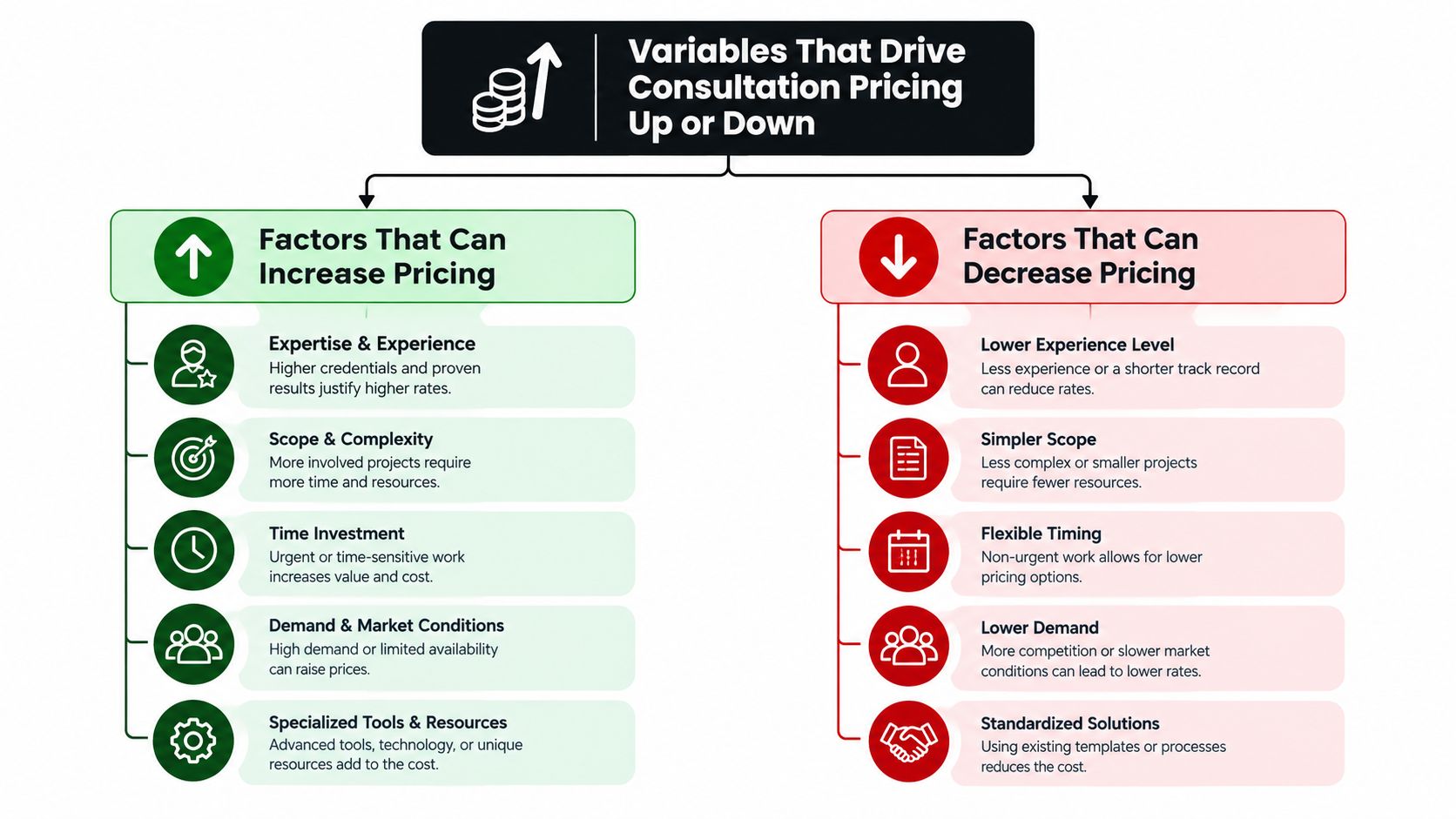
The price reflects more than the lawyer's calendar. Immigration attorneys are pricing the amount of judgment they may need to apply before they can responsibly advise you. A clear, well-documented matter is easier to assess than a case involving prior refusals, unlawful presence, conflicting records, or several possible visa categories.
Geography matters because legal practices in major markets often carry different overhead and demand than practices serving smaller communities. Experience matters too, but “years in practice” is an incomplete measure. A lawyer who has handled many family petitions may not be the right person for an extraordinary-ability petition, a waiver, or a removal-related matter.
The main pricing variables
- Case complexity: A straightforward application with a clean history generally requires less diagnostic work than a case involving prior immigration violations, complicated travel, criminal records, or uncertain eligibility.
- Specialized knowledge: A lawyer who regularly handles a narrow and demanding category may charge more because the consultation depends on detailed legal judgment, not just document collection.
- Attorney experience: Senior attorneys may price their direct time higher, particularly when clients need an immediate assessment of a high-stakes or unusual problem.
- Location and demand: Lawyers in major legal markets may set different fees from practitioners in less expensive regions. The fee reflects the local market, office costs, and the demand for a particular specialty.
- Scope of review: A general conversation about goals is not the same as a review of refusal notices, prior applications, supporting evidence, or a detailed family and employment history.
- Who conducts the meeting: Some firms distinguish between an initial call with a staff member and a strategy session with the attorney who may handle the case.
Why complexity changes the value calculation
Immigration law contains significant information asymmetry. You know your personal story, but you may not know which facts have legal significance or which omissions could create risk. The attorney has the training to triage the matter, separate decisive facts from background noise, and determine what needs verification.
That is why attorneys often price the first meeting as a fixed consultation rather than a generic hourly conversation. A legal guide on immigration consultations describes common initial consultation pricing at about $100 to $400 for 30 to 60 minutes, while hourly attorney rates vary with geography and experience.
A higher fee makes sense when the lawyer is expected to perform a deeper assessment. It doesn't make sense merely because the profile uses impressive language. Ask the attorney to explain what the price includes and what specific experience is relevant to your facts. If the response is vague, the fee is difficult to evaluate at any level.
What a Paid Consultation Actually Covers
A paid appointment should produce something you can use after the call. It doesn't need to resolve every legal issue or guarantee an outcome. It should, however, leave you with a clearer view of your options, the main risks, and the evidence required to make a sensible next decision.
The difference between a free screening and a paid consultation is analysis. A screening may establish whether the office handles immigration matters. A paid session should connect your facts to a possible legal strategy.

A productive consultation follows a clear sequence
The lawyer establishes your objective. Are you trying to remain in the country, obtain work authorization, reunite with a relative, respond to a notice, correct a past problem, or plan a future move? The attorney can't assess a route until the desired outcome is clear.
You provide the relevant chronology. The lawyer needs to understand entries, exits, prior applications, changes of status, employment, relationships, and any contact with immigration authorities. Sequence matters because the same event can carry different significance depending on what happened before and after it.
The attorney tests possible pathways. A useful consultation compares the plausible options rather than jumping to the first familiar form. The lawyer should explain why one route appears stronger, why another may not fit, and what facts could change that assessment.
The lawyer identifies risk. Ask directly about weak points, missing records, inconsistencies, prior refusals, deadlines, and facts that require additional legal research. An attorney who only discusses favorable facts isn't giving you a complete diagnosis.
You receive an action plan. The plan may identify documents to collect, questions to answer, records to request, or steps to take before filing. It should also clarify whether the attorney recommends representation and what that engagement would cover.
Questions that test the quality of the advice
Don't judge the meeting by how confident the lawyer sounds. Judge it by whether the lawyer can explain the reasoning behind the recommendation in language you understand.
Ask which facts are most important, what information is still missing, what could cause a denial or delay, and whether the lawyer sees a viable alternative. Ask what the next decision is, not just what the next form is.
A generic sales pitch leaves you with enthusiasm but no map. A strong consultation gives you usable uncertainty. You may learn that the case is promising, premature, fact-sensitive, or unsuitable for the proposed route. That clarity is the product.
Connecting the Consultation to Total Representation Costs
The initial fee is only one part of the financial decision. Immigration representation may be arranged as a flat fee, hourly work, or a combination of both. The consultation helps both sides determine which structure is appropriate and whether the lawyer's understanding of the case matches the client's expectations.
A cited AILA 2025 survey found that flat-fee arrangements accounted for 68% of immigration cases, according to an overview of immigration lawyer costs and fee structures. The same source describes broader representation costs ranging from roughly $1,500 to $15,000, depending on the case, and reports hourly rates of $250 to $500 in the United States. Those figures are not a quote for your matter. They're a reminder that the consultation sits at the front of a much larger engagement.
What the first meeting should reveal about the engagement
A lawyer shouldn't ask you to approve a substantial fee without explaining what the firm will do. The consultation should help define the boundaries of the proposed work.
Look for clarity on:
- Included services: Determine whether the fee covers strategy, form preparation, evidence review, filing, correspondence, interview preparation, and responses to government notices.
- Excluded services: Some firms treat appeals, motions, requests for evidence, consular processing, or litigation as separate work. Those exclusions should appear in writing.
- Billing method: Confirm whether the engagement uses a flat fee, hourly billing, staged payments, or another arrangement.
- Communication: Ask who will answer questions, how often updates are provided, and whether communication with family members or employers is included.
- Additional expenses: Clarify which government fees, translations, courier costs, expert services, and document requests fall outside the legal fee.
- Consultation credit: Some firms credit the initial consultation toward representation if the client retains them. Never assume this applies. Ask for the policy before booking.
The consultation therefore acts as a financial benchmark. If the lawyer cannot describe the likely work, the assumptions behind the quote, or the events that could expand the scope, you don't have enough information to compare proposals.
Don't mistake a flat fee for unlimited protection
A flat fee creates predictability, but it doesn't mean every possible problem is included. A case can change when new facts emerge, a government agency issues a notice, a family relationship changes, or evidence proves harder to obtain than expected.
Ask the attorney to identify the assumptions behind the quote. For example, does the proposal assume that your prior records are consistent, that a required document is available, or that the case proceeds without an interview complication? A transparent lawyer will explain the boundaries without making you feel difficult for asking.
The best engagement is not always the one with the lowest total quote. It's the one where the deliverables, risks, and potential extra work are visible before you sign.
Evaluating Attorney Experience Against the Price Tag
A senior attorney isn't automatically the right choice, and a lower consultation fee isn't automatically a bargain. Match the lawyer's experience to the legal problem in front of you. The relevant question is not just how long someone has practiced immigration law, but whether they've handled cases with the same legal pressure points.
A routine matter may not require a highly specialized practitioner. A case with a prior denial, waiver issue, removal history, or unusual evidence problem may justify paying more for focused experience. The premium should buy relevant judgment, not prestige alone.
| Case Scenario | Recommended Attorney Tier | Expected Consultation Value |
|---|---|---|
| A relatively clear application with complete records and no known complications | Competent general immigration practitioner | Confirmation of the likely pathway, document gaps, and next steps |
| A work-based matter with employer timing, status concerns, or a change in employment | Attorney with direct employment-immigration experience | Assessment of status, employer obligations, timing, and practical filing risks |
| An extraordinary-ability or national-interest matter requiring a persuasive evidence strategy | Specialist with case-specific experience in that category | Evaluation of the evidence theory, weaknesses, and whether the record supports the proposed route |
| A matter involving prior refusals, unlawful presence, admissibility concerns, or conflicting records | Senior attorney or specialist in waivers and complex cases | Early risk diagnosis and a reasoned view of whether further preparation is worthwhile |
| A case involving court proceedings or removal-related consequences | Attorney who regularly handles the relevant litigation or court work | Assessment of procedural posture, urgent risks, and the limits of an ordinary application strategy |
Compare substance, not labels
Ask each lawyer the same questions. Which facts in your case create the greatest risk? What similar matters has the attorney handled? What would the lawyer need to review before giving a firmer opinion? What work would the firm perform personally, and what work would be delegated?
An attorney who can describe the relevant experience without promising an outcome is usually easier to evaluate than one who relies on broad claims. You want a lawyer who can say, in practical terms, how your facts resemble or differ from matters they've handled.
The guidance in this resource on choosing an immigration lawyer is useful for building that comparison. Use it to assess communication, credentials, practice focus, and engagement terms together rather than treating the consultation price as the sole measure of quality.
Price test: Pay more when the attorney's specific experience addresses your hardest legal issue. Don't pay more merely for a longer biography.
When a second opinion is worth the cost
A second consultation can be sensible when two lawyers propose different pathways, the first lawyer refuses to explain a risk, or the representation quote is substantial relative to your resources. Present the second lawyer with the same chronology and documents, and ask for an independent assessment rather than asking only whether the first attorney is right.
The purpose isn't to collect opinions indefinitely. It's to resolve a meaningful disagreement before you commit to a strategy that may be difficult or expensive to change.
Using HeyAtty to Eliminate Pricing Guesswork
Traditional directories make you repeat the same process at every office. You call, explain enough of your situation to reach the right person, ask whether the lawyer handles the matter, and then try to discover the consultation price and availability. That time is a real cost, especially when you're already managing deadlines and sensitive documents.
A structured marketplace such as HeyAtty puts relevant information in one place. Users can review verified professional profiles, compare consultation pricing, see availability, and book through a consent-based process instead of making disconnected inquiries. The platform also offers guided intake for people who aren't sure which legal specialty fits their problem.
What to compare before booking
Use any legal marketplace as a comparison tool, not as a substitute for professional judgment. Look for:
- Relevant case experience: A profile should help you determine whether the lawyer has handled your type of immigration matter, not merely whether the lawyer practices immigration law.
- Visible consultation terms: Confirm the price, session format, duration, cancellation policy, and whether the fee can be credited toward later representation.
- Availability: A lawyer who fits your case but can't meet within your required timeframe may not be a practical option.
- Verification and privacy: Review how credentials are presented and how your information is shared. Don't upload sensitive records until you understand the platform's consent process.
- Useful early guidance: Community questions can help you formulate issues to raise with counsel, but they shouldn't replace advice about your individual facts.

The practical advantage is reduced friction. You can start with your situation, narrow the search to relevant professionals, compare the visible terms, and reserve a time without treating every office's intake process as a separate research project.
That doesn't mean the lowest listed fee wins. It means you can focus your judgment on fit, scope, and diagnostic value instead of wasting energy uncovering basic pricing information.
Maximizing the ROI of Your Consultation Session
A lawyer can't produce useful analysis from a disorganized story if the appointment is short. Preparation determines whether the meeting becomes a strategic review or an expensive repetition of facts you could have supplied in advance.
Start with a timeline. Write down every relevant entry and departure, visa or status change, application, refusal, approval, employment change, relationship event, and contact with immigration authorities. Don't edit out facts because they seem embarrassing or unrelated. The attorney needs the complete sequence to identify what matters.
Build a compact consultation file
Send only what the lawyer requests through the approved channel, but have the following information ready:
- Your objective: State what you want to accomplish and whether there is a deadline influencing the decision.
- Immigration history: Prepare a chronological account of entries, statuses, filings, decisions, and travel.
- Government notices: Gather refusal letters, requests for evidence, notices to appear, approval notices, and other official correspondence relevant to the issue.
- Identity and family facts: Note relationships, citizenships, prior marriages, dependents, and other facts that may affect eligibility.
- Employment information: For work-related matters, organize job title, employer, work location, education, and changes in employment.
- Your uncertainty: List the facts you don't understand or fear may create a problem. Those are often the highest-value questions.
Don't spend the appointment asking questions that a lawyer's public FAQ can answer. Use the call to test how general information applies to your record.
Ask questions that force a decision
Prepare questions such as:
- What pathway appears most plausible based on the facts I've provided?
- Which fact creates the greatest risk?
- What information or documents could change your assessment?
- What should I avoid doing before the next step?
- What evidence would strengthen the case?
- What work would your firm include if I retain you?
- Which services would cost extra?
- What would you need from me to begin responsibly?
The questions to ask before hiring a lawyer can help you turn a general conversation into a structured evaluation of fit, communication, and scope.
Take notes during the appointment, and ask the attorney to restate the recommended next step before the call ends. Afterward, compare the lawyer's analysis with the written engagement terms. If the advice and the contract don't match, pause before paying the larger representation fee.
HeyAtty helps you compare vetted legal professionals by practice area, consultation pricing, availability, and relevant profile information, then book securely with consent-based information sharing. Visit HeyAtty to reduce pricing guesswork and find an immigration lawyer whose experience matches the actual problem you need to solve.