
Immigration Lawyer for Green Card: Your 2026 Guide
Find the best immigration lawyer for green card cases. Expert advice on choosing experienced legal help for your permanent residency application in 2026.

You've spent the evening comparing immigration lawyers, opening tabs with polished websites, and still can't answer the basic question: which lawyer fits your green-card case? One attorney advertises family immigration, another promises employment-based results, and a third claims to handle “all immigration matters.” Their profiles may look similar, but your route, timing, and risk can be completely different.
I've learned to treat the search as a diagnosis, not a popularity contest. First identify the green-card category. Then identify whether you'll apply from inside the United States through adjustment of status or complete consular processing abroad. Only after that should you compare lawyers.
Table of Contents
- What Kind of Help You Need
- Matching the Lawyer to Your Category and Route
- Solo Attorney, Boutique Firm, or General Practice
- The Vetting Checklist That Actually Works
- Why a Single Success Rate Is Mostly Marketing
- Getting Real Value Out of the Consultation
- Your Green Card Lawyer Decision in One Sitting
What Kind of Help You Need
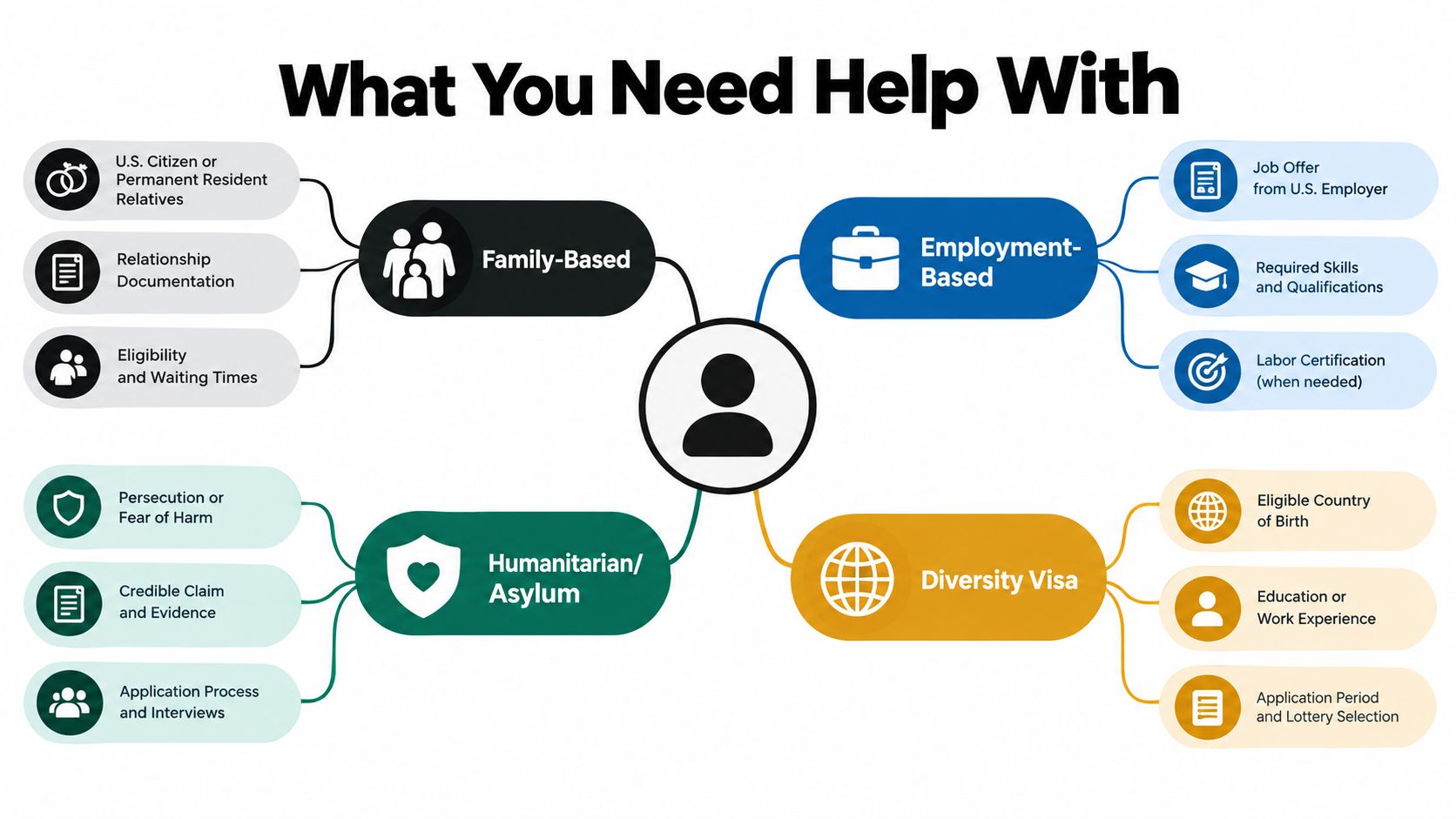
A search for “immigration lawyer for green card” becomes useful only after you define the route. Permanent residence can involve family-based, employment-based, humanitarian, diversity, or other immigrant categories. Each has different eligibility rules, evidence demands, visa-availability questions, and procedural risks.
From FY 2014 through FY 2023, the United States granted lawful permanent resident status to an average of about 1 million foreign nationals annually. During that period, approximately 65% received residence through family-based immigration, 16% through employment-based immigration, 11% as refugees or asylees adjusting status, 4% through the diversity-visa program, and 4% through other categories, according to the Congressional Research Service overview of permanent immigration.
Those figures show why broad claims of “green card experience” are not enough. A lawyer who regularly prepares marriage-based adjustment cases may be poorly suited to an extraordinary-ability petition, a national-interest waiver, or a case involving prior immigration violations. Match the lawyer to the legal problem you have.
Write your case in two sentences
Before contacting a lawyer, complete these statements:
- “I'm applying through…” a spouse or relative, an employer, a humanitarian route, the diversity visa program, or another category.
- “I plan to apply…” from inside the United States or through an embassy or consulate abroad.
For example: “I'm applying through my U.S. citizen spouse, and I'm currently in the United States on valid nonimmigrant status.” Or: “My employer is sponsoring me, and I live abroad, so I expect to use consular processing.”
That summary gives a competent lawyer enough context to ask focused follow-up questions. It also exposes firms that answer with generic promises instead of asking about your category, priority date, chargeability country, current status, and filing route.
Technical case management matters because USCIS received approximately 717,000 Form I-485 adjustment applications in FY 2021, compared with 519,700 in FY 2020, and completed roughly 572,100 in FY 2021, compared with about 504,200 the year before, as reported in the USCIS Statistical Annual Report. A lawyer must manage timing, evidence, visa availability, and agency requests, rather than just complete forms.
Matching the Lawyer to Your Category and Route
Start with your immigration category, then test the lawyer's experience with the procedure you will use. A general “immigration” label tells you very little.
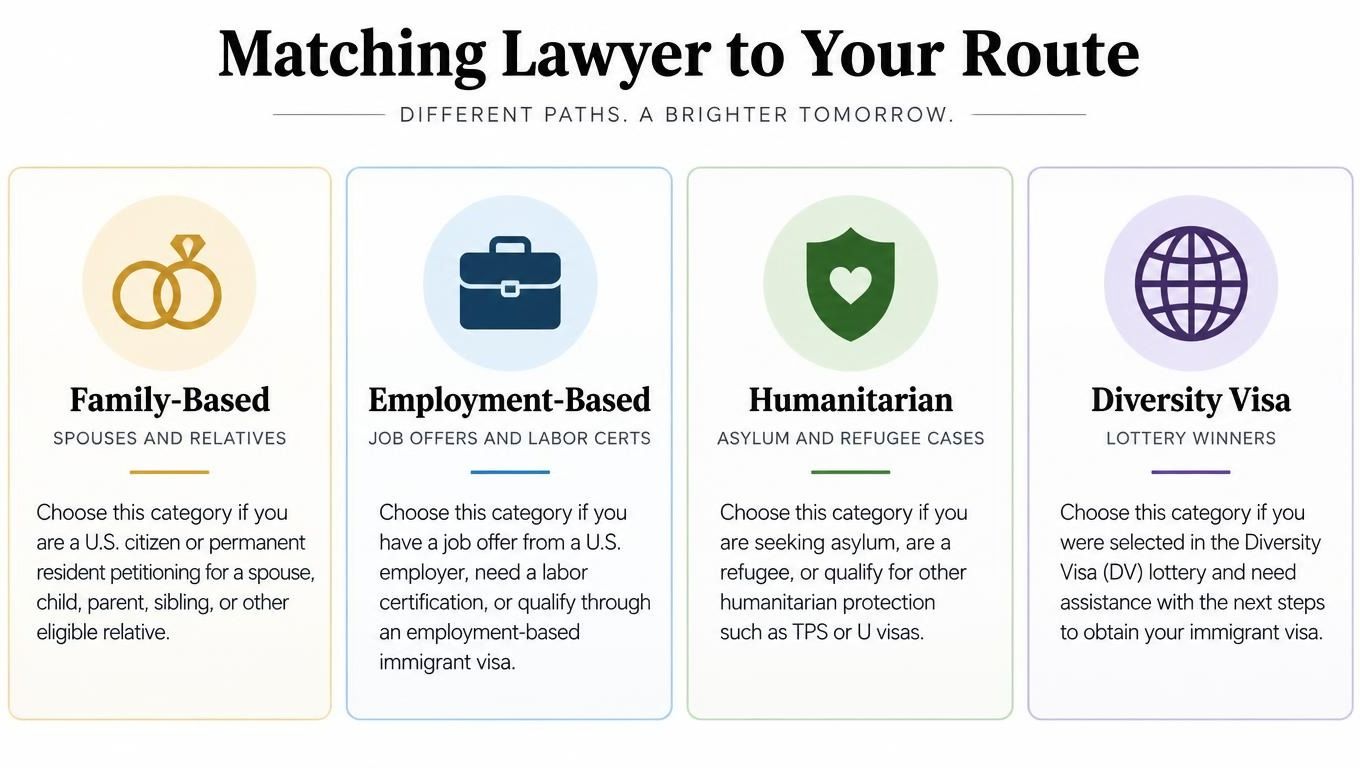
Family-based cases include spouses, parents, children, and other qualifying relatives. Find counsel who handles your specific relationship and routinely reviews bona fide relationship evidence, prior marriages, financial sponsorship, status history, and inadmissibility concerns. A straightforward immediate-relative case may need limited assistance. An overstay, unauthorized employment, prior removal, or suspected misrepresentation calls for careful legal review.
Employment-based cases demand category-specific knowledge. Employment immigration covers routes such as EB-1A, EB-1C, EB-2 national-interest waiver, PERM-based EB-2 or EB-3, and physician cases. Ask which of these the lawyer handles regularly. Then ask about requests for evidence, priority-date planning, employer compliance, and job-offer requirements in your exact category. USCIS guidance for employment-based green cards sets out the eligibility framework, but your lawyer should explain how those rules apply to your facts.
Humanitarian cases may involve refugees, asylees, special immigrant classifications, or other protections. Personal history, credibility, prior filings, and sensitive evidence can shape the case. A lawyer who mainly prepares routine family petitions may not have the right experience for this work.
Diversity visa cases follow a lottery-based route with strict deadlines and procedural requirements. Choose counsel who understands derivative beneficiaries, eligibility documents, consular processing, and the program's timing.
The route changes the lawyer's job
Adjustment of status is generally the route for applicants inside the United States. Counsel may coordinate Form I-485 with an underlying Form I-130 or Form I-140, the medical examination, work authorization, travel permission, and responses to agency requests. Employment-based applicants must also address admission or parole, physical presence, category eligibility, and immigrant-visa availability.
Consular processing takes place abroad through the National Visa Center and a U.S. embassy or consulate. The lawyer coordinates the approved petition, civil documents, interview preparation, and timing around visa availability. Leaving the United States can trigger unlawful-presence bars or reveal another inadmissibility problem, so get specific advice before departing.
Priority dates affect both routes. USCIS may permit filing under one Visa Bulletin chart, while approval depends on the applicable final-action date, admissibility, eligibility, and visa availability. A lawyer who cannot clearly separate petition approval, filing eligibility, and final approval timing has not earned my trust.
Use this guide on how to choose an immigration lawyer as a screening aid. Search with precise terms such as “EB-2 NIW attorney with RFE experience” or “consular processing lawyer for my country,” then ask for examples involving your category and route.
Solo Attorney, Boutique Firm, or General Practice
The firm's structure affects what you'll pay, who answers your questions, and how much category depth you receive. There's no universally superior option. The wrong structure can still create frustration even when the lawyer is licensed and competent.
| Structure | Typical Fee Range | Attorney Access | Best-Fit Applicant |
|---|---|---|---|
| Solo immigration attorney | Ask for a written flat, hourly, or hybrid quote | Often direct access to the attorney, but limited backup coverage | Routine or moderately complex cases where personal attention matters |
| Immigration boutique | Usually priced according to category complexity and staffing | Lawyer access may be shared with experienced case staff | Applicants needing deeper category experience or risk review |
| Large general-practice firm | Often uses a customized quote based on immigration and related services | More layers, but broader internal resources | Employers, executives, or cases involving business, tax, employment, or corporate work |
The first row isn't automatically the budget choice. A solo lawyer may charge efficiently because there are fewer layers, but the office may have less capacity if the lawyer becomes unavailable or your case suddenly requires specialized help.
A boutique can be a strong middle ground. You may get focused immigration knowledge, established document systems, and backup coverage without paying for a large corporate platform. Ask whether the attorney you meet will review the final filing or whether the file moves entirely to a case manager.
Large firms make more sense when the green card is connected to a wider business relationship. An employer-sponsored case may involve corporate restructuring, an executive transfer, labor obligations, or employment changes that require more than immigration-form preparation. For a simple family-based case, however, a large firm's infrastructure may add cost without adding proportional value.
Practical rule: Choose the smallest structure that can competently handle your risk profile, not the smallest structure that can mail a form.
Ask each firm to separate legal fees from government filing fees, medical costs, translation expenses, and possible responses to requests for evidence. Confirm what happens if your priority date retrogresses, your employer changes, your relationship evidence raises questions, or USCIS issues an interview notice. A low initial quote can become expensive if every complication triggers a new bill.
The Vetting Checklist That Actually Works
A polished website proves very little. I'd screen a lawyer in this order: license, category experience, actual staffing, communication, then price.
Start with the state bar. Confirm that the attorney is licensed and check for publicly available disciplinary information. Then look for immigration practice that matches your route, not just a broad statement such as “years of legal experience.”
Ask questions that force useful answers
Send a short first email with two questions:
- “How many cases in my specific category and procedural route have you handled recently?”
- “Who will prepare and review my filing, and what complications would you want to investigate before accepting the case?”
Strong answers contain detail. A lawyer might explain experience with employment-based adjustment after a status change, marriage cases involving prior entries, or consular processing with a particular inadmissibility concern. Weak answers repeat a success slogan or push you straight into a paid consultation without asking what category you're pursuing.
Use this questions to ask before hiring a lawyer as a starting point, but don't treat a long questionnaire as a substitute for judgment.

Look past the name on the website
Find out whether the partner you speak with will handle the case or merely sell the engagement. Ask who drafts forms, who reviews evidence, who communicates with USCIS or the National Visa Center, and who answers urgent questions.
Request a written fee agreement. It should identify the scope of work, included forms, document review, interview preparation, responses to agency notices, refund terms, communication channels, and billing for work outside scope. A flat fee can make budgeting easier, while hourly billing may be fairer when the case is unpredictable. Hybrid arrangements can work if the agreement explains exactly where the billing model changes.
Walk away from these red flags:
- Guaranteed approval: No ethical lawyer can promise an outcome controlled by eligibility, evidence, visa availability, and agency discretion.
- No category questions: A firm that doesn't ask about your route, status, priority date, or prior immigration history isn't screening responsibly.
- Unclear staffing: If nobody will tell you who prepares and reviews the file, expect communication problems later.
A good lawyer doesn't need to impress you with jargon. They need to identify the facts that could change the strategy.
Why a Single Success Rate Is Mostly Marketing
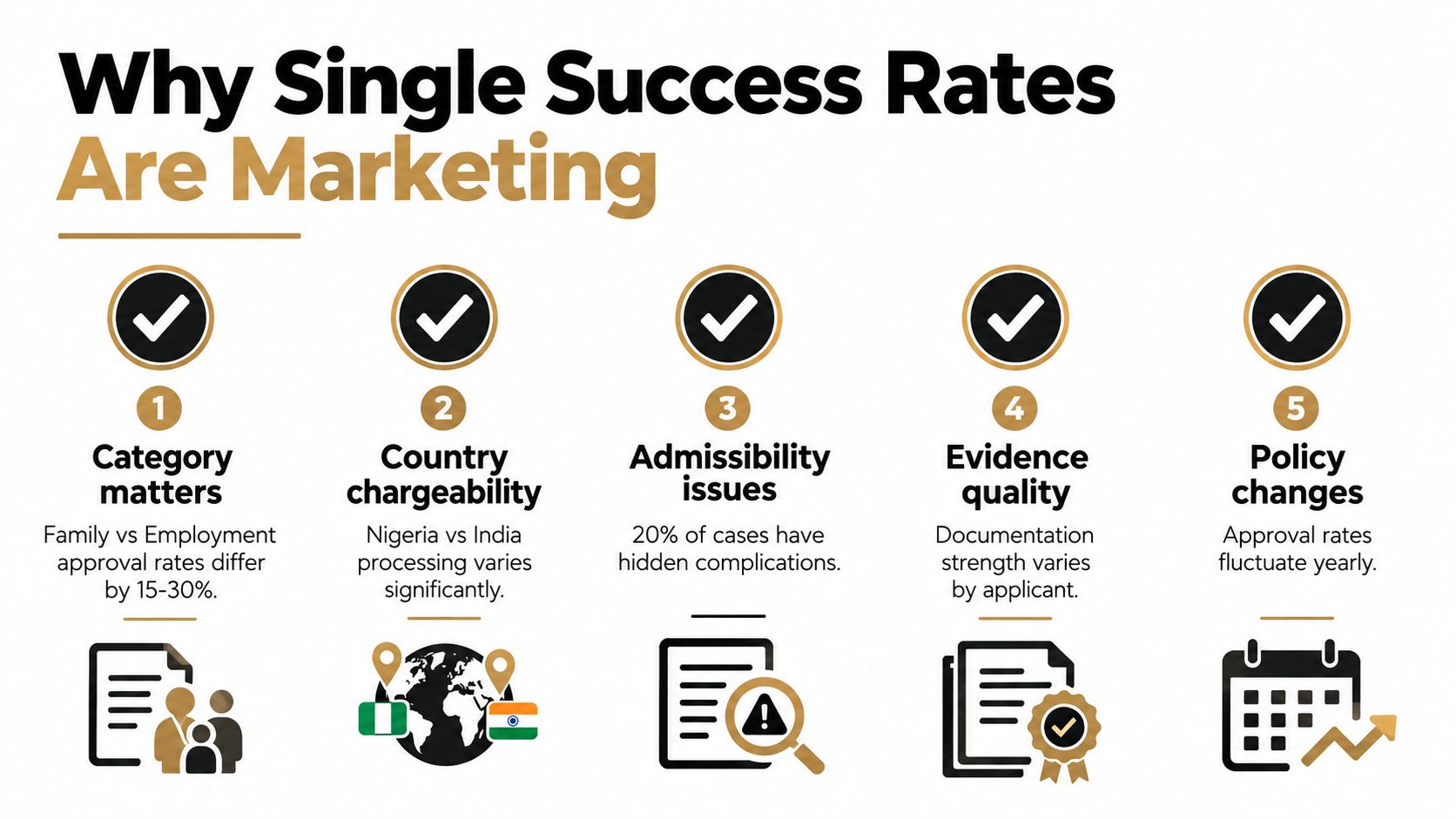
A law firm's “95% approval” claim can sound reassuring, but the figure means little without the category, time period, country of chargeability, admissibility profile, evidence standard, and definition of a completed case. A firm that selects straightforward applications can present a stronger percentage than one that accepts difficult matters.
A cited analysis found an average denial rate of 8.0% for employment-based immigration cases over a decade and 11.8% during the first three quarters of a later administration. Those figures describe broad groups, not your application. The American Immigration Council analysis shows why population-level rates cannot replace a case-specific review.
Your risk depends on the underlying category, visa availability, country of chargeability, admissibility history, petitioner strength, and evidence quality. Ask a lawyer which facts drive your risk and which documents would address them. A percentage cannot show whether the lawyer spots a weak point early, explains the consequence, or proposes a workable solution.
Run a denial-risk audit instead
Before comparing firms, privately list the facts your lawyer must review:
- Immigration history: Every visa, entry, petition, application, denial, departure, and status change.
- Status problems: Any overstay, unauthorized employment, or gap in lawful status.
- Admissibility concerns: Criminal issues, fraud or misrepresentation allegations, health-related grounds, prior removal, or unlawful presence.
- Evidence weaknesses: Missing birth records, inconsistent names, incomplete translations, weak relationship proof, or gaps in employment records.
- Petitioner strength: Whether the family petitioner can meet sponsorship obligations or the employer can support the offered position.
- Visa timing: Whether the category and priority date allow filing and whether approval is currently possible.
For employment-based adjustment, USCIS considers filing eligibility, admission or parole, physical presence, visa availability, and category-specific rules. In many employment cases, Supplement J helps confirm that the offered job remains valid. Ask how the lawyer will document and monitor that offer.
The useful performance measure is whether the lawyer identifies the problem before USCIS does, rather than quoting an unqualified approval percentage.
Getting Real Value Out of the Consultation
A consultation should produce a decision, not just a pleasant conversation. Treat it as a paid work product and prepare enough information for the lawyer to analyze the appropriate route.
Send a concise timeline before the appointment. Include entries and exits, visa history, prior filings, current status, relationship or employment facts, previous refusals, and any incident that makes you nervous. Add the relevant notices and petitions rather than summarizing them from memory.
Then ask the lawyer to explain four things:
- Which category and route fit the facts?
- What could make the case ineligible or unsafe?
- What documents would prove each important requirement?
- What event controls the filing and approval timing?
A strong consultation identifies missing facts, separates known answers from open questions, and gives you a practical next step. It may recommend immediate filing, additional evidence, a waiver analysis, consular processing, adjustment of status, or waiting for visa availability.
A weak consultation sounds confident but stays generic. The lawyer talks about forms, quotes a fee, and never asks about prior immigration history, chargeability country, status maintenance, or the underlying petition.
Bring the same packet to two lawyers and compare their written follow-up. Ask for a flat-fee option where the work is predictable, and confirm whether the quote includes document review, interview preparation, and responses to agency requests. Before hiring, verify who will handle the file day to day and how quickly the office responds to client questions.
For practical preparation, review this guide to an immigration lawyer consultation. The consultation has done its job when you understand both the recommended path and the reason competing paths are weaker.
Your Green Card Lawyer Decision in One Sitting
You can usually narrow the decision to one of three choices.
Hire a specialist now if your case includes a prior overstay, unauthorized work, criminal or misrepresentation concern, removal history, complicated employment category, weak documentation, or uncertain visa availability. The test is simple: if one missed fact could change your eligibility or route, pay for specialized review before filing.
Self-file and consult on risk points if your category is routine, your records are consistent, your status history is clean, and you understand exactly which forms and evidence apply. Use a lawyer for a targeted review rather than paying for full representation you don't need.
Pause and wait if your petition may be approvable but your priority date doesn't permit the next step. Waiting without a written explanation is careless. Waiting with a Visa Bulletin strategy and an evidence plan is sensible.
After the consultation, ask for one deliverable: a written timeline showing your category, chargeability country, priority date, permitted filing chart, expected bottlenecks, and every evidence item required before submission.
That document tells you whether the lawyer understood your case. It also gives you something far more valuable than a generic approval percentage, a defensible plan.
HeyAtty helps you describe your immigration situation, compare vetted attorneys by relevant experience, review availability and pricing, and book a consultation. Use the guided matching process to find a lawyer who fits your green-card category and route, then visit HeyAtty to get started.