
Online Lawyer Consultation: How It Works and What to Expect
Learn how online lawyer consultation works, from choosing the right attorney to preparing for your first virtual meeting. Practical tips
The first time someone needs a lawyer, it usually happens on a bad day. A lease notice lands in the inbox, a contract looks risky, an immigration deadline starts looming, or a family issue becomes too important to keep guessing about. The hard part isn't always the legal problem itself, it's the first outreach, the awkward call, the uncertainty about whether you're even talking to the right person.
That's where an online lawyer consultation earns its place. Done well, it lets you compare fit, price, and availability before you commit, which matters because legal help now starts online for many people and remote delivery has become part of the mainstream service mix in both the U.S. and the U.K. Stanford Legal Design Lab's summary of survey findings notes that the internet often becomes the first stop for legal problems, and the Legal Services Consumer Panel found that a large share of services were mainly delivered by email or online in 2024. For clients, that shift changes the core question from “Can I book a call?” to “Who's the right lawyer for my situation?”
Table of Contents
- When an Online Lawyer Consultation Actually Makes Sense
- How the Online Consultation Process Works From Search to Follow-Up
- What Makes a Lawyer Profile Worth Trusting Remotely
- Preparing Your Materials Before the First Virtual Meeting
- Why a Shortlist Beats a Long Directory of Lawyers
- Privacy, Consent, and What Is Safe to Share Online
- Making Your First Online Consultation Count
When an Online Lawyer Consultation Actually Makes Sense
A lot of people wait too long because they assume legal help has to begin with an office visit. In practice, an online lawyer consultation makes sense the moment you need a quick read on the issue, but you are not yet at the stage that requires someone physically beside you. A tenant in another city dealing with an eviction notice, a founder needing contract advice before signing, or a parent sorting out a family matter without an immediate court appearance can all start remotely.
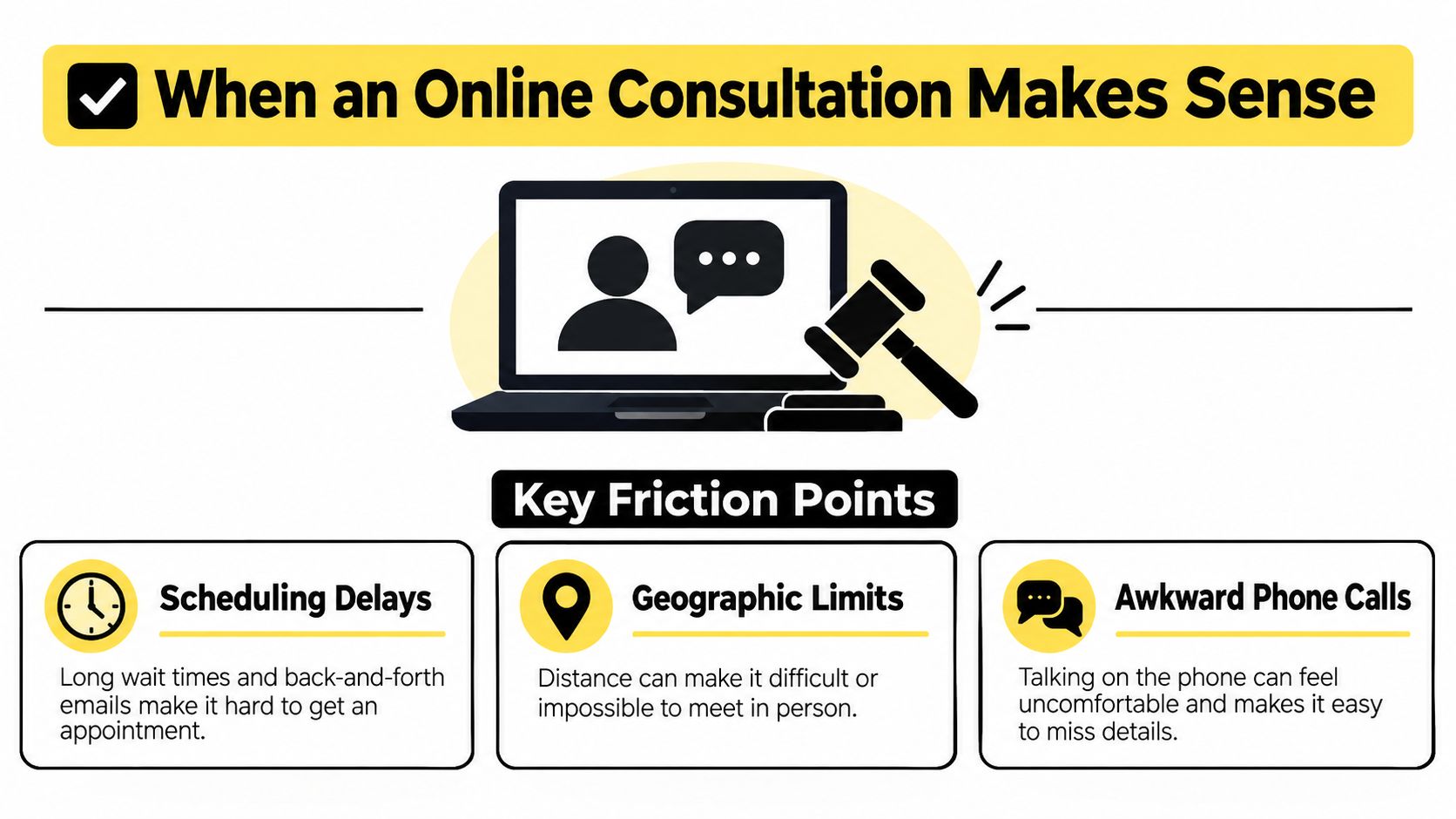
The cases that fit remote first
Remote consultations work especially well for initial case assessment, document review, and second opinions. They also fit matters where the main issue is information rather than appearance, because the lawyer can hear the facts, ask follow-up questions, and tell you whether the problem is urgent or routine. That is why a remote first meeting can save you from booking the wrong specialist, especially when your issue sits at the edge of more than one practice area.
Practical rule: if the first meeting is mostly about understanding the problem, remote usually works. If the meeting depends on a physical filing, a live hearing, or a local appearance, online still helps, but it will not solve everything.
The market has clearly moved in that direction. U.S. online legal services reached an estimated $15.2 billion market size in 2026, with revenue growing at a 4.8% CAGR from 2020 to 2025 and the number of businesses rising to 17,243 in 2025 IBISWorld. That does not mean every legal matter should stay remote, but it does mean the infrastructure is mature enough to support serious comparison and booking.
Online consultation is not a replacement for all legal work. It is the fastest way to decide whether the lawyer in front of you is the one you should keep talking to, and whether the matter needs in-person follow-through later.
How the Online Consultation Process Works From Search to Follow-Up
The cleanest online consultation flow starts before the call and ends after the call, not during it. Search is the first filter, and it should narrow by jurisdiction, practice area, and, when relevant, language. If those basics are wrong, everything after that wastes time.
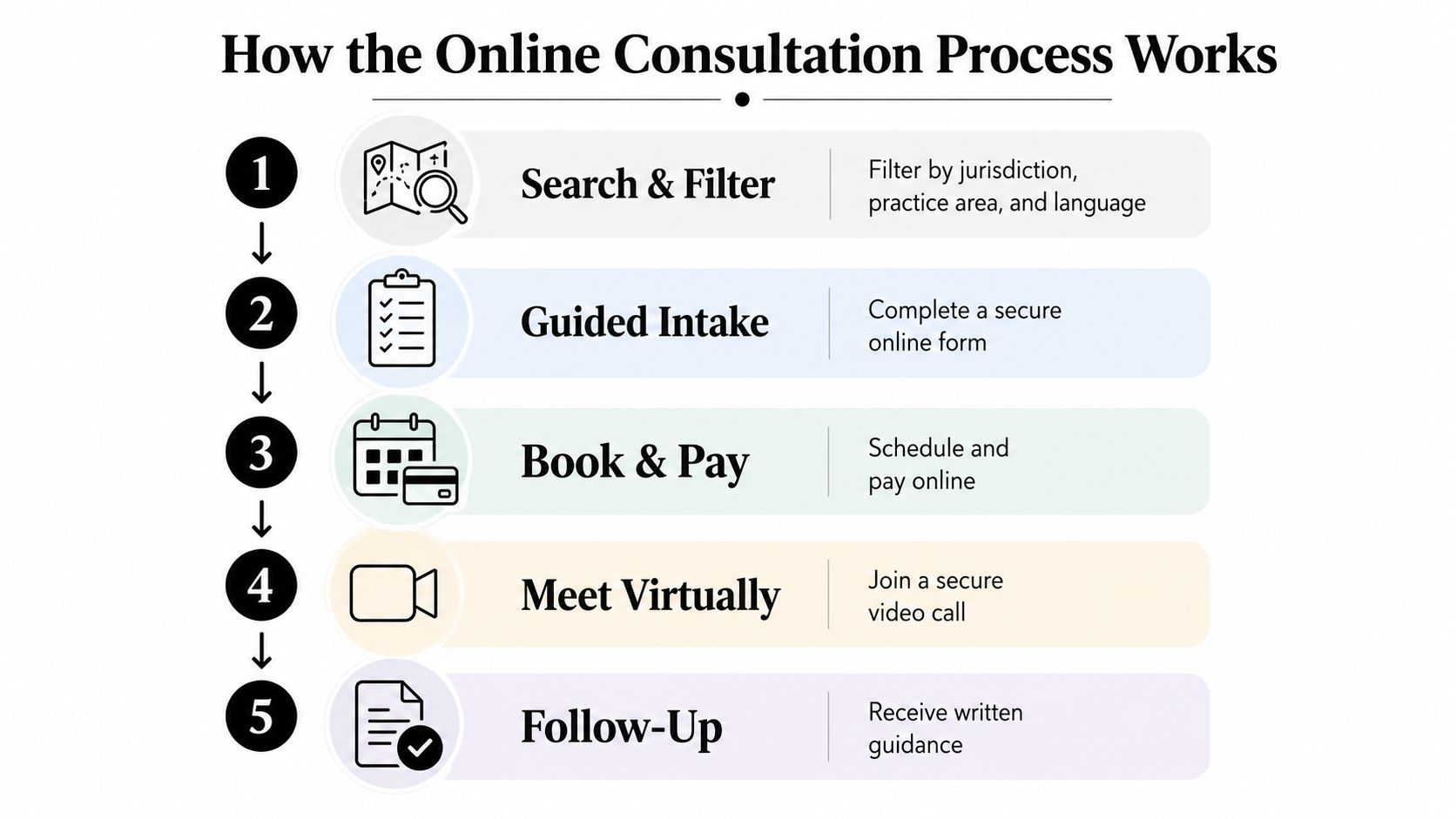
From search to booking
The next step is guided intake. A good intake form asks what happened, how urgent it is, what documents you already have, and what outcome you want. That structure matters because consumer research shows many people contact only one attorney before deciding, so the first contact has outsized weight in whether the matter moves forward.
Booking should happen only after the platform has enough information to avoid random matches. In a well-run process, you see availability, the consultation fee, and confirmation details in one pass. If payment is part of the workflow, the client should know what the fee covers before the calendar invite lands.
What happens during the live meeting
The live consultation should feel like a focused working session, not a meandering intake. Screen sharing helps when you need to review a lease, a demand letter, a contract redline, or a timeline of events. A lawyer who takes real notes and keeps the conversation tied to your actual issue is usually giving you better value than someone who fills the hour with generalities.
Post-meeting follow-up matters just as much as the call itself. A written summary, a next-step email, or an engagement letter turns a verbal conversation into something you can act on. For matters that continue, secure document exchange should move into a portal rather than staying in email threads.
The biggest friction point I see is mismatch between the client's time zone and the lawyer's availability. Automated time-zone conversion, calendar reminders, and clear rescheduling rules reduce that drag. HeyAtty fits this workflow by letting users compare profiles, see availability and pricing, and book securely after a short guidance flow when the legal issue is unclear.
What Makes a Lawyer Profile Worth Trusting Remotely
A polished profile is not the same thing as a trustworthy one. When you're evaluating a lawyer remotely, the most objective signal is still license verification, ideally with a bar registry link or registration number that you can cross-check yourself. Anything less is just marketing until you verify it.
The signals that deserve attention
Practice-area specificity matters more than broad claims. A lawyer who says they handle “everything” may be experienced, but a lawyer who clearly handles your kind of issue gives you a better read on fit. Representative matters, years active, and client reviews that describe the actual result all matter more than generic praise about being “helpful” or “responsive.”
Pricing transparency is another deciding factor. If the profile shows hourly ranges, flat-fee options, or whether the consultation fee gets credited toward future work, you're much closer to a real buying decision. That kind of detail also helps you avoid the common frustration of booking a call only to discover the matter is outside your budget.
Trust comes from specificity. If the profile leaves you guessing about licensing, scope, or price, the consultation starts with doubt instead of confidence.
| Trust Signal to Check on a Lawyer Profile | What to Look For | Why It Matters |
|---|---|---|
| License verification | Bar registry link, registration number, active status | Confirms the person is actually authorized to practice |
| Practice-area fit | Clear description of the exact issue handled | Reduces mismatch and wasted consult time |
| Case experience | Representative matters that resemble your situation | Helps you judge practical relevance, not just credentials |
| Pricing clarity | Hourly range, flat fee, consultation fee policy | Lets you compare options without hidden surprises |
| Proof of expertise | Articles, speaking, memberships, publications | Suggests the profile reflects real professional activity |
Softer signals still have value. Published articles, conference speaking, and professional memberships can show that the lawyer stays visible in the field, but they should support, not replace, verification. The core habit is to cross-check claims instead of trusting the bio at face value.
If you want a tighter checklist of questions to bring into the call itself, this guide helps frame the conversation well: questions to ask before hiring a lawyer.
Preparing Your Materials Before the First Virtual Meeting
A remote consultation goes wrong most often when the client treats it like a casual intro call. The lawyer can only reason from what's in front of them, so preparation determines whether the meeting produces strategy or just expensive confusion. If you show up with scattered files and no chronology, you'll spend your paid time reconstructing basics.
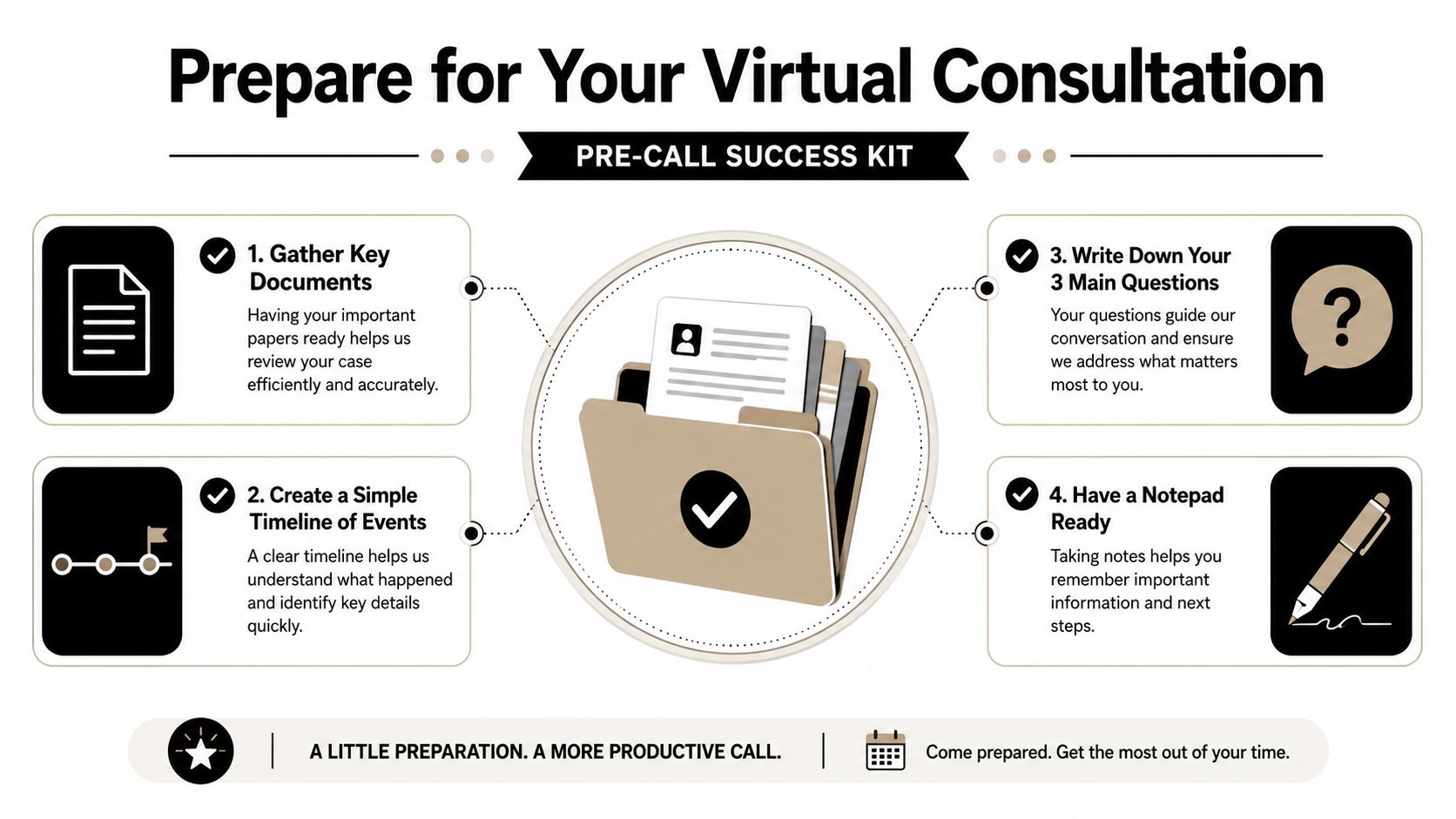
What to gather before you click join
Start with one folder that holds everything relevant. That means emails, notices, contracts, screenshots, letters, and anything else that helps tell the story. Add a one-paragraph timeline of events, then list your top three questions in priority order so the lawyer can work from your actual goals instead of wandering through the file.
Technical preparation matters too. Test your camera, microphone, browser, and backup audio option before the appointment starts. If you can, keep a second device nearby so you can view documents and the video call side by side without constantly switching tabs.
What to confirm before the call
Confirm the legal jurisdiction in advance, because that changes the advice. A lawyer can't give useful guidance if they're guessing which state, province, or country rules apply. Also check whether the platform allows screen sharing and whether recording is permitted, because those two details affect how freely you can discuss documents.
Simple standard: the first five minutes should be about facts, not logistics. If you're still hunting for files or fixing audio, the meeting has already lost momentum.
A concise written summary template helps more than people expect. Before the call, write the issue, the dates, the parties involved, the current status, and the outcome you want. That gives the lawyer a clean starting point, and it keeps the live meeting focused on legal judgment instead of intake repetition.
Why a Shortlist Beats a Long Directory of Lawyers
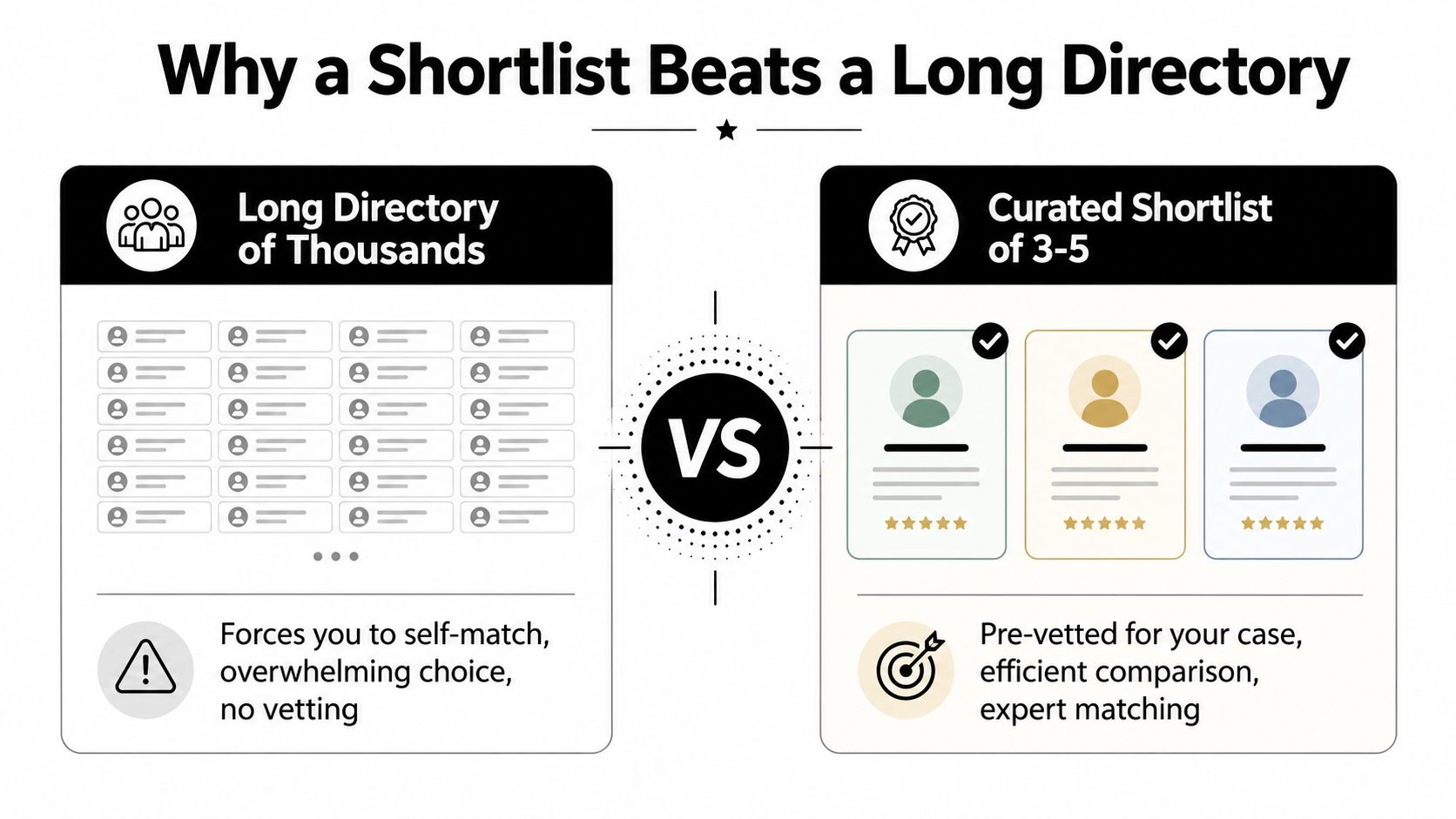
More options sound helpful until you're the one trying to compare them. A long directory usually shifts the matching work onto the client, which is exhausting when you don't already know the practice area, the local rules, or how to judge experience from a profile photo. A shortlist of three to five lawyers is often better because it forces the platform to do the filtering up front.
Why fewer options help decision quality
A curated shortlist reduces noise. Instead of scanning dozens of generalists, you compare only the profiles that already look relevant to your matter. That makes the consultation decision feel more like choosing among viable candidates and less like decoding a directory.
The trade-off is real. Shortlists can miss a good generalist or an emerging specialist, so independent verification still matters. But for most people, the goal isn't to admire breadth, it's to identify one credible lawyer who can talk about the exact problem without wasting your time.
Why structured matching works better
Guided intake improves the shortlist because it captures the facts that matter for fit. When a platform asks about the issue, jurisdiction, and urgency before showing lawyers, it can surface a smaller set of professionals who handle that kind of matter. That's much stronger than a directory where every profile looks equally relevant until you open it and realize it isn't.
The practical value shows up in the consultation itself. Lawyers spend less time figuring out whether they're the right fit, and clients spend less time bouncing between irrelevant profiles. The result is a cleaner first meeting and a better shot at booking someone who can take the file.
Privacy, Consent, and What Is Safe to Share Online
Remote legal help only works when people trust the platform enough to disclose the right facts. That trust starts with encryption, clear data-retention policies, and explicit consent before anything gets recorded or shared. It also depends on how the platform handles storage, because the legal answer and the technical answer are both part of the risk.
Sensitive matters raise this issue fastest. People hesitate for good reason in areas like immigration, family, and housing, where the story can involve identity documents, financial details, or third parties. The safest approach is to share the issue summary, jurisdiction, and urgency first, then hold back the most sensitive files until the relationship is formalized.
What to share before a retainer exists
Before engagement, stick to the minimum needed for a meaningful assessment. That usually means a concise description of the problem, the location involved, key dates, and what outcome you want. Full IDs, bank details, account numbers, and unrelated sensitive documents can wait until there's a signed engagement letter and a clear consent framework.
Unsecured email and personal messaging apps are the weak points. They're convenient, but convenience is not the same as confidentiality. If a platform doesn't explain how data is stored, who can access it, and how deletion requests work, treat that as a gap rather than a minor omission.
Ask one simple question before you book, where does my information go, and who can see it?
A quick platform check should include the jurisdiction of data storage, the breach-notification policy, and the right to request deletion. If those answers are hard to find, the platform may still be useful, but it hasn't done enough to earn blind trust.
Making Your First Online Consultation Count
Treat the first call like a decision meeting. Open with the legal issue in two sentences, the outcome you want, and the deadline you're facing. That gives the lawyer something concrete to work with, and it immediately shows whether they understand your problem at the right level.
How to test fit in real time
Ask the lawyer to repeat the issue back in their own words. If they can't summarize it clearly within a few minutes, that's a signal to pay attention to. A strong consultation usually feels specific fast, because the lawyer can identify the legal path, the risk level, and the next practical step without drifting into vague reassurance.
Fee clarity should happen before the call ends. Get the hourly rate, flat-fee option if there is one, retainer requirements, and what the retainer covers in writing. If you want a deeper look at fee structures before booking, this guide breaks down the topic well: legal consultation fee.
What to leave with
You should leave the meeting knowing who will do the work. A senior lawyer may attend the consultation and then hand the file to someone else, which is fine if you know that upfront. Ask for a written follow-up that summarizes the advice, next steps, and timeline, then decide whether to book the next meeting or close the file.
Build a short buffer around the appointment so you can review notes while the conversation is fresh. That small habit makes the meeting more useful because you can capture action items, compare options, and decide whether the lawyer feels like the right fit before the thread goes cold.
If you're ready to compare lawyers without sorting through a huge list, start with a platform that shows fit, availability, and pricing together, then use that shortlist to book the first serious conversation. HeyAtty gives you a structured way to narrow the field, review verified profiles, and move from question to consultation without wasting time on the wrong match.