
How to Sign a Lease Without Making Costly Mistakes
Learn exactly how to sign a lease with confidence. Master key clauses, negotiation strategies, and avoid hidden fees with this comprehensive guide.
59.6% of U.S. leases are for 12 months, but signing one safely requires reviewing every page, addendum, and fee schedule before you commit. The rent may be the largest line on the offer, yet the fine print often determines what you will pay and how easily you can leave.
You've found an apartment that fits your budget, the landlord wants an answer today, and the lease arrives as a long PDF or a stack of pages. The temptation is understandable. You skim the rent, dates, and deposit, sign where the platform points, and assume the rest is standard.
That assumption causes trouble. A lease can allocate utility charges, parking costs, repair duties, insurance requirements, renewal deadlines, and early-termination exposure. Treat the signature as the beginning of your tenancy, not as a routine administrative step.
Table of Contents
- The Lease Signing Trap Most Renters Fall Into
- Understanding Standard Lease Terms and Durations
- The Critical Review Process Before Signing
- In-Person Versus Electronic Signing Methods
- Avoiding Hidden Move-In Costs and Fee Stacking
- Final Steps and When to Consult a Professional
The Lease Signing Trap Most Renters Fall Into
A common signing scene looks harmless. You're at a table, or on your phone between errands, with a landlord or leasing agent waiting for your decision. You've already discussed the monthly rent, whether a pet is allowed, and the hoped-for move-in date. The conversation feels settled, so the document seems like a formality.
The problem usually appears later. The lease says utilities are billed separately, the pet arrangement is missing, the parking space carries a separate charge, or the landlord's promise to repair a fixture exists only in a text message. None of those details had to look suspicious during a rushed signing. They become important when the first bill arrives or a disagreement develops.

Why the rent line is not enough
The lease's headline terms rarely tell the whole financial story. The full cost can change through:
- Additional charges: Utilities, parking, pet-related charges, and administrative fees may sit in an addendum rather than beside the rent.
- Repair responsibilities: A tenant may be expected to handle minor maintenance, service calls, filters, or damage that the tenant assumed the landlord would cover.
- Notice language: A missed deadline can affect renewal, move-out timing, or the amount of rent owed after the initial term.
- Promises outside the document: A verbal concession has little practical value if nobody records it in the signed agreement.
A neutral lease-reading guide recommends checking attachments, notices, repair procedures, security deposits, utilities, parking, pets, insurance, and notice requirements because those items can alter the true monthly cost. That is the useful mindset: read the lease as a complete contract, not as a rent confirmation.
Practical rule: If a promise matters to your decision, put it in the lease or a signed addendum before you sign.
The safest response to pressure isn't automatically walking away. Ask for the complete document, review it away from the conversation, and send a written list of discrepancies. If the landlord won't provide the attachments, won't clarify a fee, or insists that an important promise “doesn't need to be written down,” treat that conduct as information about the tenancy you're considering.
Understanding Standard Lease Terms and Durations
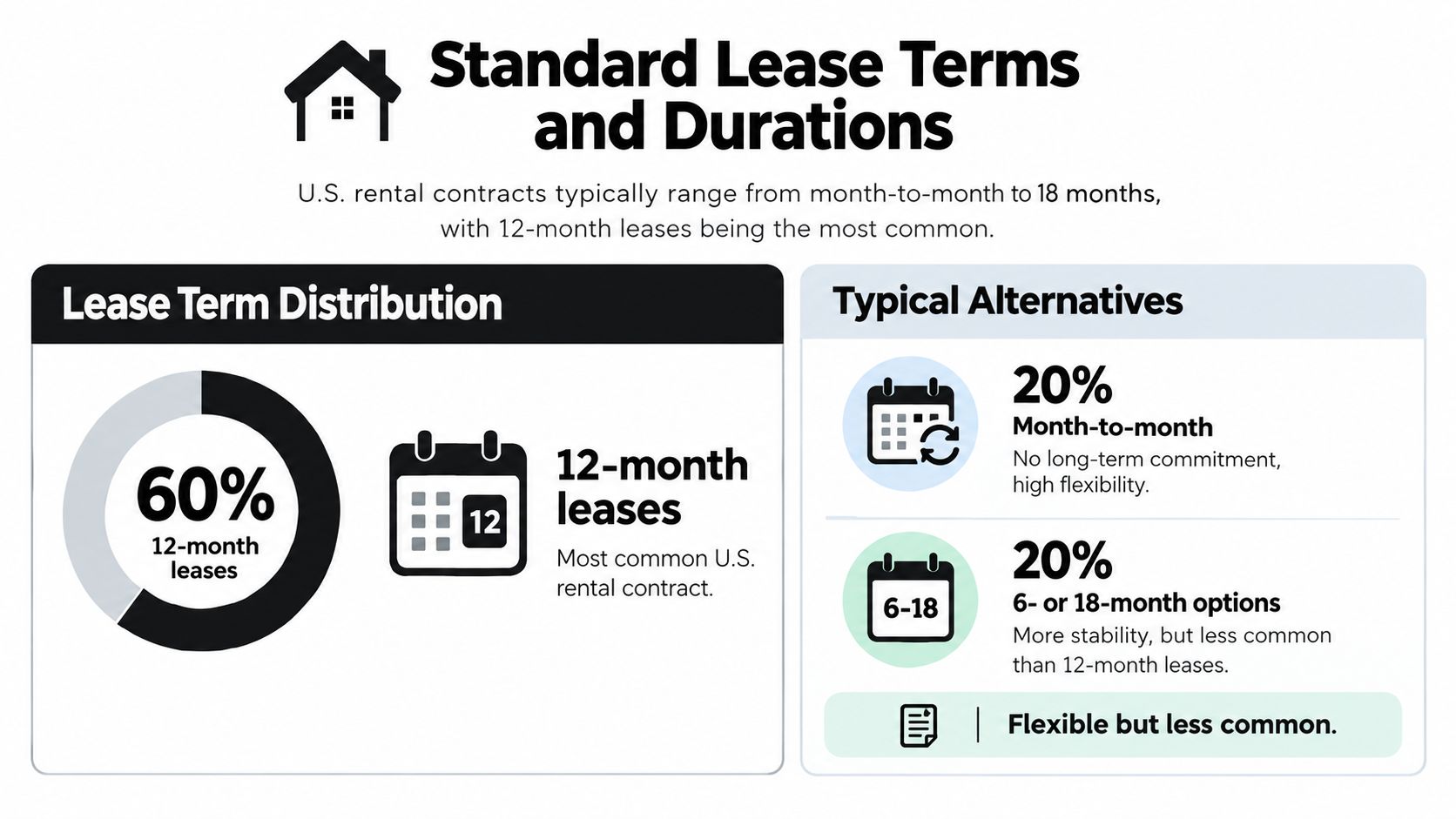
The one-year lease is the dominant pattern in the U.S. rental market. A Bureau of Labor Statistics housing survey covering January through June 2022 found that 59.6% of leases lasted 12 months, compared with 31.8% that were month-to-month and 8.6% with another term. The figures appear in the BLS analysis of housing leases.
That distribution matters before you sign because the term controls more than the date printed on the first page. A 12-month commitment may provide predictable occupancy for the stated period, but it can also limit your ability to relocate. Month-to-month occupancy may offer a more adaptable exit, yet its renewal and termination rules can create different forms of uncertainty.
What the term tells you
The smaller group of nonstandard terms isn't uniform. Within that group, BLS reported 24-month leases at 29.9%, 13-month leases at 14.8%, and 6-month leases at 12.4%. Those alternatives can serve different needs, so don't accept “standard” as an answer to a question about your own circumstances.
| Lease structure | Practical question before signing |
|---|---|
| 12 months | What happens at expiration, and how much notice is required to leave? |
| Month-to-month | Can either party terminate, and what notice applies? |
| Longer fixed term | Is the stability worth giving up flexibility? |
| Shorter fixed term | Will the next renewal rate or availability be clear? |
Tenure also changes the pattern. The BLS found that nearly 92% of tenants who had lived in a unit for less than one year had a 12-month lease, while 49.7% of tenants who had stayed five years or more still had a 12-month lease, with most of the remainder in month-to-month arrangements. The data suggests that a fixed term often governs the initial occupancy, while longer stays may move toward a more flexible arrangement.
Read the exit language first
Start with the end date, renewal mechanism, notice period, and early-termination clause. Look for language that automatically converts the tenancy, requires written notice in a particular form, or imposes financial responsibility after an early move. Don't assume that asking about renewal later will produce the same terms as the original offer.
If you want flexibility, negotiate it before signing. Ask the landlord to state the renewal process, notice deadline, and consequences of leaving early in clear language. A lease that is ordinary in length can still be unusually restrictive if its exit provisions are vague or heavily one-sided.
The Critical Review Process Before Signing
The highest-value review method is simple, but it requires discipline: compare the final lease with everything you negotiated. Don't review only the page that shows the rent. Download the complete file, confirm that every page is present, and check that the addenda named in the lease are attached.
Build a reconciliation list
Use the offer, emails, messages, and notes from your conversations as a comparison document. Then work through the lease in a fixed order:
- Confirm the parties and property. Check the legal names, unit address, included spaces, storage areas, and parking description.
- Match the financial terms. Verify rent, payment date, deposit, recurring charges, one-time fees, utilities, and any concessions.
- Check the dates. Compare the possession date, lease start, lease end, renewal timing, and any deadlines for notice.
- Read every addendum. House rules, pet terms, utility schedules, parking agreements, insurance requirements, and repair policies may carry obligations absent from the main document.
- Resolve contradictions. If the body of the lease conflicts with an addendum or a negotiated promise, ask for a corrected document before signing.
The reason for this process is practical. A missing repair promise can become a disagreement about responsibility. An unclear utility formula can make the monthly cost unpredictable. A vague notice clause can limit your ability to move out on the date you expect.
Examine the clauses that change cost
Security deposits deserve more than a glance at the amount. Find the conditions for deductions, the move-out documentation process, and the procedure for disputing a charge. Then review utilities, parking, pets, repairs, insurance, and notice requirements as separate cost centers.
Don't rely on a leasing agent's verbal explanation when the text says something else. Mark the exact provision, describe the change you need, and request a revised lease or signed addendum. Keep the final version, not just a screenshot of the signing screen.
| Review area | Question to answer in writing |
|---|---|
| Utilities | Which services are included, and how are shared charges allocated? |
| Repairs | Who handles routine items, emergency calls, and tenant-caused damage? |
| Insurance | Is coverage required, and when must proof be provided? |
| Pets and parking | Are permission and charges documented in the signed papers? |
| Notice | How must notice be delivered, and when does it have to arrive? |
If the lease involves unusual obligations, a commercial arrangement, a guarantor, or a serious disagreement over wording, a business contract lawyer may be able to identify problems that a general checklist won't catch. For an ordinary rental, careful self-review may be enough, but uncertainty about a clause is a reason to get a qualified interpretation before your signature turns the terms into a commitment.
In-Person Versus Electronic Signing Methods
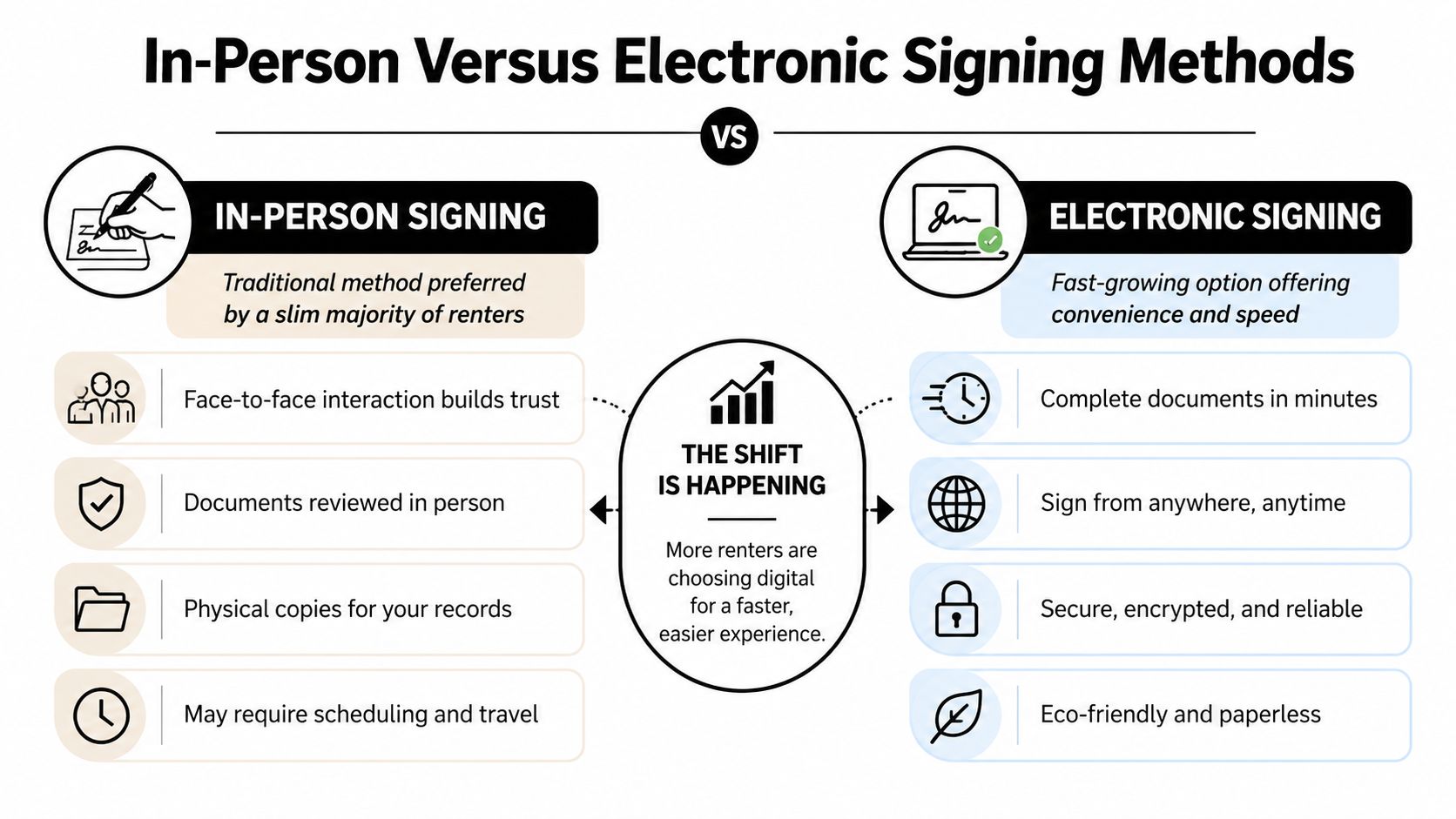
The method you use to sign a lease affects convenience and review quality, not just appearance. In-person signing gives you a chance to ask questions while the other party is present. Electronic signing gives you more control over timing and creates a digital workflow, but it can also encourage a quick click-through if you don't download and read the complete document first.
Zillow's Consumer Housing Trends data records a clear movement toward digital execution. The share of recent renters who signed electronically rose from 21% in 2018 to 23% in 2019, 30% in 2020, 35% in 2021, 36% in 2022, 40% in 2023, and 43% in 2024, before reaching 40% in 2025, according to the 2025 Zillow renters report. In 2025, 52% signed in person, while 47% said they ideally preferred electronic signing.
Choose the method that protects your attention
In-person signing works well when the landlord is willing to go page by page and answer questions. You can point to a clause, request a correction, and confirm that the final printed set includes the changes. It works poorly when the meeting is presented as an immediate signature appointment and you're expected to discover important terms in real time.
Electronic signing works well when you receive the document early, can review it on a larger screen, and get a completed copy with an audit trail after all parties sign. It works poorly when the signing platform guides you only through required signature fields. A platform can confirm that you signed every required box without confirming that you understood the fee schedule beside it.
| Method | Strength | Risk to manage |
|---|---|---|
| In person | Immediate discussion and clarification | Pressure to sign before a private review |
| Electronic | Convenient access and a clear document trail | Fast clicking, technical errors, or an incomplete download |
Before you sign digitally, save the unsigned lease, open every attachment, and make sure the final copy includes initials and signatures where required. Check that the names, dates, and agreed changes appear correctly. If a technical problem interrupts the process, don't assume the landlord has the same version you do. Ask which document controls and request a complete replacement if necessary.
You can also seek advice remotely if the concern is legal rather than technical. An online lawyer consultation can help you prepare focused questions about an unfamiliar clause without turning a convenient signing method into an uninformed one. The best method is the one that gives you enough time, a complete record, and a genuine opportunity to ask questions.
Avoiding Hidden Move-In Costs and Fee Stacking
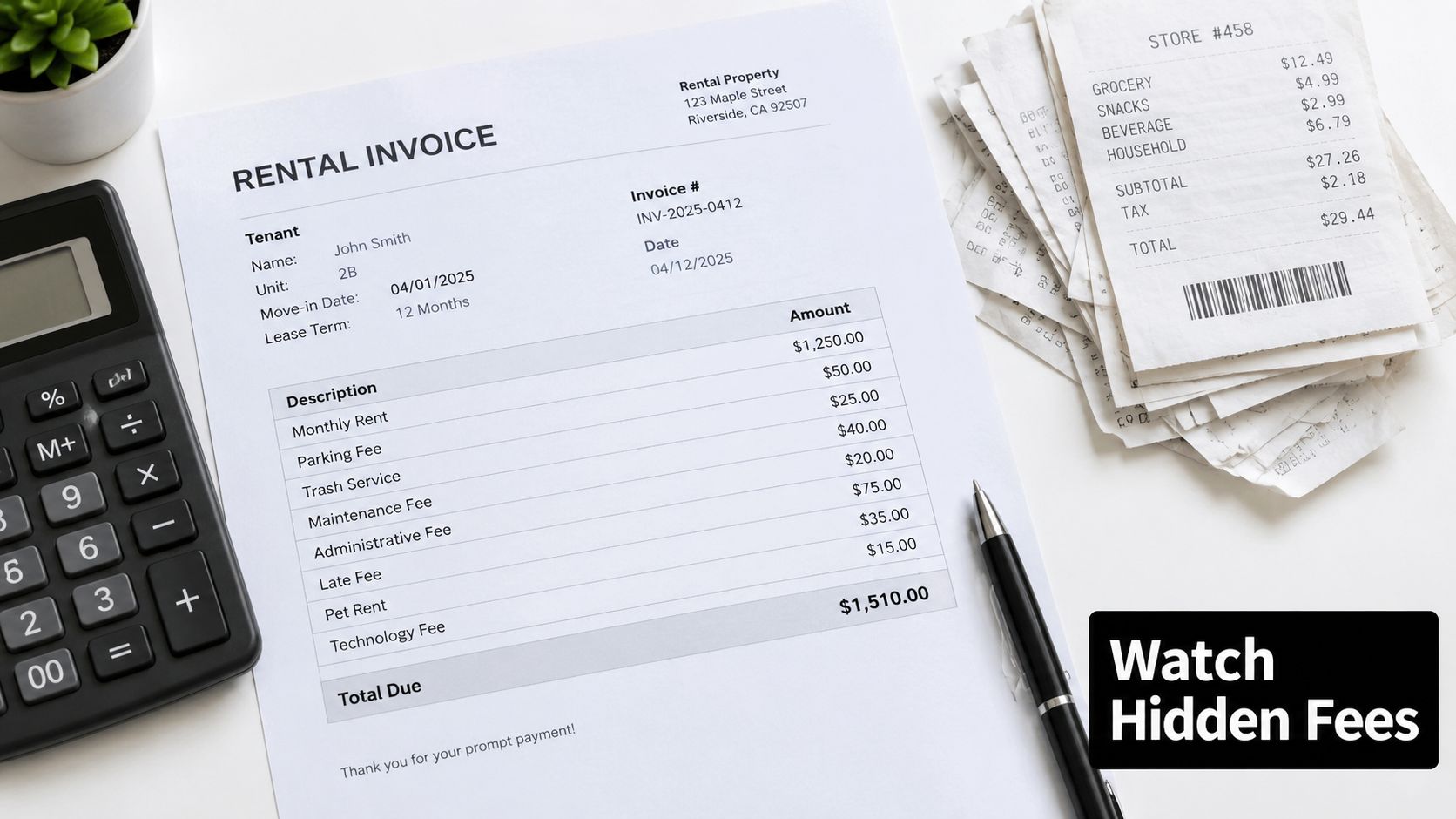
Renters often focus on the recurring rent and treat everything due at move-in as one unavoidable package. That approach makes it harder to tell whether a charge is a refundable deposit, a nonrefundable fee, a recurring cost, or a payment connected to a separate service.
Request a full move-in cost statement before you sign. It should list each amount by name, show whether it recurs, identify whether it may be refundable, and connect the charge to a lease clause or addendum. If the leasing office gives you only a total, ask them to itemize it.
Separate every charge
A security deposit, move-in fee, pet fee, and lease fee may not serve the same purpose. The legal treatment can depend on the jurisdiction and the wording of the agreement, so don't assume that calling something a “fee” answers what happens to the money later.
Use questions that force clarity:
- Security deposit: Under what conditions can the landlord deduct from it, and how will deductions be documented?
- Move-in charge: Is it refundable, and what service or obligation does it cover?
- Pet charge: Is it a one-time payment, a recurring charge, or both?
- Lease or administrative fee: Is it included in the advertised rent, and does it appear anywhere else in the contract?
- Utilities and services: Are billing, convenience, technology, trash, or other service charges recurring?
The written answer matters because a casual explanation can disappear when the staff member changes. Ask for the lease, addendum, invoice, and payment instructions to use the same names for the same charges. If they don't, request a correction before transferring money.
Don't let market pressure make the decision for you
A January 2026 rental market report said the median list-to-lease time reached 41 days, a signal that many listings may remain available long enough for renters to feel pressure to decide quickly, as described in Apartment List's rental market report. Pressure doesn't make an unexplained charge acceptable. It does make preparation more important, because you may have less time to compare the offer with the complete contract.
Keep the move-in statement with the signed lease and payment receipts. A complete paper trail is much easier to use than a memory of what the leasing office said.
If the landlord refuses to identify a charge, adds a cost after you agreed to the terms, or asks you to pay an amount that isn't in the documents, pause the signing process. Ask for a revised contract or written explanation. Where local law is unclear, a tenant-side legal professional can tell you whether the fee is permitted and how to respond.
Final Steps and When to Consult a Professional
A safe signature is the result of a short sequence, not a single moment. Before you sign, confirm the complete document, reconcile the business terms, itemize the money due, and decide whether the exit provisions match your plans.
Use a final pre-signing checklist
Keep your checklist beside the lease and mark each item only after you can point to the answer in the document:
- Complete file: Every page, exhibit, rule, and addendum is present.
- Correct terms: The rent, dates, concessions, spaces, occupants, and permissions match the agreement.
- Clear costs: The move-in statement identifies deposits, fees, recurring charges, utilities, and payment dates.
- Defined responsibility: Repairs, damage, maintenance, insurance, pets, parking, and utilities have clear owners.
- Exit route: Renewal, conversion, notice, and early-termination language is understandable.
- Final copy: You know how each party will receive the signed agreement and where you'll store it.
After signing, document the unit's condition promptly. New York housing guidance says tenants must sign and return a vacancy lease within 60 days, and related NYC guidance notes that tenants can request a move-in inspection and itemized pre-move deductions after signing, as described by New York's lease guidance. Those procedures illustrate a broader point: some protections and deadlines begin immediately around signature, so don't postpone documentation until a dispute appears.
Know when professional review is worthwhile
You don't need a lawyer for every ordinary lease. Professional help becomes more valuable when the document includes unusual penalties, a guarantor, shared housing obligations, commercial elements, disputed repairs, a large financial commitment, or terms that conflict with what you were promised. It also makes sense when local rules are heavily regulated and you can't tell which provisions are enforceable.
Prepare specific questions rather than asking for a general reading. Highlight the clause, explain what you were told, attach the relevant addendum, and ask what risk the wording creates. A guide to choosing a lawyer can help you evaluate experience and fit before you book a consultation.
Don't sign while an important issue is unresolved. The strongest final step is to obtain a corrected lease, a signed addendum, or a clear written explanation, then preserve the complete record with your payment confirmations and move-in documentation.
HeyAtty helps renters find, compare, and book vetted legal professionals when a lease clause, fee dispute, or move-in obligation needs individual review. Visit HeyAtty to identify the right legal starting point and arrange a consultation before a small wording problem becomes an expensive tenancy dispute.