
Stay of Adjudication Explained in Plain English
Learn what a stay of adjudication means, when courts grant one, how it differs from dismissal or a stay of removal, and what it means for your record.

A stay of adjudication is a court's decision to withhold entry of judgment and place a defendant on probation, so successful completion may avoid a conviction while a violation can lead to one. In Minnesota, the distinction can also affect later criminal-history scoring because the Sentencing Guidelines generally do not count a prior felony stay of adjudication as a prior felony when no judgment of guilt was entered.
You may be standing in a courthouse hallway with a plea offer in your hand, hearing a lawyer say, “You can keep this off your record if you complete probation.” At nearly the same time, a noncitizen might hear an immigration lawyer use the word “stay” to describe a pause in a visa or benefits case. The language sounds similar, but the legal machinery is different.
Table of Contents
- A Question Most People Ask Too Late
- What a Stay of Adjudication Actually Means
- How It Differs From Dismissal and Other Stays
- Who Requests One and on What Grounds
- The Hidden Cost on Your Record
- Two Worked Examples You Can Picture
- What to Ask Counsel and What to Do Next
A Question Most People Ask Too Late
Consider Maya, who has just been offered a stay of adjudication in a criminal case. The prosecutor is willing to recommend probation, and the judge may withhold a formal conviction. Maya hears the most important part first: if she completes every condition, she may finish without a conviction. Then she hears the less comfortable part: the court may still require a guilty plea, treatment, testing, community service, or other conditions, and a violation can reopen the path to conviction and sentencing.
Her neighbor, Daniel, is dealing with an immigration application. His lawyer says the case may be “stayed” while an agency or court resolves a legal question. Daniel hears the same word Maya heard and assumes the result is similar. It isn't. His immigration case hasn't necessarily ended favorably, and the pause doesn't itself give him lawful status, work authorization, or a merits decision.
That difference matters because people often make decisions based on the label rather than the legal effect. A criminal stay of adjudication concerns how a criminal case is disposed of after a plea, verdict, or finding of guilt. An immigration stay of adjudication generally concerns a procedural pause while an application or case remains unresolved. A stay of removal is different again, because it addresses physical removal rather than the underlying immigration decision.
Practical rule: Before accepting or relying on any “stay,” ask what action is being paused, what legal consequence is being withheld, and what deadlines or risks continue.
The person in Maya's position needs advice about criminal records, probation, future sentencing, and possible sealing or expungement. Daniel needs immigration-specific advice about the paused proceeding, status, employment authorization, travel, and enforcement consequences. If you are trying to find the right lawyer before making that decision, a guided approach to choosing a lawyer can help you identify the relevant practice area. The first question is not, “What does stay mean?” It is, “Which legal system is using the word, and what can still happen while the matter is stayed?”
What a Stay of Adjudication Actually Means
Start with the courtroom mechanics. A stay of adjudication is a legally distinct criminal disposition in which the court receives a guilty plea, verdict, or finding of guilt, but postpones entering the judgment of conviction. The defendant is placed on probation and must follow stated conditions.
The court has not treated the case as an ordinary completed conviction. Instead, the legal result remains conditional. If the defendant satisfies probation, the court may decline to enter the conviction. If the defendant violates probation, the court may revoke the stay, enter a conviction, and impose sentence. The exact authority and procedure depend on the jurisdiction and the order in the individual case.
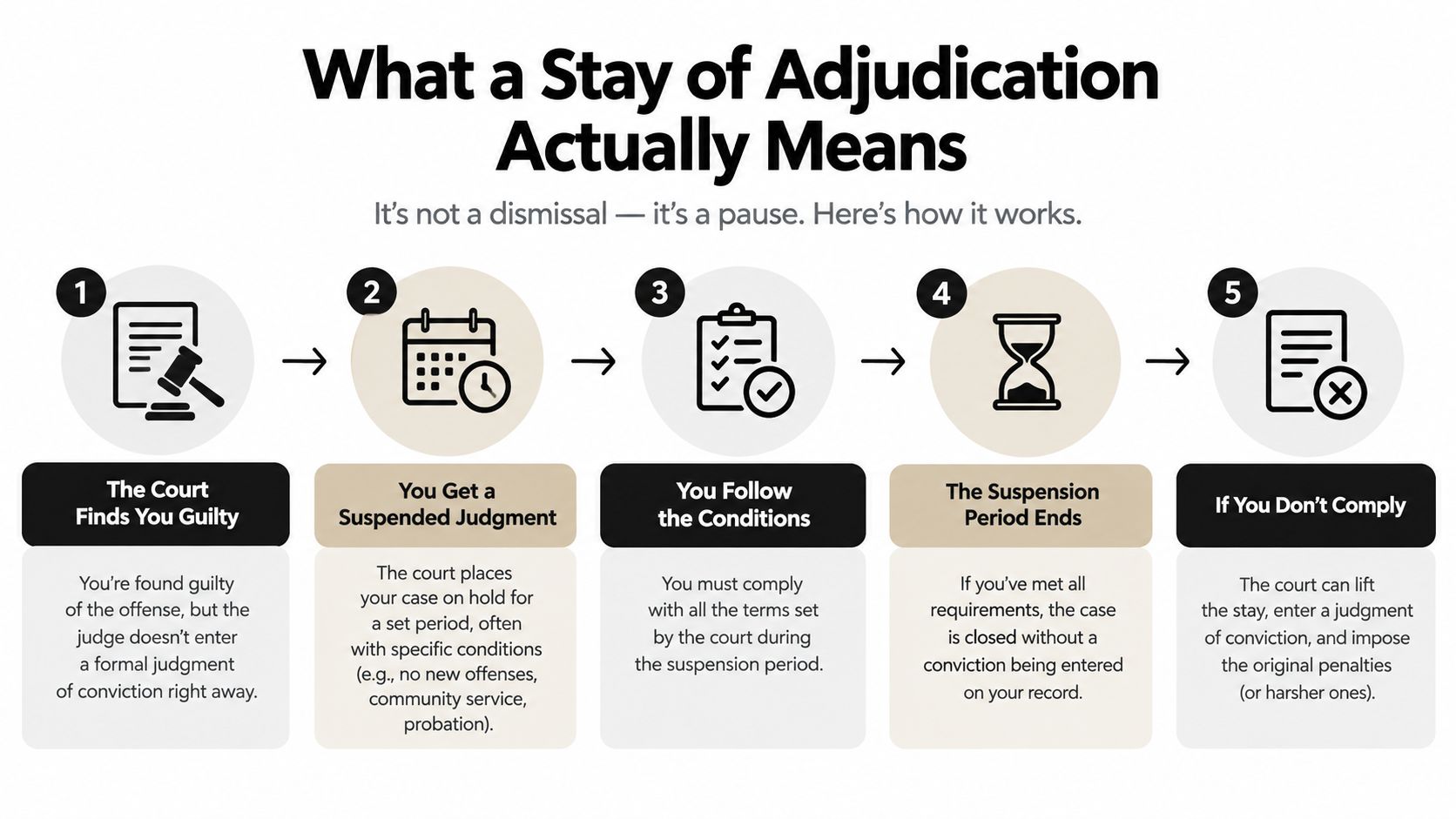
The sequence matters
A useful way to understand the disposition is to separate its stages:
- The case reaches a plea, verdict, or finding of guilt.
- The court withholds entry of the judgment of conviction.
- The defendant serves probation under specified conditions.
- Successful completion may prevent a conviction from being entered.
- A violation may allow the court to enter the conviction and sentence the defendant.
This isn't the same as being found innocent. It also isn't the same as an ordinary conviction followed by a suspended sentence. The court is withholding the formal judgment that would ordinarily create the conviction, while keeping the defendant under enforceable conditions.
Minnesota provides a concrete example of why the distinction matters. The state's sentencing framework generally doesn't count a prior felony stay of adjudication as a prior felony for criminal-history purposes because no judgment of guilt was entered before a later sentencing. Minnesota's statutory framework also includes Minnesota Statute § 152.18, which permits a first-time defendant convicted of a low-level felony drug-possession offense to receive deferred proceedings without an entered judgment of guilt. The specific statute, eligibility rules, and court practices must be checked in the case at hand.
A delayed grade, not a passing grade
Think of the court as recording a serious warning but delaying the final grade. You haven't received a conviction, but you haven't walked away from the case either. Probation conditions still control your conduct, and the court retains authority to respond if you fail them.
That is why a lawyer should review the written order, not rely on a shorthand description such as “dismissed” or “no conviction.” The order should identify the plea or finding, the conditions, the duration, the consequences of violation, and what happens after successful completion.
How It Differs From Dismissal and Other Stays
Legal vocabulary creates trouble because “stay” describes several different tools. The word doesn't tell you whether the court is delaying a conviction, pausing litigation, or stopping enforcement of an existing order.
| Tool | What It Does | What It Does Not Do | Typical Setting |
|---|---|---|---|
| Stay of adjudication | Withholds entry of a criminal judgment of conviction while the defendant completes conditions | It doesn't guarantee that the case is invisible, and it doesn't eliminate violation consequences | Criminal court |
| Dismissal | Ends the case without a conviction under the governing order or procedure | It doesn't necessarily erase arrest, charge, or court records | Criminal or civil proceedings |
| Stay of proceedings | Pauses a proceeding, sometimes under strict statutory or procedural standards | It doesn't automatically decide the merits or provide a favorable final result | Criminal, civil, or administrative litigation |
| Stay of removal | Prevents physical removal for the period covered by the order | It doesn't necessarily resolve the immigration case or grant lawful status | Immigration enforcement |
| Immigration adjudication pause | Temporarily withholds further action on an application or adjudication | It doesn't itself grant work authorization, relief, lawful status, or a favorable merits decision | Immigration agencies or courts |
The word “stay” needs a noun after it
A Canadian criminal example shows why a stay of proceedings can be an exceptional remedy rather than a scheduling convenience. Under the statutory mental-disorder framework, a court may order a stay only when clear information establishes that the accused remains unfit to stand trial and is unlikely ever to become fit, the accused doesn't pose a significant public-safety threat, and the stay serves the proper administration of justice. Once ordered, the existing disposition ceases to have effect.
That framework doesn't control a Minnesota criminal case or a U.S. immigration application. It does demonstrate that a stay can produce final legal consequences, not merely move a hearing to a later date. The Canadian statutory framework also illustrates why counsel must identify the exact authority supporting the requested relief.
An immigration pause has a different anatomy. The underlying application remains unresolved while the agency or court temporarily withholds further action. It may preserve the status quo, but related deadlines, enforcement mechanisms, or expiration dates may still require separate attention. A stay of adjudication in immigration practice should never be treated as interchangeable with a stay of removal.
Who Requests One and on What Grounds
In a criminal case, defense counsel commonly seeks a stay of adjudication through a motion, negotiated recommendation, or agreement with the prosecutor. Prosecutorial consent is generally required or practically important, although the governing law and the judge's authority vary by jurisdiction. The defendant usually has to accept meaningful conditions rather than receive a risk-free dismissal.
A judge may weigh the nature of the offense, the defendant's record, the evidence, the defendant's willingness to complete treatment or community service, and whether the proposed result is proportionate. The prosecutor may focus on public safety, the interests of the victim, deterrence, and whether the conditions adequately address the conduct. A persuasive request connects the facts to the legal authority instead of merely asking for leniency.
What counsel needs from you
Bring your lawyer accurate information about:
- Your complete history: Prior cases, probation, pending charges, and any unresolved violations may affect the request.
- The actual facts: The offense level, alleged harm, injuries, loss, weapons, controlled substances, and victim concerns can change the analysis.
- Your proposed plan: Treatment, counseling, testing, employment, education, restitution, or community support may help counsel propose workable conditions.
- Your downstream concerns: Immigration status, licensing, employment, travel, housing, and future sentencing exposure should be raised before the plea is accepted.
- The prosecutor's position: A recommendation, objection, or consent may materially shape the court's options.
The Canadian mental-disorder framework offers a useful comparison because it treats a stay as exceptional and sets specific statutory requirements. The Supreme Court of Canada has emphasized that a stay application may be summarily dismissed only when it is “manifestly frivolous,” meaning failure is inevitable or necessary. That screening rule doesn't govern U.S. courts, but it teaches a valuable lesson: courts need a legally grounded request, not a vague appeal for extra time.

For any stay request, counsel should identify the precise legal authority, the proceeding being paused or altered, the requested duration, the conditions, and the concrete harm that would result if adjudication continued. Those details are especially important in immigration matters, where an agency may lack authority to suspend statutory duties broadly or indefinitely without clear authorization.
The Hidden Cost on Your Record
Successful completion doesn't necessarily mean the case disappears. An arrest, charge, court filing, plea, or stayed disposition may remain in public records or appear in a background report even when the court never enters a conviction. Employers, professional licensing boards, landlords, government agencies, and immigration authorities may use different databases and apply different rules to the same history.
The practical question is therefore broader than, “Will I have a conviction?” Ask instead: Who can see the case, what will the record say, and what procedure could limit disclosure?
State records and federal treatment can diverge
A state court may treat a completed stay as a non-conviction disposition. Immigration authorities may apply an independent definition of conviction. Under USCIS guidance on conviction-related immigration analysis, a guilty plea combined with punishment, penalties, or restrictions can potentially qualify as a conviction for immigration purposes even when a state court withholds adjudication or later dismisses the case.
That creates a serious mismatch. The state record may look favorable because no conviction was entered, while the federal immigration analysis may still examine the plea and the conditions imposed. The risk can affect visa applications, adjustment of status, naturalization, removal proceedings, or admissibility, depending on the offense and the person's circumstances.
Controlled-substance offenses, domestic-violence allegations, fraud, and offenses involving moral turpitude can raise distinct immigration concerns. The lawyer must examine the exact statute, plea documents, sentence, probation terms, and later disposition. A state criminal lawyer may understand the local result but not the immigration consequences, and an immigration lawyer may need the complete criminal file before offering an opinion.
The safest assumption is not that a successful stay is harmless, but that its consequences must be analyzed separately for state records, immigration law, and licensing.
A person may also need to consider sealing or expungement. Some jurisdictions permit it after a favorable disposition, but eligibility, timing, and effect vary. Before applying for a job or license, obtain advice about what the application asks. “Have you been convicted?” is not the same question as “Have you pleaded guilty, been charged, or appeared in court?” If you're budgeting for advice, ask in advance what a legal consultation fee covers and whether record review is included.
Two Worked Examples You Can Picture
Start with a criminal example. Jordan is a first-time defendant facing a low-level felony drug-possession charge. Under a provision like Minnesota Statute § 152.18, a qualifying defendant may receive deferred proceedings without an entered judgment of guilt. The court imposes probation and conditions, and Jordan completes them successfully. The court may then leave Jordan without a conviction.
Jordan's codefendant takes a similar arrangement but violates probation. The court may revoke the stay, enter the conviction, and proceed to sentencing. The two cases began with similar allegations, but the probation result changed the legal outcome. The written orders and exact statute control, so neither person should assume that the other person's result guarantees their own.
Now consider Priya, a noncitizen whose immigration application is placed on hold by an agency or court while a related legal issue is resolved. The pause may preserve the position of the application while the decision-maker withholds further action. It doesn't automatically approve the application, grant lawful status, authorize employment, or stop every deadline connected to travel, enforcement, biometrics, expiration, or another filing.
The difference is easier to see when you focus on the object of the stay:
- In the criminal example, the court delays entry of a conviction and ties the outcome to probation.
- In the immigration example, the agency or court pauses adjudicative work while the underlying matter remains unresolved.
- In a stay of removal, the government may be prevented from carrying out physical removal even though the underlying immigration order or case remains a separate issue.
The same word therefore describes different legal anatomy. One stay can determine whether a criminal conviction enters after a plea. Another can merely freeze administrative action. Read the full phrase in the order, not just the word “stay.”
What to Ask Counsel and What to Do Next
Treat the decision as a three-record problem. Ask counsel to analyze the state criminal record, federal immigration treatment, and licensing or background disclosure separately, then compare the answers before you accept conditions or rely on the result.
Use this short checklist after disposition:
- Get the final court order. Confirm the plea or finding, conditions, duration, and violation procedure.
- Confirm the final outcome. Ask whether the court entered a dismissal, discharge, or another disposition after successful completion.
- Check reporting rules. Review the state and federal background-reporting rules that apply to your employer, landlord, license, or agency.
- Ask about sealing or expungement. Eligibility and timing depend on the jurisdiction and the exact case history.
- Answer applications accurately. Read whether the question asks about convictions, pleas, charges, arrests, or court involvement.
- Get immigration advice before acting. A state non-conviction result doesn't automatically control the federal immigration analysis.
Before the consultation, write down two questions: What exactly will appear in each record? and What happens if I violate a condition or apply for immigration or licensing benefits later? A focused list of questions to ask before hiring a lawyer can help you compare advice and identify missing issues. This article provides a framework, not a prediction of your outcome. Your lawyer needs the actual charging document, plea agreement, court order, probation terms, and immigration history.
HeyAtty helps you describe your situation, identify the likely practice area, compare vetted legal professionals, and review availability and pricing before booking. For a stay of adjudication, that guided starting point can help you find counsel who will address the criminal record, immigration consequences, and licensing questions together. Visit HeyAtty to begin.