
What Is a Retainer Fee for a Lawyer? a Plain-English Guide
Learn what is a retainer fee for a lawyer, how trust accounts protect your money, the main retainer models, and key contract terms to watch before signing.

In U.S. practice, a retainer fee for a lawyer has two legally distinct meanings: a true retainer buys the lawyer's availability and is generally earned on receipt, while an advance-fee retainer is client money held in trust until the lawyer performs work. For example, a $3,000 advance at $300 per hour funds 10 hours of work, not necessarily the entire case.
You've finished a consultation, and the lawyer has sent an agreement to sign. You understand why you need help, but the payment language leaves you wondering whether you're buying access, paying a deposit, or covering the whole job. Before you send the money, you need to know which promise the lawyer is making in return.
Table of Contents
- The Moment You First Hear the Word Retainer
- What a Retainer Fee Actually Means
- The Main Retainer Models Clients Encounter
- How a Retainer Gets Billed in Practice
- Refund Rules When Representation Ends Early
- Key Contract Terms to Watch Before Signing
- Common Misconceptions About Retainer Fees
- Smart Questions to Ask Before You Sign
The Moment You First Hear the Word Retainer
You're sitting with a fee agreement open on your laptop. The lawyer seemed clear during the meeting, but the document uses retainer without explaining what happens after you pay it.
It's reasonable to hesitate. An upfront payment can look identical on your bank statement while working very differently under the agreement. The practical question isn't how much you owe today, but what that payment purchases.
Read the promise behind the payment
Start by finding the sentence that describes the lawyer's obligation. Does the lawyer promise to reserve availability, perform work charged against a deposit, or complete a defined service for an agreed fee?
Those possibilities give you a useful reading framework:
- Availability: You're paying the lawyer to remain available under specified terms.
- Future work: You're funding legal services that the lawyer will charge against your balance.
- A defined service: You're agreeing to a price for particular work, subject to the stated scope.
These aren't interchangeable promises. A flat-fee arrangement also needs its own earning and refund terms, rather than being treated automatically as an availability payment.
Reading rule: Look for the obligation attached to the money, not just the word printed beside the amount.
Separate the consultation from the engagement, too. If you've already paid for the meeting, ask whether that payment is separate or credited toward representation; this guide to legal consultation fees can help you prepare that conversation.
Don't try to resolve unclear language by guessing what lawyers usually mean. Ask counsel to identify the arrangement in plain English and point to the clause that establishes it. You should be able to describe the payment without using the word retainer at all.
What a Retainer Fee Actually Means
The distinction between a true retainer and an advance-fee retainer starts with what the lawyer has earned. North Carolina's client-fund commentary distinguishes payment for exclusive availability from an advance payment that serves as a security deposit for future services.
Paying for availability
A true or classic retainer compensates the lawyer for reserving availability for a specified period or matter. It isn't payment for particular legal services. Because the lawyer generally earns that availability payment upon receipt, it generally belongs in the firm's operating account, where the firm keeps its own money.
Think of paying a restaurant specifically to hold a table for you. The promise you purchased is the reservation, not dinner. In the legal setting, you therefore need to ask whether actual legal work will carry a separate charge.
The analogy has limits: a lawyer's agreement remains subject to professional-conduct rules. But it helps explain why payment for availability and payment for future work shouldn't be confused.
Depositing money for future services
An advance-fee retainer works more like prepaying for meals that haven't been served. The lawyer receives your money, but receiving it doesn't itself mean the lawyer has earned it.
The money generally stays in a client trust account, separate from the firm's operating funds. As the lawyer performs work or incurs covered expenses, the corresponding amount becomes available for payment under the agreement and applicable rules.
| Contract language to examine | What to clarify |
|---|---|
| Payment reserves availability | What availability is promised, and is work charged separately? |
| Fees are charged against a deposit | What makes a charge earned, and how is it reported? |
| Payment covers specified services | What is included, and when is that fee earned? |
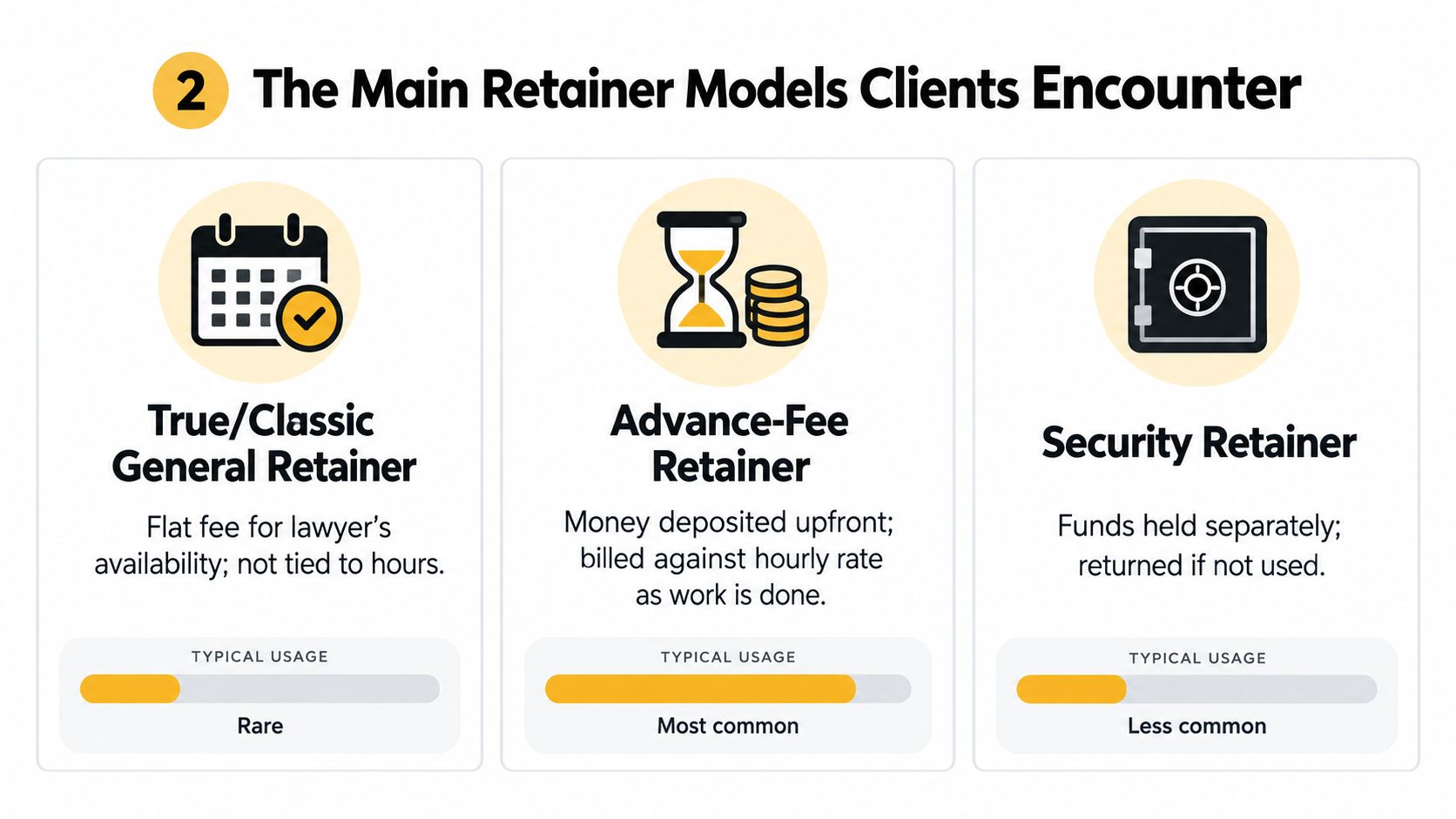
Don't treat “security retainer” as proof of a separate legal category. North Carolina's commentary uses the security-deposit concept to explain an advance payment. Whatever terminology appears in a chart or agreement, ask the lawyer to explain ownership, earning, and account treatment.
The Main Retainer Models Clients Encounter
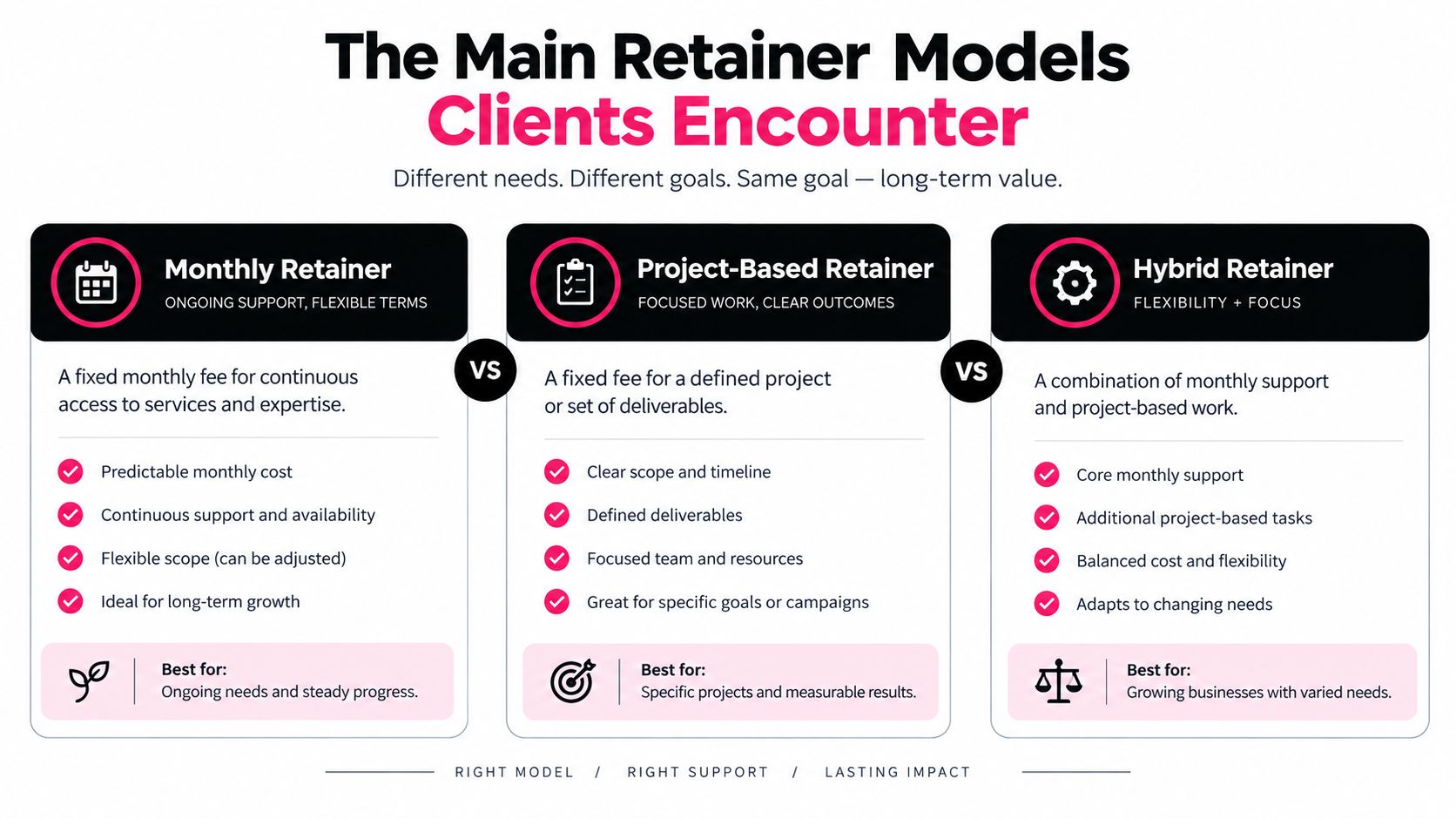
A business owner who wants counsel available for recurring questions needs a different payment conversation from someone hiring a lawyer to complete a specific document. Match the arrangement to the promise you need, rather than choosing by the label alone.
Match the structure to the assignment
For a hypothetical startup seeking reserved access to counsel, a true availability retainer might be relevant. The important drafting task is to define that access: what the lawyer is reserving, for what period, and whether substantive work costs extra.
For a hypothetical contested divorce, an advance deposit could fund work whose extent isn't yet clear. In that conversation, focus on the hourly billing method, the expected tasks, and how the lawyer will communicate changes in the anticipated workload.
A flat or special fee addresses another question: what will the lawyer charge for a defined assignment? For example, a business owner might seek an agreed price for drafting a particular contract. The scope should say whether revisions, negotiations, or related advice are included, rather than leaving “contract work” undefined.
| Structure | The client's main drafting concern |
|---|---|
| Availability arrangement | Define the access being reserved |
| Advance deposit | Explain how work reduces the balance |
| Flat-fee assignment | Identify the included deliverable and exclusions |
| Evergreen funding | Specify the balance that must be maintained |
A fixed price still needs earning rules
A prepaid flat fee isn't automatically earned just because the price is fixed. Several bar authorities treat prepaid flat fees as unearned until the contracted service is performed, while some jurisdictions permit an expressly disclosed earned-upon-receipt structure. North Carolina's discussion of fee ownership explains why classification and jurisdiction matter.
An evergreen retainer describes an ongoing funding arrangement with replenishment requirements. It doesn't, by itself, answer whether the lawyer charges hourly or provides a defined service. A small business with recurring questions should therefore clarify both the work being purchased and the funding obligation.
If your assignment concerns drafting or reviewing an agreement, use this guide to hiring a business contract lawyer to help describe the work before discussing the payment structure. A precise assignment makes the fee conversation easier to follow.
How a Retainer Gets Billed in Practice
Consider the hourly example from the opening. If the lawyer earns only 6 hours of work, $1,200 remains unearned before expenses from the initial advance; Michigan's ethics guidance on unearned fees provides the accompanying trust-account framework and explains that unearned fees cannot be withdrawn until earned and accounted for.
Follow the money through the invoice
First, the firm receives the advance and places the unearned funds in the appropriate trust account. Think of this as a labeled holding place, not the lawyer's spending money.
Next, the lawyer records work under the agreed billing method. The statement should let you connect the charge to the services performed, rather than presenting only an unexplained reduction in your balance.
Once the work is earned and accounted for, the firm transfers the corresponding payment into its operating account. The remaining unearned balance stays protected. Expenses can affect that balance too, so ask whether the invoice separates fees from costs.
A useful statement lets you trace the starting balance, the charges, and the money still held for you.
Replenishment is a separate obligation
An agreement may require additional funding before the balance runs out. In the illustrative replenishment model, a $5,000 deposit less $2,000 in billed work leaves $3,000, so a $4,000 minimum-balance threshold would trigger a request for additional funds.
The firm uses that threshold to reduce the risk of continuing work without funding. For you, the practical concern is predictability: when will the request arrive, how much will you need to contribute, and what happens if you can't replenish immediately?
- Check the trigger: Ask whether replenishment depends on a minimum balance, anticipated work, or both.
- Check the amount: The threshold doesn't necessarily tell you how much the next payment will be.
- Check notification: Ask how the lawyer will alert you before funding becomes a problem.
- Check the statement: Confirm how deposits, charges, transfers, and the remaining balance will appear.
Don't assume every invoice requires your approval before a trust withdrawal. Ask what withdrawal procedure and billing cadence apply under the agreement and local rules. The payment process should be explained clearly enough that you can follow it without reconstructing the firm's bookkeeping yourself.
Refund Rules When Representation Ends Early
Suppose you end the representation before the lawyer completes the matter. You don't need to begin by debating whether the entire retainer is refundable. Begin by asking which portion has been earned.
Under the ABA's explanation of advance fees and retainers, advance payments ordinarily remain attributable to the client until earned, and unearned funds generally must be returned when representation ends. The agreement's substance and jurisdiction-specific rules control, not its label.
Ask for a closing calculation
For an advance deposit, the practical starting point is the money held for you, less properly earned fees and applicable expenses. Ask for a final accounting that explains those deductions and identifies the remaining balance.
If the agreement uses a flat fee, ask which contracted services were completed and how the lawyer determined the earned portion. Don't assume elapsed time alone decides the refund; the service promised and applicable rules matter.
You can organize the closing conversation around these requests:
- Identify completed work: Ask the lawyer to connect charges to the services performed.
- Separate expenses: Request an explanation of costs deducted from your funds.
- State the remaining balance: Ask how much is still unearned.
- Explain the return process: Confirm the refund method and expected handling.
- Address disputed charges: Identify any entry you don't understand and request clarification.
Read “nonrefundable” with care
A payment merely labeled nonrefundable doesn't automatically eliminate refund obligations. A genuine availability payment presents a different earning question from a deposit for unfinished work, and lawyers remain subject to rules against excessive fees.
Firing the lawyer also doesn't automatically make every earlier charge refundable. Keep the questions separate: what work was properly earned, what money remains unearned, and what does the governing agreement require? That approach gives you a concrete accounting discussion instead of an argument about a single word.
Key Contract Terms to Watch Before Signing
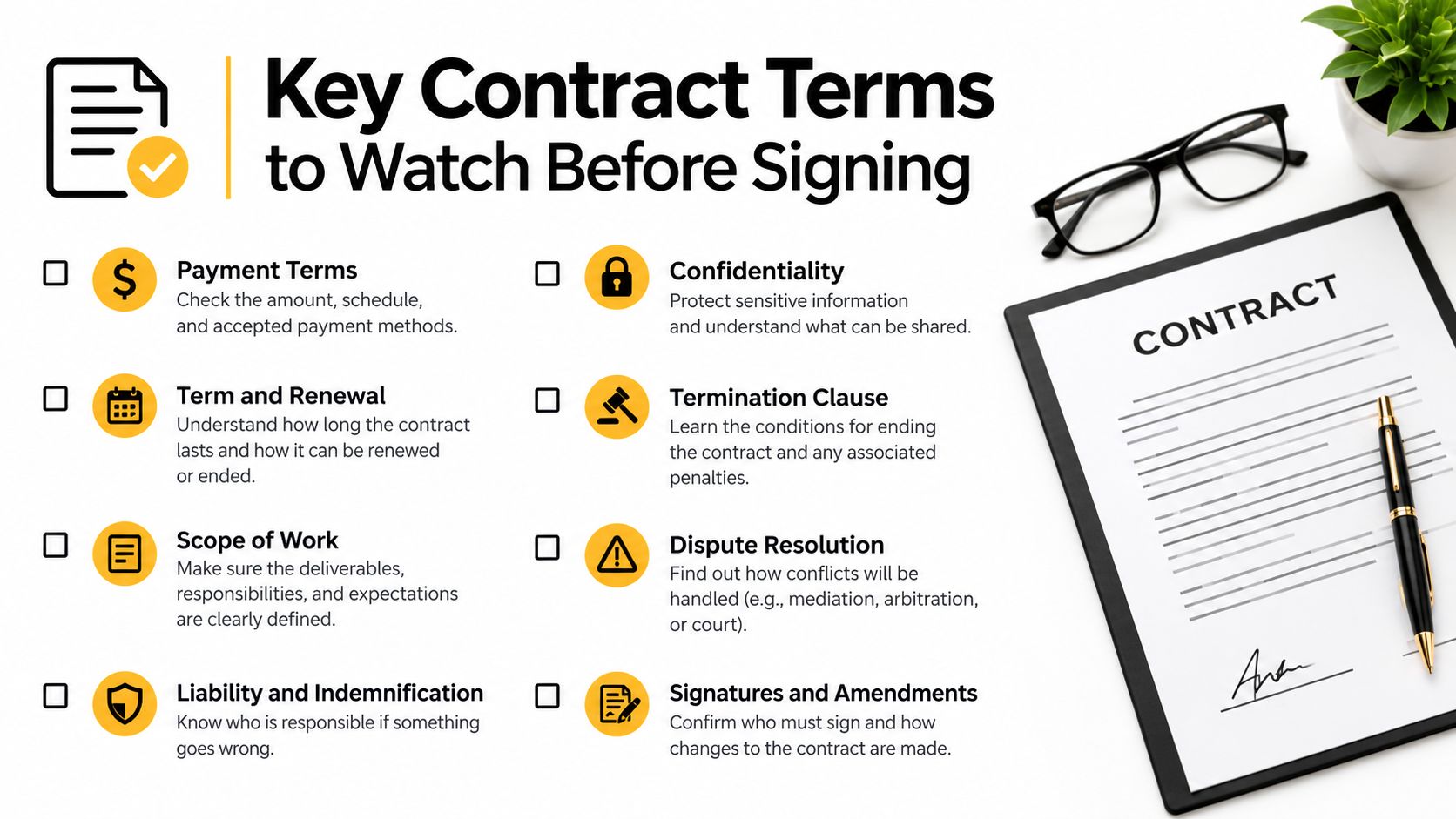
Return to the agreement and read it as though the matter ended sooner than expected. Could you work out what you'd paid for, what the lawyer had earned, and what balance remained?
If the answer is no, ask for clarification before signing. You don't need complex legal vocabulary; you need terms that let you trace the payment from receipt through final accounting.
Decode each clause into a question
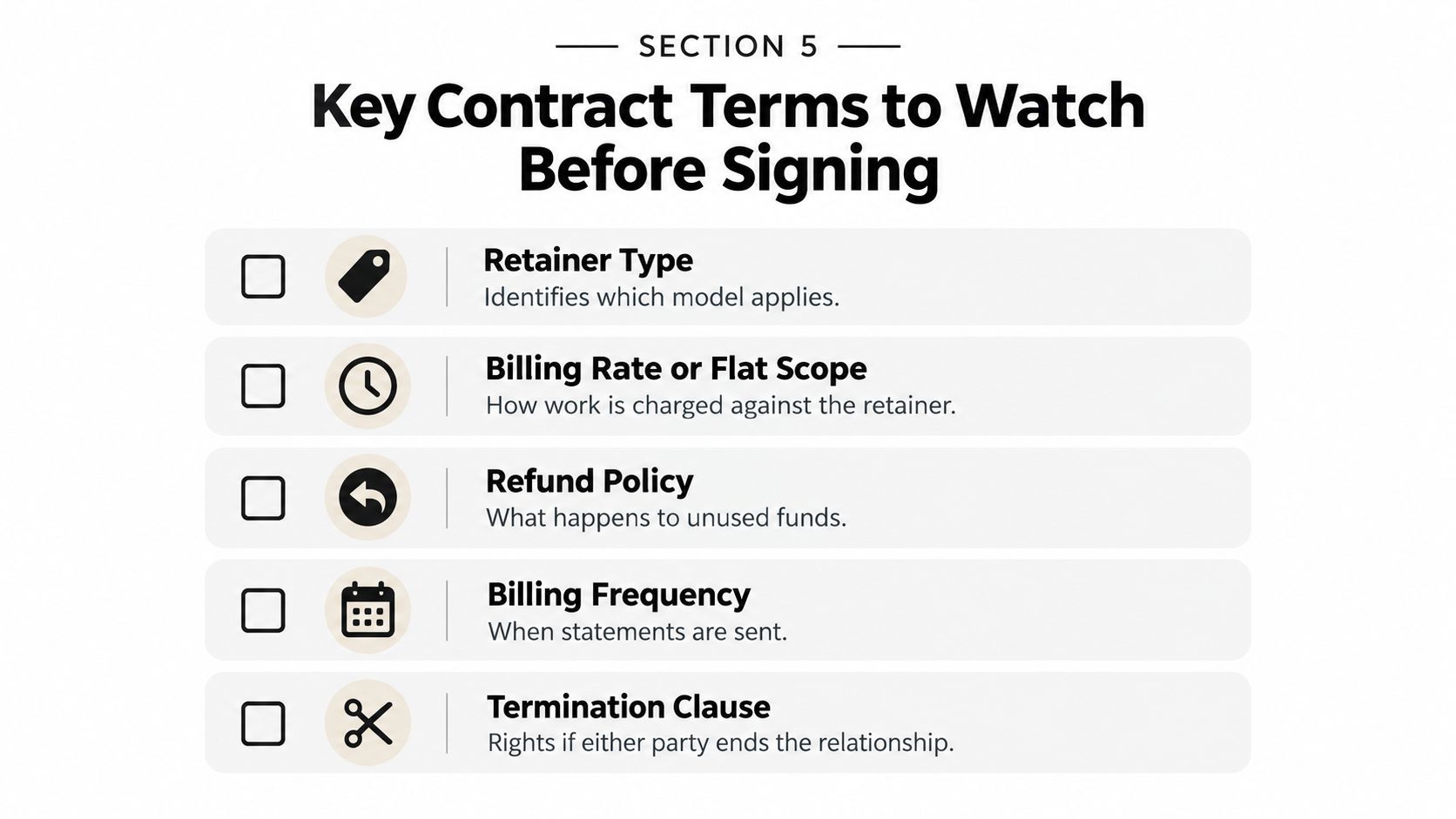
Use this checklist beside the engagement letter:
- Retainer type: What exactly does this payment buy? Ask the lawyer to distinguish reserved availability, an advance against work, and a fixed-price assignment.
- Billing rate or flat scope: How will the lawyer calculate charges? For hourly work, confirm rates and billing increments; for a flat fee, identify the deliverable and exclusions.
- Trust-account treatment: Where will the payment go, and what event permits the lawyer to treat it as earned?
- Replenishment: What balance must you maintain, how will you be notified, and what additional payment will be requested?
- Costs and expenses: Which expenses are separate from legal fees, and will they reduce the advance?
- Withdrawal cadence: When will the firm issue statements and transfer earned payments?
- Refund method: How will the firm calculate and return unearned funds?
- Termination rights: What does the agreement say about ending representation and delivering a final accounting?
Test the answer against an early ending
In a hypothetical early settlement, you should be able to apply the clauses to the work completed. An hourly agreement should support tracing the billed work; a flat-fee agreement should identify what the lawyer promised to deliver.
Ask counsel to explain what portion is earned today, what portion funds future work, and what you would receive back if the matter ended tomorrow.
A profile's consultation price and availability can help you choose whom to contact. They don't replace counsel's explanation of trust handling, earning rules, or refund rights.
Save the agreement and ask that material clarifications appear in writing. If the lawyer's spoken explanation differs from the document, request that the language be reconciled before you pay.
Common Misconceptions About Retainer Fees
The retainer covers the entire case. An initial deposit doesn't establish a final price. Expected work, complexity, urgency, and the lawyer's rate affect funding needs, so ask separately about the anticipated overall cost and what could change it.
Nonrefundable means I have no rights. That conclusion skips the earning analysis. The ABA's fee-related ethics checklist reinforces the distinction between payment types and the importance of refund obligations rather than relying on labels alone.
Don't use deposit size as a quality score
A larger deposit means better representation. That isn't a useful way to judge the arrangement. Treat the amount as a funding proposal to understand, not proof of skill, attention, or suitability.
Ask the lawyer to explain the expected work behind the request. Then assess whether the agreement makes the financial obligations understandable.
| Assumption | A more useful question |
|---|---|
| Paying upfront prevents further bills | What additional funding could be required? |
| Every dollar paid is immediately the lawyer's | What event makes each portion earned? |
| A high deposit proves value | How does the payment relate to the planned work? |
Look for explanations, not reassuring labels
A protective advance deposit and an unclear demand for money can look similar until you examine the terms. Clarity about earning, billing, replenishment, and refunds is more useful than a confident assurance that the arrangement is standard.
Don't accuse the lawyer of overcharging merely because the amount is substantial. Ask for the reasoning, review the scope, and make sure you understand your obligations before deciding.
Smart Questions to Ask Before You Sign
When you ask, “What is a retainer fee for a lawyer?” the most useful answer identifies how your agreement works. Bring the document to the consultation and ask counsel to show you where each financial promise appears.
You can prepare alongside these questions to ask before hiring a lawyer. Keep the discussion focused on both professional fit and the practical payment arrangement.
Bring these questions to the conversation
- Which arrangement does this create? Ask the lawyer to name what you're purchasing without relying on the word retainer.
- Where will the funds sit until earned? Request an explanation of the account treatment and any portion claimed as earned immediately.
- How will replenishment work? Confirm the trigger, requested amount, notice, and procedure if you can't add funds as expected.
- What happens if the matter ends early? Ask how the lawyer would determine the earned portion and return the remainder.
- What written accounting will I receive? Clarify when statements arrive and how they show work, expenses, transfers, and the remaining balance.
Leave with an agreement you can explain
After the conversation, try describing the arrangement to someone who hasn't read it. You should be able to explain what the lawyer will do, how charges arise, when you might need to pay more, and how unused funds will be handled.
If you still can't answer those questions, request clarification rather than signing to avoid an awkward conversation. Asking about money doesn't diminish the legal issue you brought to the lawyer; it helps establish workable expectations.
You don't need to become a trust-account expert. You need a written agreement that makes the lawyer's promise and your payment obligations understandable.
Visit HeyAtty to compare vetted legal professionals, consultation pricing, and availability before booking. Bring your fee agreement and these questions to the consultation so you can confirm what the proposed retainer buys, how it will be billed, and what happens to unearned funds.