
Work Authorization Renewal: A Practical Guide
Learn how work authorization renewal works, when to file, what documents you need, and how to avoid gaps in your EAD or permit status.
You open your calendar and see that your employment authorization document expires soon. Your employer's HR team has started asking whether you'll have proof that you can keep working, but your renewal application isn't ready. The worry is practical: a delay could affect your job, your paycheck, and your family's budget.
Work authorization renewal is manageable when you treat it as a planning process instead of a last-minute form. The right category, filing window, supporting documents, and case-monitoring routine all matter. The rules also differ depending on whether your permission comes from an Employment Authorization Document, or EAD, or from an underlying immigration status.
Table of Contents
- What Work Authorization Renewal Really Means
- Who Needs to Renew and Which Categories Qualify
- When to File and How Timing Protects You
- Documents, Forms, and the Reality of Current Backlogs
- Two Renewal Stories and What They Teach You
- How to Check Your Renewal Status Step by Step
- When a Lawyer Is Worth the Conversation
- Your Work Authorization Renewal Checklist
What Work Authorization Renewal Really Means
Maria is a Temporary Protected Status recipient in Miami. Her EAD expires in 75 days, and her employer has begun asking questions about whether she'll be able to continue working. She knows she needs to renew, but she isn't sure whether filing an application is enough, whether her employer can accept an expired card, or which documents belong in the packet.
In plain language, work authorization renewal is the formal process of extending or reissuing proof that a noncitizen may work in the United States for a defined period. For many people, that proof is a physical EAD. For others, permission to work comes from an underlying immigration status or visa category, so there may be no separate EAD to renew.
An EAD renewal isn't the same as renewing a visa. It also isn't the same as adjusting status. A visa generally concerns admission to the United States, while adjustment of status concerns changing immigration status from inside the country. The EAD answers a narrower question: Can this person work, and what document proves it?
The four questions every applicant should answer
Before preparing Form I-765, identify:
- Who must file: Does your category require a new EAD application, or does your underlying status authorize employment?
- When to file: What is your card's expiration date, and does your category qualify for an automatic extension under the current rules?
- What to submit: Which identity documents, prior EAD evidence, status records, photographs, and category-specific proof belong in the packet?
- How to track the case: Where will you find the receipt notice, case updates, requests for evidence, and approval information?
Maria's concern is not unusual. If her authorization expires and no valid extension applies, her employer may need to pause her employment until she can show current authorization. That can interrupt both work and income, which is why understanding the renewal process comes before filling out the form.
Who Needs to Renew and Which Categories Qualify
The first question isn't “How quickly can I mail Form I-765?” It's “What gives me permission to work?”
Think of an EAD like a driver's license. The license proves that you may drive, but it doesn't create the underlying right to be in the country. Similarly, an EAD proves employment authorization for a particular category and validity period. When it approaches expiration, the cardholder generally needs to renew it if the underlying basis still supports employment authorization.
People who commonly rely on an EAD include asylum applicants, refugees, TPS holders, DACA recipients, adjustment-of-status applicants, and certain nonimmigrant spouses, including eligible H-4 and L-2 dependents. The exact requirements depend on the person's category, current status, and whether a related immigration filing has changed the basis for the card.
Read the eligibility code before gathering documents
Form I-765 uses eligibility codes to connect the applicant to a legal basis for employment authorization. Common examples include:
- (c)(8): Certain asylum applicants.
- (c)(9): Certain applicants with a pending adjustment-of-status application.
- (c)(19): Certain applicants connected to TPS.
- (a)(12): Certain applicants in a protected or humanitarian category identified by the form instructions.
The code is more than a box to check. It determines which evidence USCIS expects and whether a particular automatic-extension rule may apply. A pending petition, a changed status, or a new underlying filing can affect which code is correct.
| Category | Who It Covers | Typical Validity |
|---|---|---|
| (c)(8) | Certain asylum applicants | Varies by category and USCIS decision |
| (c)(9) | Certain adjustment-of-status applicants | Varies by category and card issuance |
| (c)(19) | Certain TPS-related applicants | Varies by category and applicable notice |
| (a)(12) | Certain applicants in listed protected categories | Varies by category and eligibility |
A person whose employment is incident to status may not need an EAD at all. That's different from a person whose job authorization depends on an EAD card. If you're unsure whether your employment permission is card-based or status-based, a review of the underlying status and the employer's Form I-9 records can prevent a serious filing mistake. A resource on employment visa legal guidance may help you identify the right type of professional assistance.
Treat the eligibility code as your first safety check. Filing under the wrong category can lead to requests for evidence, delays, or denial, even when you otherwise qualify for employment authorization.
When to File and How Timing Protects You
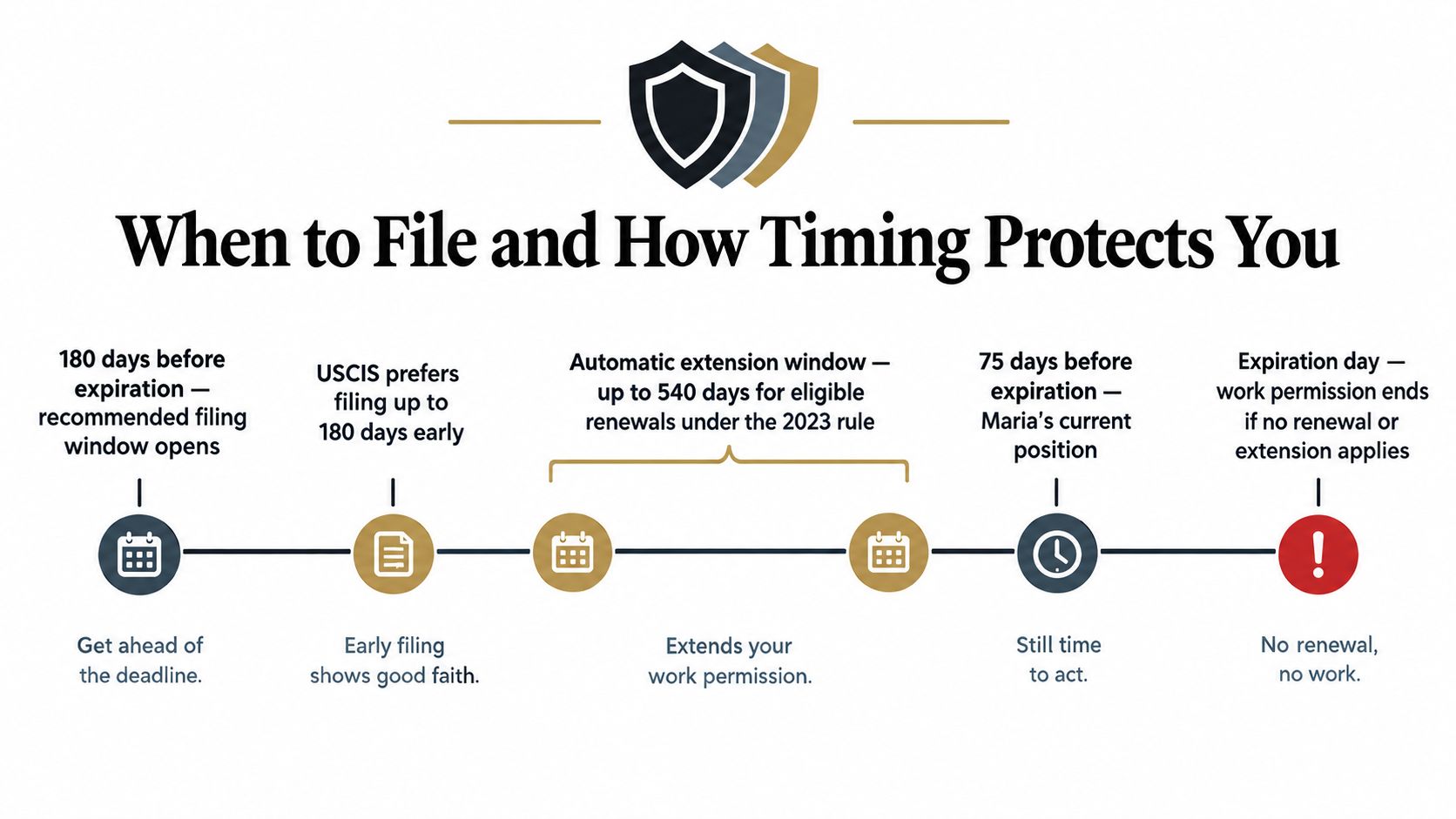
A renewal calendar should have more than one date. The 180-day planning horizon gives you room to collect records, correct mistakes, and respond to an unexpected issue. USCIS recommends filing Form I-765 within 6 months of expiration and specifically recommends filing at least 90 days before the EAD expires. See the current USCIS Form I-765 filing guidance for the agency's instructions and updates.
The 90-day point is the practical execution deadline. USCIS explains that an approved EAD is often produced within about 2 weeks, but the renewal adjudication itself may take much longer and can be unpredictable. Filing early increases the chance that the renewal is pending before the current card expires, which is important if your category qualifies for an automatic extension.
The calendar works like a runway
Think of your EAD expiration date as the end of a runway. The 180-day mark is when you should begin preparing and planning to file. The 90-day mark is when the application should generally already be on its way. The expiration date is not a target filing date. It's the point at which you need valid authorization or category-specific proof that an extension applies.
Under current U.S. rules, certain applicants who timely file an eligible renewal may receive an automatic extension of employment authorization and the EAD for up to 540 days. The extension begins on the card's expiration date and ends earlier if USCIS adjudicates the renewal or the 540-day period runs out. The USCIS employer handbook on automatic EAD extensions explains the employer verification requirements.
Practical rule: A receipt notice alone doesn't answer whether you can keep working. Your employer must confirm timely filing, category eligibility, and the documentation required for that category.
The extension isn't universal. The prior card generally must remain eligible under the applicable rule, the renewal must have been filed on time, and the category-specific documentation must match. Policy changes have also affected validity periods and automatic extensions in several categories, so applicants should verify the rule that applies to the filing date and eligibility code rather than relying on an old checklist.
Travel, a job change, or a change in immigration category can complicate the analysis. Build a calendar that records the expiration date, the 180-day preparation point, the 90-day filing point, the filing date, and every USCIS notice.
Documents, Forms, and the Reality of Current Backlogs
A complete Form I-765 packet starts with the eligibility category, not with the photograph. Use the current USCIS form and instructions, then assemble evidence that connects your identity to the status or filing that supports your work authorization.
A practical packet may include:
- Current Form I-765: Confirm the form edition, filing method, signature, and fee requirements.
- Identity evidence: Gather the identity and admission documents required for your category.
- Prior EAD evidence: Keep a clear copy of the front and back of the current or prior card when available.
- Underlying-status evidence: Include the receipt, approval, notice, or other document that proves the basis for the renewal.
- Photographs: Follow the current photograph requirements and keep copies of what you submit.
- Filing record: Save the completed form, supporting evidence, delivery confirmation, and payment record.
Category-specific evidence matters
A c(9) applicant may need evidence of the pending Form I-485, such as an I-485 receipt notice. An asylum-based applicant may need records that confirm the relevant asylum filing and procedural history. A STEM OPT applicant may need an updated Form I-983 and related school or employment records. These examples show why a generic document list can fail, even when the applicant has used Form I-765 before.
Name changes create another avoidable problem. If your identity documents and immigration records use different names, prepare the appropriate evidence and review the instructions carefully. Guidance on how to legally change your name after marriage can be useful when a name change affects your supporting records.
Preparation doesn't control the queue
USCIS data cited in 2025 showed 165,893 EAD renewal applications pending for 180 days or more as of June 30, 2025. The same congressional material cites analyses reporting 1,810,651 total I-765 applications pending around that period, with nearly 45% waiting over 180 days. Those figures appear in the Senate material concerning EAD processing.
A complete packet can prevent form-driven delay, but it can't guarantee fast adjudication. Volume-driven backlogs, transfers between adjudication centers, requests for evidence, and category-specific rules can all affect the timeline. Premium processing also isn't a universal solution for every I-765 category, so check whether it applies before building a plan around it.
Two Renewal Stories and What They Teach You
The following are illustrative scenarios, not reported case studies. They show how the same form can produce very different outcomes when the filing calendar and evidence differ.
The first applicant is a c(9) adjustment applicant who starts at the 180-day planning point. She checks the eligibility code, includes evidence of the pending adjustment filing, reviews the form for consistency, and keeps the delivery and receipt records. Her renewal is timely, her employer receives the documentation needed for verification, and she avoids an interruption while the application is pending because the applicable automatic-extension rules support her situation.
Her lesson is simple: buffer time catches errors. Starting early gives an applicant time to notice a missing receipt, correct a rejected payment, or obtain a clearer copy of a status document before the existing EAD expires.
The second applicant is an asylum-based EAD holder who waits too long and sends the packet after a mailing problem. USCIS later requests additional evidence connected to the asylum filing, and the applicant must stop and reconstruct the record before responding. Even if USCIS can reuse previously collected biometrics, that administrative convenience doesn't cure a late filing or an eligibility problem.
A strong response starts before the request arrives. Keep the underlying filing, notices, and supporting calculations organized while preparing the renewal.
The second lesson is not that every RFE causes a work gap. It's that an RFE can expose weaknesses that were already present in the packet. Review the underlying evidence before filing, confirm that the category still fits, and prepare a response plan for the most likely questions.
How to Check Your Renewal Status Step by Step
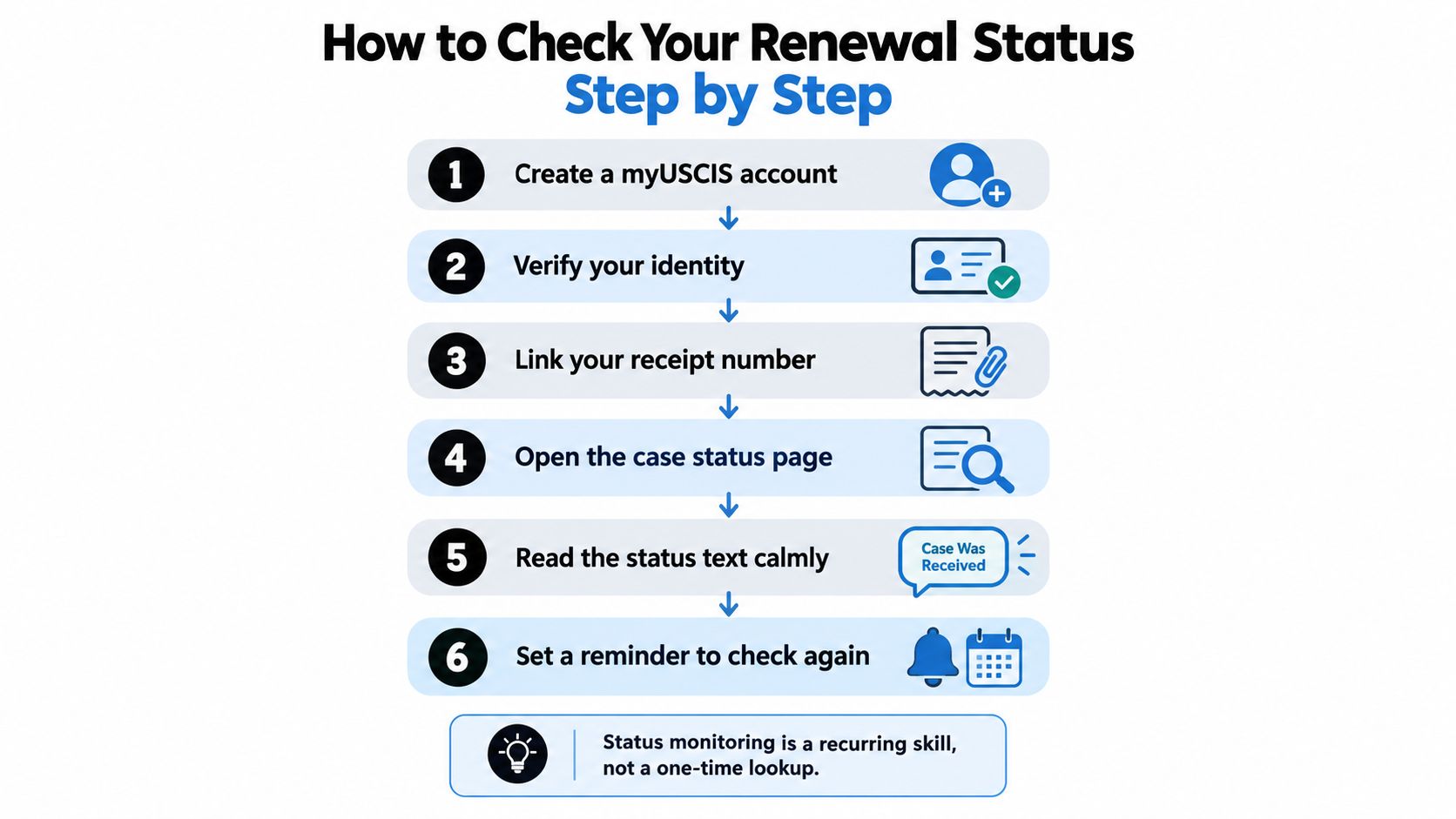
Case monitoring is a recurring task, not a single visit to a website. The receipt notice is your reference point, and the receipt number is the key that connects your paper filing to the digital case record.
Build a reliable monitoring routine
- Create a myUSCIS account. Use an email address you check regularly and protect the account credentials.
- Verify your identity. Complete the account prompts so USCIS can connect the account to you.
- Link the receipt number. Enter the number exactly as it appears on the USCIS notice.
- Open the case status page. Confirm that the case number and form type match your renewal.
- Read the wording carefully. “Case Was Received” generally confirms that USCIS recorded the filing. It doesn't mean the application has been approved.
- Set a reminder. Check at a regular interval and keep copies of status changes and notices.
A biometrics-reuse notice may mean USCIS can use existing information, but it isn't an approval. A transfer notice means the case moved within USCIS and may not indicate a problem. An RFE requires action by the deadline in the notice, and an approval notice should be reviewed for the validity period and delivery details.
Know which signals require follow-up
A missing fee receipt after mailing deserves prompt investigation. A case that remains in an early status beyond the posted processing time may justify a USCIS inquiry, but compare the case to the correct form, category, and processing location first. Keep a log of calls, online inquiries, notices, and responses.
If your case is relying on a category-specific automatic extension, keep the receipt notice and the expired EAD together with the other employment-verification records. Check your status routinely while the extension is being used, and ask for legal help if the category, employer, travel plans, or underlying case changes.
When a Lawyer Is Worth the Conversation
Many applicants assume legal advice is reserved for people with complicated histories. That assumption can be costly. A renewal may look routine while a category change, prior denial, status gap, criminal issue, or conflicting document changes the analysis.
A lawyer's review can be useful when:
- The category is uncertain: A pending adjustment filing, asylum case, TPS record, or dependent status may not fit the code you used previously.
- The prior application had trouble: A denial, rejection, RFE, missed deadline, or unexplained discrepancy deserves review before you repeat the filing.
- Your status has changed: A new petition, employer change, marriage, divorce, travel event, or overlapping filing may affect the basis for work authorization.
- Your record raises risk: Criminal history, prior unauthorized employment, removal proceedings, or a prior immigration violation can make a renewal more than a clerical task.
Match the level of help to the problem
A straightforward renewal may be appropriate for self-filing when the category is unchanged, the applicant has no prior denial or RFE, the records are consistent, and the filing instructions are clear. A nonprofit legal-aid organization or a credentialed evaluation service may be a reasonable starting point for someone who needs document review but can't afford full representation.
Legal review becomes more valuable when the cost of a mistake includes a work interruption or a weak response to USCIS. Don't choose counsel only by asking whether the lawyer handles immigration. Ask whether they regularly handle your category, whether they review the underlying case, what the consultation includes, and how they explain the automatic-extension rule that applies to your filing.
Use a focused directory or intake service to compare relevant experience, availability, and consultation terms. For example, choosing an immigration lawyer can help you prepare questions before contacting counsel.
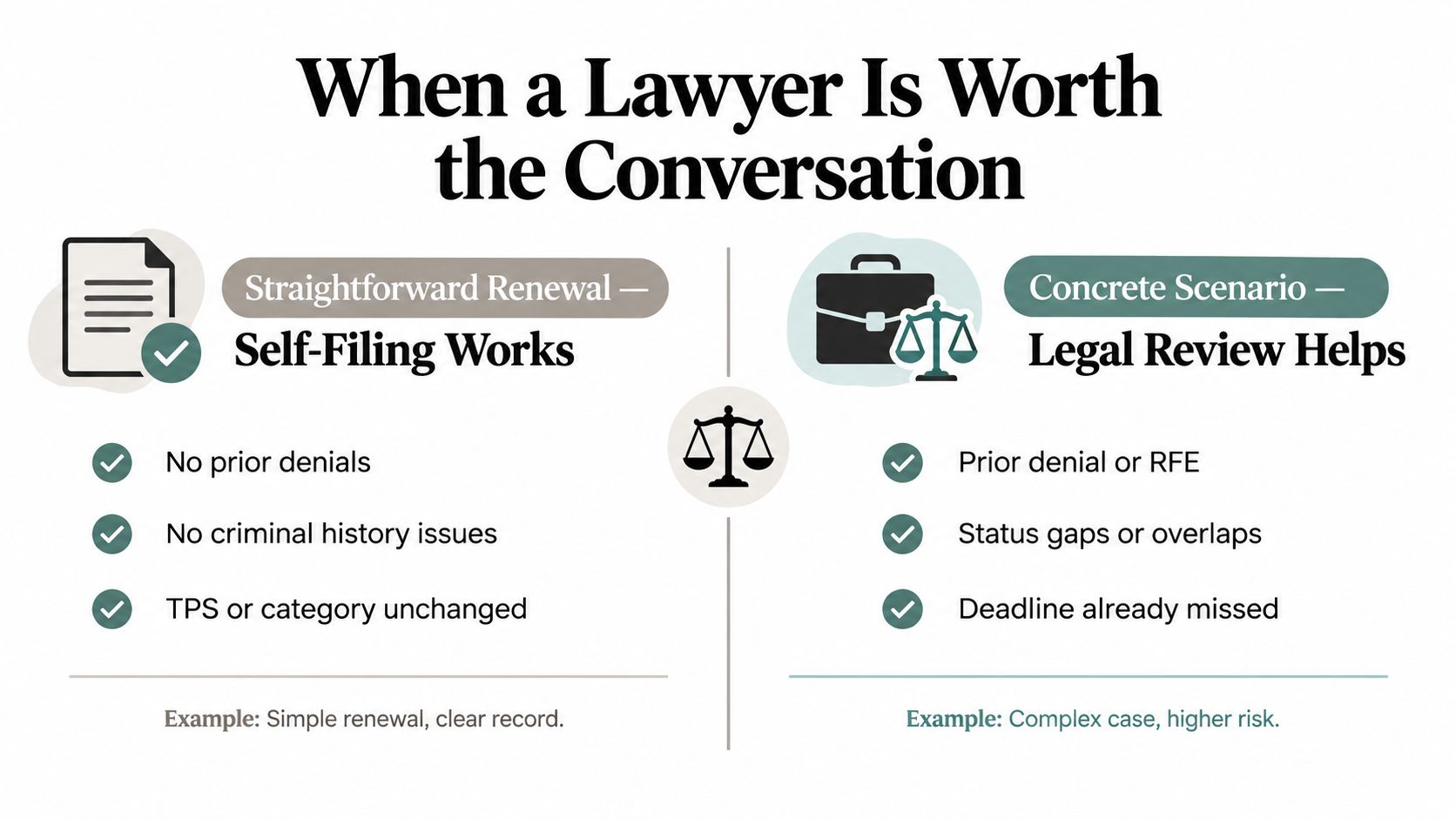
Think of legal review as preventative maintenance. You're not admitting that your case is weak. You're checking that the category, evidence, timeline, and employment-verification plan agree before the expiration date creates pressure.
Your Work Authorization Renewal Checklist
A useful checklist turns the expiration date into a series of decisions. Start with the date printed on your EAD, then work backward.
Put the dates on your calendar
- 365 days out: Confirm whether you rely on an EAD or status-based work authorization. Save a scan of the current card and identify the underlying category.
- 180 days out: Open the renewal file. Review the current Form I-765 instructions, confirm the eligibility code, and begin collecting status evidence.
- 120 days out: Check every name, date, address, receipt number, and status document for consistency. Resolve missing records before filing.
- 90 days out: File if you haven't already. USCIS specifically recommends filing at least 90 days before expiration, and earlier filing can preserve options for an eligible automatic extension.
- 60 days out: Confirm delivery, payment processing, and the receipt notice. Upload or organize the notice for your employer records.
- 30 days out: Review the category-specific work-verification rules. Tell HR which documents are available and identify what you'll do if the case remains pending.
The automatic-extension rules are not a substitute for this calendar. They apply only to eligible, timely filed renewals and depend on the category and documentation. Current policy changes also mean that older advice may not apply to a new filing, so verify the rule rather than assuming that every expired EAD receives the same treatment.
Keep one renewal folder
Use a physical folder or secure digital folder containing:
- A copy of the current and prior EAD, front and back.
- The completed and signed Form I-765.
- Identity and immigration documents.
- Category-specific evidence, such as a receipt notice or underlying-status record.
- Photographs and payment confirmation.
- Delivery proof, USCIS notices, the receipt number, and case-status history.
- A written log of calls, inquiries, RFEs, and responses.
Before filing, pause if you answer “yes” to any of these questions:
- Has USCIS previously denied or rejected your EAD application?
- Has your underlying status, petition, employer, or family situation changed?
- Do your identity documents use different names?
- Have you missed the recommended filing window?
- Are you unsure whether your category qualifies for an automatic extension?
- Do you have criminal, removal, or prior unauthorized-employment concerns?
If the renewal is still pending after the card's printed expiration date, don't just keep working because a receipt exists. Confirm whether your category, filing date, prior EAD, and documents satisfy the applicable extension rule. Give your employer the correct records, respond to every USCIS notice, and seek legal review promptly if the facts don't fit neatly.
HeyAtty lets you compare vetted legal professionals, review profiles with availability and pricing, and book an immigration consultation when your work authorization renewal raises category or timing questions. Visit HeyAtty to describe your situation and find an appropriate starting point before an expiration deadline becomes an employment problem.